
The role of technology in procurement has not been as critical as it is in 2026. A 2025 Deloitte Global CPO Survey reveals that today 78% of procurement leaders have made digital transformation their top strategic priority compared to only 54% three years ago.
Just a short time ago, the procurement teams used to work on a paper-based bidding system, manual purchase orders and a disjointed email trail in order to have control over supply chains worth millions of dollars. That model is now quickly being phased out. The old manual ecosystem has been supplanted by cloud platforms. AI-based analytics and intelligent supplier portals that provide speed, accuracy and auditability that is unavailable on a spreadsheet.
Within this article, you will find out specifically how the latest procurement technology is implemented in a construction environment. Which technology yields the best ROI, how to address the most common obstacles to implementation and what the future of technology looks like after 2026. The insights provided here will prove to be an upper hand whether you handle one commercial project or a portfolio of enterprise-level projects.
The Evolution from Manual to Digital Supply Chains
Understanding the role of information technology in procurement requires first appreciating how crippling the manual era truly was. The three fundamental bottlenecks of traditional construction procurement included: delaying the selection of vendors by weeks due to paper-based bidding, manual purchase orders that were subject to transcription mistakes and the lack of communication between site managers, procurement officers and suppliers..
One lost PO or a backlogged approval might result in a site going down, costing thousands of dollars a day. A 2024 McKinsey report on infrastructure procurement found that companies that continued to use manual processes in high proportions still had an average of 22% cost overruns on large construction projects. A figure that dropped to less than 9% with the adoption of digital.
The digital backbone that is offered by modern connected ecosystems substitutes this weakness with a single entity. Enterprise Resource Planning systems consolidate procurement information between departments and cloud-based systems provide all stakeholders. Both site supervisors and CFOs have real-time spend, inventory and vendor performance. IT infrastructure has now ensured data flow within supply chains as end-to-end encrypted, role-based access control and compliance audit trails, significantly decreasing the chances of fraud and data breaches.
This is no cosmetic move. It involves a change in the business structure, specifically in the way construction businesses procure materials, their relationships with suppliers, and the control of cash flows. It is a change that is essential for survival and growth in the modern market.
Key Technological Drivers in Modern Sourcing
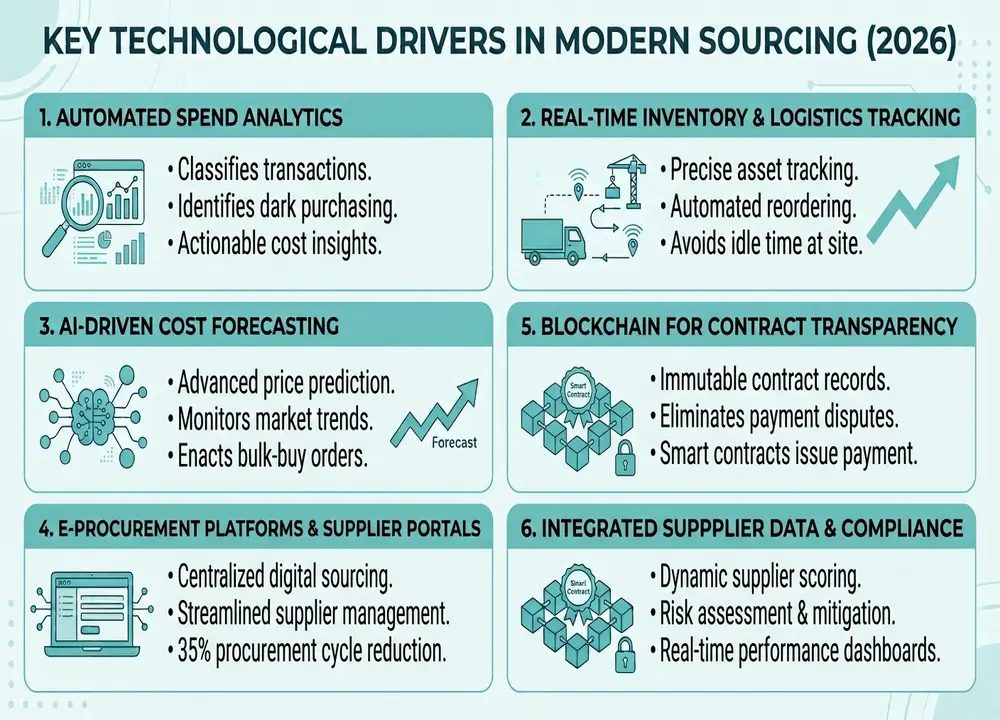
The five categories of technology that will change the way construction companies undertake sourcing, manage spending and supplier relations in 2026 are listed below.
Automated Spend Analytics
Visibility is the first step towards automation in procurement. Spend analytics software automatically classifies all purchase transactions, including by vendor, category, project, and cost center and it is simple to determine dark purchasing (unapproved or off-contract buying). Tools such as SAP Spend Management can identify abnormalities in seconds that will provide procurement managers with actionable intelligence that would otherwise have taken weeks to put together manually.
This is a direct conversion to cost savings in the case of construction businesses. According to a 2025 Hackett Group benchmark, organizations with automated spend analytics saved maverick spending at an average rate of 19% or hundreds of thousands of recoverable annual costs on mid-size projects.
Real-Time Inventory & Logistics Tracking
One of the most prevalent causes of construction project overruns is material delays. The IoT sensors and real-time GPS tracking have now enabled procurement teams to identify the precise position, condition and estimated date of arrival of each shipment. In case of a flagged delayed delivery, the system would automatically initiate a second supplier order. No idle time at the site without human operator intervention.
Supply chain transparency is no longer a luxury feature and it is a necessity in operations. A 2024 PwC Construction Industry Report reported that companies employing real-time inventory monitoring had 31% fewer material-related project delays than those utilizing manual check-ins.
AI-Driven Cost Forecasting
One of the strongest uses of artificial intelligence in construction sourcing is predictive analytics in procurement. Machine learning algorithms track historic pricing values, commodity market dynamics and the demand dynamics by season to forecast when the cost of materials will spike. Thus allowing procurement staff to purchase in advance of an inflation cycle.
To use the example, when steel prices are expected to increase by 14% in the next two quarters, an AI-based procurement system can automatically create a bulk-buy order. These orders with estimated savings values, supplier information and storage cost estimates, all before a human opens a spreadsheet. This is a competitive edge in 2026, as this level of data-driven procurement decision-making is a hallmark.
E-Procurement Platforms & Supplier Portals
E-procurement platforms like SAP Ariba, Coupa and Jaggaer have substituted decentralized procurement processes that were mainly executed through emails with centralized digital processes that can be audited. Through self-service portals, suppliers are able to place bids, manage catalogs and monitor payment status. According to the Gartner 2025 Procurement Technology Report can save the administrative workload on internal procurement teams by up to 40%.
Cloud-based procurement systems are a source of truth in construction companies that are dealing with dozens of subcontractors and vendors of materials at the same time. All RFQs, contracts, delivery confirmations, and invoices are housed in a single system and no more version-control mess of email attachments and shared drives. Companies with modern procurement practices report an average of 35% decrease in procurement period cycle following the implementation of the platform.
Blockchain for Contract Transparency
Blockchain in procurement can get rid of one of the most systemic issues in construction: payment disagreements. The facility of documenting contractual terms on a distributed ledger that cannot be modified enables the buyers and suppliers to have an immutable record of the agreed terms. More to the point, smart contracts automatically issue a payment as soon as the specified criteria are satisfied. When a delivery has been detected using an IoT sensor in the location.
This is especially important during construction when payment delays by subcontractors often lead to legal battles and work halts. A 2025 IBM Blockchain for Construction Industry white paper notes that smart contracts based on blockchains shortened the time spent on payment processing on average of 28 days to less than 48 hours.
Technology Drivers at a Glance:
| Technology | Primary Benefit | Impact on Construction Procurement |
| AI & Machine Learning | Predictive cost forecasting | Up to 23% reduction in material overspend |
| e-Procurement Platforms | Centralized supplier management | 40% reduction in procurement team workload |
| Blockchain | Tamper-proof contract records | Eliminates payment disputes; auto-releases funds |
| IoT & Live Tracking | Real-time inventory visibility | Reduces delivery delays by up to 31% |
| Cloud-Based ERP | Unified data environment | Cuts procurement cycle time by 35–50% |
Operational & Financial Benefits for Businesses
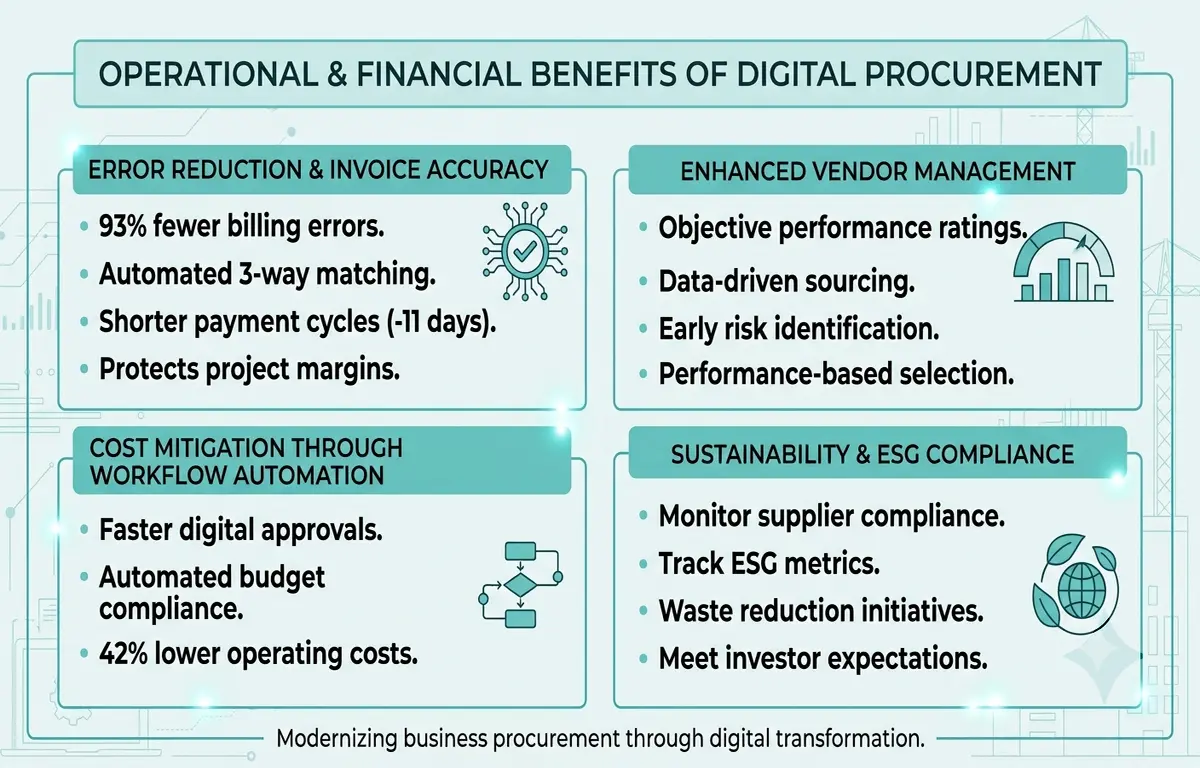
The benefits of digital procurement go much further than cost savings. They touch on all aspects of the operation of a construction business such as accountability of the vendor and environmental compliance.
Error Reduction & Invoice Accuracy
Billing errors are virtually nonexistent with procurement software that has built-in three-way matching comparing purchase orders with delivery receipts and invoices. A 2024 study by the Aberdeen Group found that organizations that automated the invoice matching decreased billing errors by 73% and shortened payment cycles by an average of 11 days. This degree of accuracy directly safeguards the margins of projects in the case of hotel FF&E procurement and other large-volume sourcing situations.
Enhanced Vendor Management
The digital procurement systems enable businesses to objectively rate supplier performance in aspects such as on-time delivery rate, quality compliance, responsiveness and competitiveness in prices. These data matrices eliminate any subjectivity in the evaluation of vendors and evidence-based strategic sourcing. Underperforming vendors are identified at an early stage before they become a risk to the project.
Cost Mitigation Through Workflow Automation
Many organizations tend to pose the question when assessing ROI: What is the role of technology in procurement in terms of reducing bottom-line costs? The solution is in the process optimization. Unified digital approval processes remove the delays associated with physical sign-offs. This takes over a period of several days and purchase requisition systems are fully automated to make sure that expenditures do not surpass pre-determined budget limits. As indicated by the 2025 CPO Survey by Deloitte, digitally mature procurement functions are 42% cheaper than manual ones.
Sustainability & ESG Compliance
The compliance with regulations and investor expectations in 2026 is increasingly linked to sustainable procurement. ESG scoring modules on digital procurement platforms are now in place to monitor the carbon footprint of suppliers, ethical sourcing certification and waste reduction activities. In the case of energy and industrial project procurement, where regulators and clients are keen on the environmental impact of a project. This ability is no longer a luxury but rather a contractual requirement.
Overcoming Deployment Challenges
Digital procurement adoption is not a smooth sail even in light of the strong ROI. The construction companies encounter four major implementation obstacles. All of which can be overcome with the correct approach.
| Challenge | Root Cause | Recommended Solution |
| Legacy System Integration | Outdated ERP & siloed databases | Use API middleware and phased migration |
| Data Security & Compliance | Unsecured third-party access points | Enforce ISO 27001 & role-based access controls |
| Workforce Adaptation | Resistance to new digital workflows | Structured onboarding & change management |
| High Implementation Costs | Upfront licensing & customization fees | Start with SaaS models; measure ROI quarterly |
Integration with Legacy Systems
Most construction companies are working with the 20-30-year-old ERP systems that were not developed to interact with the latest procurement software. A complete replacement is not always the solution. The data can be sent both ways without the need to make an entire overhaul of the infrastructure, which can be achieved with API middleware, software that serves as a translator between old and new systems. The phased migration strategies enable the businesses to upgrade gradually, minimizing the risk and the initial capital spending.
Data Security & Regulatory Compliance
With procurement going to the cloud procurement compliance and data security become more of an issue. Non negotiable baselines include ISO 27001 certification, end-to-end data encryption and role-based access controls. The businesses that are running in international jurisdictions should also consider GDPR, CCPA and regional laws on data sovereignty. The best-known procurement sites release their security architecture publicly and an essential due-diligence requirement when choosing vendors.
Workforce Adaptation & Training
The adoption of technology is most frequently unsuccessful not because of the software but rather because of the people who will use it. Formal change management initiatives such as practical workshops, certification programs and departmental champions enhance adoption rates significantly. According to a 2025 Prosci Change Management Benchmarking Report, projects that had focused change management planning were 6 times more likely to achieve their goals on time and on budget.
Managing Implementation Costs & ROI Timelines
The cost of licensing is also a real challenge to mid-sized construction companies because of the high initial costs. Software-as-a-Service (SaaS) procurement platforms help alleviate this by substituting huge capital investments with predictable monthly subscriptions. The businesses must monitor ROI by quarterly procurement cost-per-transaction, time-to-approve and supplier performance increases. The majority of digital adopters have reported quantifiable returns in 12-18 months. The initial step in risk management in procurement is to have a realistic business case based on these quantifiable KPIs.
Modernize Your Procurement Today
Find out how technology streamlines construction procurement efficiency.
Future Outlook of Procurement Technology Beyond 2026
There is no indication of slowing down the rate of procurement technology innovation. According to Gartner, Deloitte and McKinsey forecasts on procurement technology in 2025-2026, the next procurement technology frontier will be characterized by the following four developments.
Generative AI in Contract Drafting & RFP Generation
AI in procurement is becoming less analytical and more generative. By the end of 2026, the major platforms will help procurement teams input simple parameters of projects. Also automatically produce full RFP documents, vendor evaluation scorecards, and contract draft frameworks, cutting the time spent on document preparation from days to minutes. Gartner forecasts that by 2027, 40% of all procurement requests in enterprise firms will be written with the help of generative AI.
Blockchain for Transparent Supplier Ecosystems
The second stage of the digital document management in procurement is distributed ledger networks that integrate whole supply chains not bilateral buyer-supplier deals. All subcontractors, material suppliers, logistics and site managers will have access to one tamper-proof project record. This will do away with the information asymmetry that has brought about so many construction conflicts and delays.
Predictive Procurement & Demand Sensing
With real-time market data and on-site IoT sensors, the next-generation procurement platforms will be predictive, rather than reactive. The system will also automatically trigger procurement processes as it can detect when a project is at a specific milestone of project progress and generate a material requisition instead of waiting to be raised by the project manager. This bridges the disconnect between project planning and supply chain execution, an essential skillset to both school procurement solutions and large-scale commercial builds.
IoT-Powered Auto-Reorder Systems
Fully automated inventory replenishment will be implemented with the help of mobile procurement technology and IoT sensors. The construction sites will be equipped with smart storage systems that will track the stock levels in real-time and automatically issue a purchase order once the thresholds are violated without the need to be controlled by humans. In residential construction procurement where material shortages can put a stop to the work on several concurrent construction projects, this feature will be revolutionary.
The 2026 Digital Procurement Outlook by McKinsey predicts that construction companies that completely adopt the next generation of procurement technology shall realize 18-27 total cost of ownership savings on materials in five years of adoption. There is no question whether to adopt or not but when.
Conclusion & Call to Action
Digital procurement is not a competitive advantage anymore; it is a minimum requirement for businesses to survive in 2026. In the form of automated spend analytics and AI-driven cost forecasting, blockchain-supported smart contracts and IoT-supported auto-reorder systems, technology is transforming each stage of the construction sourcing lifecycle. The risk of businesses that fail to adapt on time is cost overruns, supplier conflicts, compliance issues and failure to scale.
The future lies in those organizations that can consider procurement as a strategic operation. One that is driven by real-time information, smart automation and open supplier relationships. Developing such ability today translates to going into the next ten years with faster, leaner and more resilient supply chains than the competition.
Omni Build Pro is an end-to-end construction, commercial and institutional procurement consultancy firm. Our team is spa procurement services or office FF&E procurement, lobby furniture and fixture procurement, orhealthcare FF&E procurement, would leverage both operational expertise and state-of-the-art technology alliances to each endeavor.
Ready to modernize your procurement function?
- Contact Omni Build Pro for a free procurement technology consultation customized to your project type and scale.
- Browse our list of reliable construction procurement contractors to source the correct partners to build your next project.
- Get our free Procurement Readiness Checklist and compare your existing processes to 2026 industry standards.
Frquently Asked Questions
How does technology play out in procurement by construction businesses in particular?
Procurement technology in the construction industry is used to automate the process of sourcing materials, subcontractors and equipment. It replaces the paper-based bidding, manual POs and fragmented communication with centralized digital sites.
What are the most used e-procurement platforms in the construction industry?
The three most popular enterprise e-procurement solutions in construction are SAP Ariba, Coupa and Jaggaer. Both provide supplier portals, contract management, spend analytics and connect with leading ERP systems.
What are the advantages of blockchain in enhancing procurement transparency?
Blockchain documents all the terms of the contract, delivery and payment history on an unchangeable distributed register. In other words, no record can be changed afterwards. Blockchain-based smart contracts automatically transfer payment upon meeting agreed-upon conditions. It eliminates the manual approval process that often takes weeks of time to finalize payments.
What are the largest threats to transitioning to digital procurement?
The four main risks include: vulnerability of data security in case systems are not properly secured; lack of integration with the existing ERP infrastructure. Also lack of user adoption because of a lack of training and mismanaged expectations in terms of ROI. The cost of non-adoption is higher: becoming a lagging force in terms of competitors that already act at the digital maturity level.
What is a realistic period to realize a procurement technology payback?
The majority of mid-to-large construction companies start to experience tangible benefits in 12-18 months after the implementation of procurement technology. Initial victories usually occur through improvements in invoice accuracy, decreased maverick expenditure and decreased time-to-approval. Long-term ROI, strategic sourcing savings or supplier performance and builds up over 24 to 36 months.