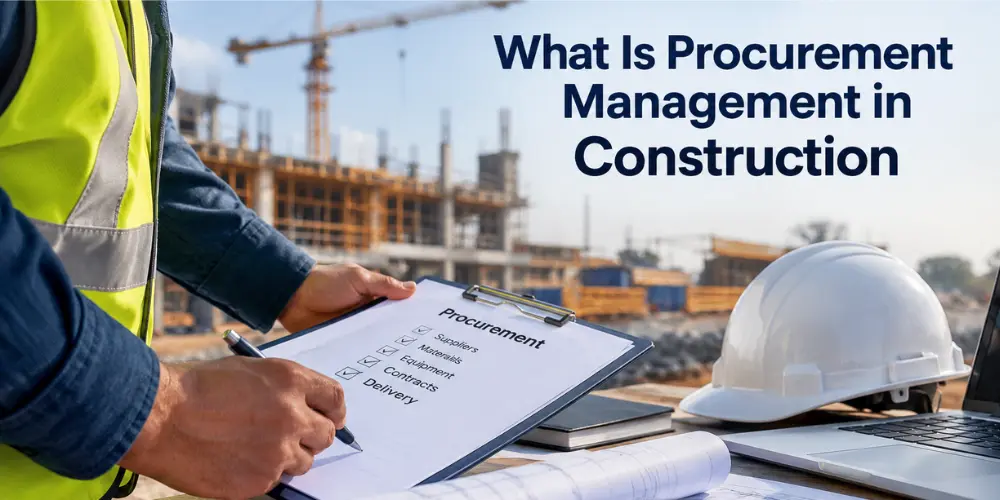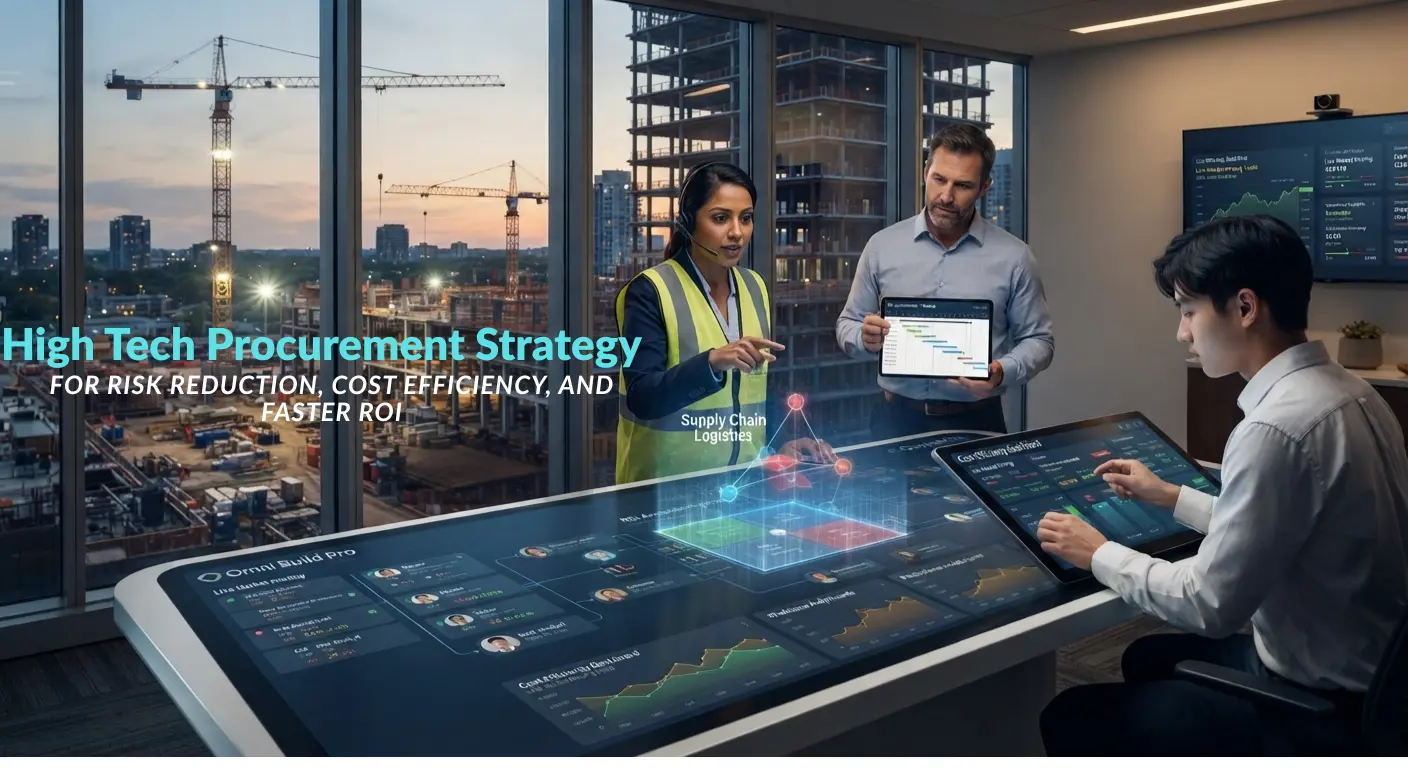

It is 6 am, and the site foreman is already on the phone, complaining about a late delivery of rebar. We’ve heard enough of such calls at Omni Build Pro to understand this: in 2026, when the profitability of thin construction is variable, when steel and cement are as unpredictable as ever, when the lack of labor is nearly half a million workers, construction procurement has become the back-office activity that has become the largest lever a builder can pull. Do it wrong, and a project burns cash before the first slab is poured. Do it properly and procurement will be silently the workhorse of every profitable close-out.
The majority of people continue to view procurement as merely purchasing goods. In reality, it is a tactical means of delivery that decides how architecture will endure the encounter with the real world, real suppliers, real freight schedules and real weather delays. With the industry moving towards a new model of integrated project delivery as opposed to the old design-bid-build model, it is not the sourcing, risk or technology team working in isolation that secures cash flow when steel prices increase by single-digit margins in a quarter.
Understanding the Core Construction Procurement Process
Imagine a delivery truck sitting outside a work site, waiting to be called to the loading dock and no one bothers to verify the loading-dock schedule. Compound that friction with all the trades, and you begin to understand why this is a lifecycle, rather than an event. It starts with a spec sheet and finishes many months later with an as-built asset and each of the steps in between is a spot where money silently evaporates.
That is what makes procurement in construction fundamentally different than procurement in most other industries. A delayed shipment does not merely aggravate a warehouse manager but it halts a live crew on site, who spends every hour that the material is not delivered to incur labor costs.
The Lifecycle of Project Fulfillment
There is no teleportation of materials in architectural drawings to the job site. They go in a series: design intent is a Bill of Quantities, a BOQ is a tender package, tender is a contract, and a contract is a Purchase Order with milestones at the site. Interpreting this flow as a larger procurement in supply chain management is to enable site teams to identify areas of failure that are not seen through a just-financial perspective such as a subcontractor who wins the bid but is unable to meet the delivery window.
Key Stages of the Procurement Flow
Any project has a budget that is likely to be made or broken in three phases before the concrete is poured:
- Tender document preparation and Bill of Quantities (BOQ) alignment: ensuring quantities are as intended in the design before going out to price.
- Subcontractor vetting and Request for Proposal (RFP) floating: vetting of bidders based on capacity and not price.
- Award of contracts, milestone-based Purchase Orders and retention fee establishment – performance-based payment and not time-based.
Any one of these stages is a shaky process that does not remain within its own boundaries. An ill-defined BOQ becomes a site variation order 6 weeks down the road and a hasty RFP usually implies that the winning bid was merely the most accurate one. These errors are passed on to field teams in the form of scope creep, a costly, preventable consequence that can be traced by most seasoned quantity surveyors to the very initial two weeks of the tendering process.
Strategic Sourcing and Materials Procurement in Construction
Between the mill and the job site, a ton of rebar can swing a price by a double-digit without anyone touching the design. That is the fact of Strategic Sourcing in 2026: it is not about the lowest vendor anymore; it is about the time, storage, and risk tolerance.
Bulk Sourcing vs. Just-In-Time Site Delivery
Early purchase of materials ties up the current price but all pallets stored on the premises cost the company money in storage, security and handling. Current bid information indicates that the steel pipe is running approximately 12.5% higher annually and copper is approximately 32% higher. That is precisely why additional contractors are buying items with long lead times and scheduling them to be delivered later, locking the price and not locking up the yard. The correct decision regarding the procurement methods is usually reduced to an easy question: is it a bulky and storable material, or is it a small, critical and volatile one?
Compliance and Vetting Standards
Any price savings are futile in case a shipment cannot pass inspection. Before a single purchase order has been signed, reputable contractors inspect to ensure structural suppliers comply with ASTM structural requirements and ISO 9001 quality management requirements, in addition to local building-authority sign-off. This step is often skipped to save two days on a tender but this rarely saves any money as it simply transfers the cost to the rework line and rework itself is estimated to increase the overall project cost by nearly 5% industry-wide.
Audit Your Vendor Risk Matrix Today
Protect margins before the next price spike.
Navigating Vendor and Supplier Risk Management
A supplier who has been afloat in January may be in liquidation in June and nothing can bring a schedule to pieces like a vendor who merely fades away. Supplier Risk Management is now part of procurement as much as price negotiations, given that, in most markets, the fabrication lead times have increased to 12-16 weeks rather than the usual 8-10 weeks.
Identifying Weak Links in the Construction Chain
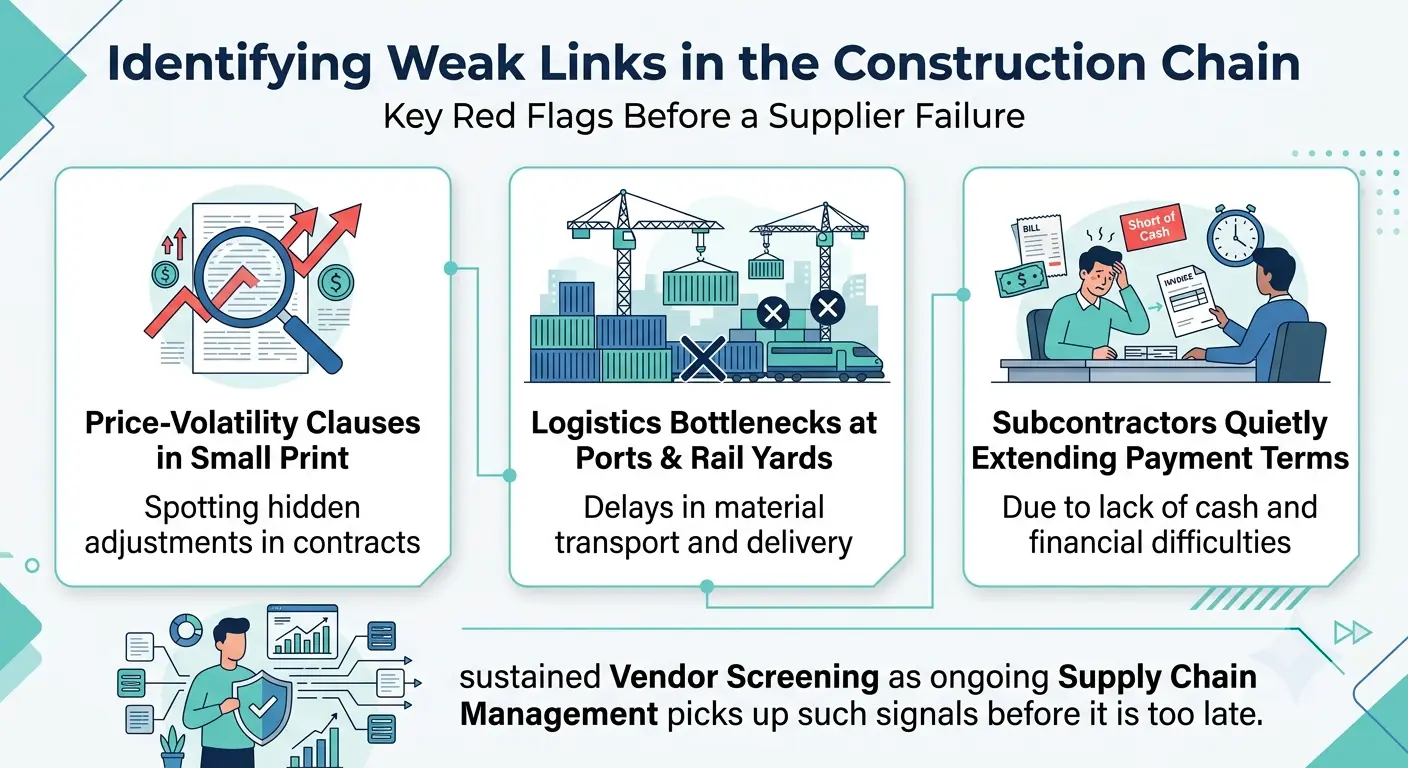
Three red flags are likely to appear before a supplier failure: price-volatility clauses in the small print, bottlenecks in the logistics at the ports or rail yards and subcontractors who are quietly extending payment terms as they are short of cash. Vendor screening as a sustained sourcing and supply chain management, as opposed to a single approval, picks up such signals before it is too late.
Proactive Risk Mitigation Frameworks
The intelligent procurement teams create redundancy ahead of its demand:
- Dual-Sourcing of critical-path materials such as rebar, so when one mill goes offline, the pour schedule is not held.
- Tier-1 suppliers: performance bonds and financial-health audits to identify cash-flow trouble early enough it is missed delivery.
- Live monitoring of lead-time latency of specialized heavy equipment or manufactured parts as a four-week delay in a crane rental could spread through three trades.
The checklist shown below follows the same format as professional contractors in signing off the capacity of a fabricator:
| # | Check | What to Verify |
| 1 | Financial health | Recent credit report or bank reference confirming solvency. |
| 2 | Production capacity | Current order book vs. available capacity for your delivery window. |
| 3 | Compliance certification | Valid ASTM/ISO certifications and local code approvals. |
| 4 | Track record | References from at least two comparable projects completed on time. |
| 5 | Contingency plan | A documented backup plan if their primary facility or route is disrupted. |
Use this checklist prior to all Tier-1 awards, not only the big-ticket awards. A fabricator that fails in one of the lines hardly ever fails in isolation, poor financials and thin capacity goes hand in hand.
Cost overruns are still painfully widespread in the industry, analyses of industry trends indicate that on average, overruns are almost 28% in the national projects, and that only one out of every ten projects are delivered at less than 10% of the initial budget. The failure of vendors is hardly the front-page reason, but it is often the catalyst: a shipment that is late will result in an urgent replacement purchase at the market price and the runaway freight will be accumulated after that point. It is among the less recognized risks of procurement in construction industry today especially among the Tier-1 structural suppliers.
Achieving Cost Savings: Procurement in Construction Sector Strategies
Contractors enjoy a bargaining unit price. Much less negotiate total cost and it is on that margin that real margin conceals itself. That is the attitude change that will characterize procurement in construction sector in 2026: total-cost thinking will be the winner over unit-price thinking.
Value Engineering During Sourcing
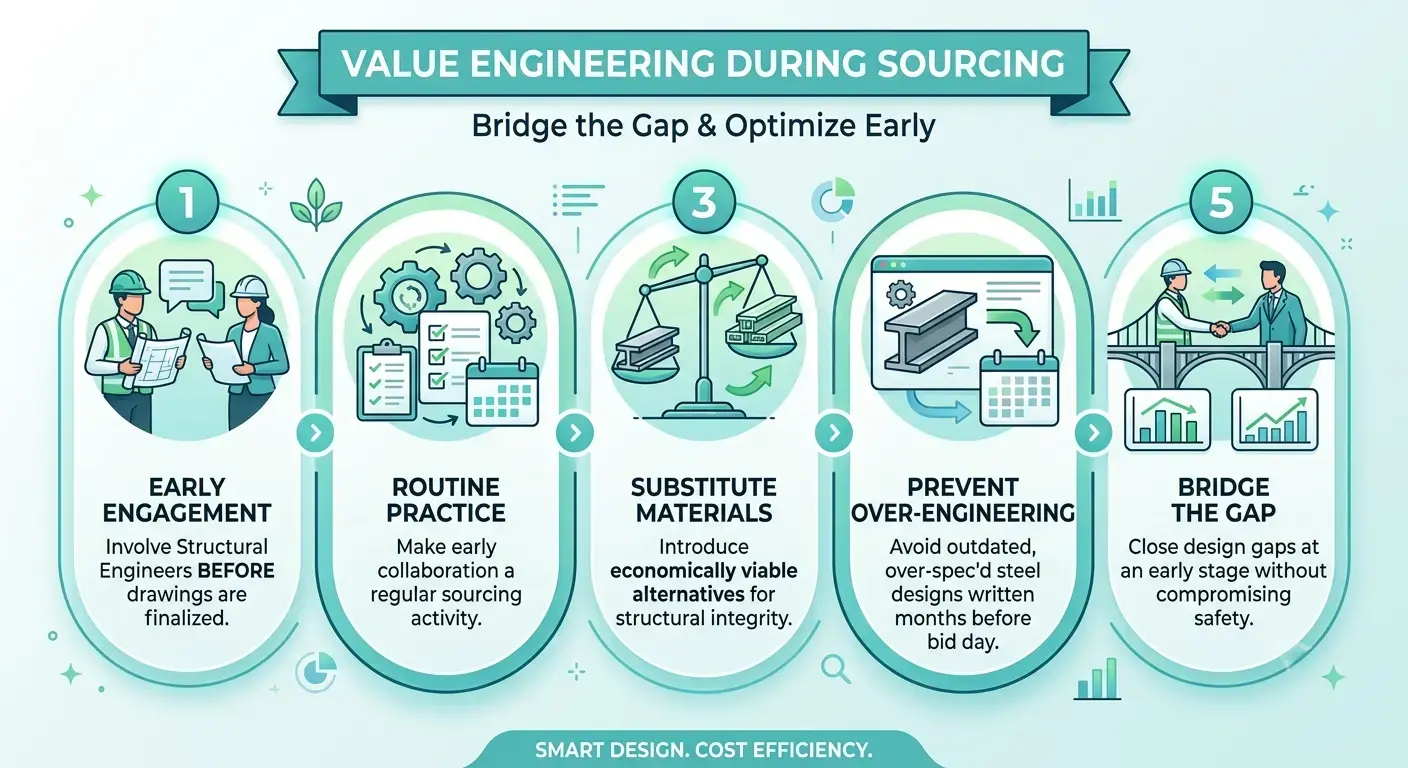
Introducing structural engineers into sourcing discussions prior to drawings being finalized and not after has become a routine practice. Which continually throws substitute materials into sourcing discussions that are economically viable in terms of structural integrity. A steel beam spec written six months before bid day is likely to be over-engineered just because it was safer to over-spec than to have the discussion. This gap can be bridged at an early stage without infringing safety margins.
Total Cost of Ownership (TCO) vs. Initial Material Quote
A quotation that appears to be cheaper on paper will turn out to be higher after the addition of haulage, crane offloading, wastage and staging storage. This is a simplified comparison of TCO of a 100 ton structural steel order, which shows why the lowest quote is not necessarily the lowest cost:
| Cost Component | Supplier A (Lower Unit Price) | Supplier B (Higher Unit Price) |
| Material cost (100 tons) | $148,000 | $156,000 |
| Haulage & freight | $9,200 | $6,100 |
| Crane offloading | $4,500 | $2,800 |
| Wastage (est. 6% vs. 3%) | $8,880 | $4,680 |
| Staging & storage (30 days) | $3,100 | $1,200 |
| Total Cost of Ownership | $173,680 | $170,780 |
Paper Supplier A will win by $8,000. When haulage and wastage and storage are added in, Supplier B is in fact the cheaper purchase by about 2,900 pounds a difference which would have been entirely missed in a comparison based on unit prices alone. It is at this point that real Cost Savings are achieved through total-cost thinking, as opposed to line-item negotiation.
Standardizing Contract Clauses
The inbox RFQ threads that are manually fished by somebody are stealthily one of the most costly customs that have been left behind in the industry. The workload of procurement teams is increasing by about 8% in 2026 and headcount and budgets are changing by little, a gap that can only be addressed by automation.
The Modern Shift: Construction Procurement Management Tech
Cloud-based bidding systems are instead of fragmented email conversations, a single transparent record: all suppliers are presented with the same scope. All bids fall into a single location and price comparison no longer needs an individual to remember a phone call. Such transparency alone is likely to increase price transparency, as suppliers are aware that they are being directly compared as opposed to being estimated.
Automating Tendering and RFQs
Connecting the procurement tracking information to the BIM models and ERP processes implies that a missed shipment won’t appear as a red flag on the day of delivery. Such integration is turning into the new ground rule of procurement on construction industry platforms, not a luxury feature, teams that do not have it are in effect operating 2026 supply chains with a 2015 toolkit.
Inventory and Supply Visibility
Connecting the procurement tracking information to the BIM models and ERP processes implies that a missed shipment won’t appear as a red flag on the day of delivery. Such integration is turning into the new ground rule of procurement in construction industry platforms, not a luxury feature – teams that do not have it are in effect operating 2026 supply chains with a 2015 toolkit.
Conclusion: Building Margin Protection Into Every Purchase Order
To recap: construction procurement in 2026 is not a single field but three interconnected fields. The source of materials determines the initial cost. The risk structures determine whether the price makes it to the delivery day. And technology is the determinant of whether someone on your team will see a problem before a change order.
The market advantage in 2026 will be to those builders who view their supply chain as seriously as they do their concrete pours; that is not the lowest unit pricing builder, but the builder who never gets caught off guard. That is what we model at Omni Build Pro on building all sourcing decisions.
When your subcontractor risk matrix was last reviewed, was it before the last tariff round, which will be an afternoon? Five-point vendor check in the present day is a lot cheaper than a month four delivery that could be missed.
Frequently Asked Questions
what is construction procurement in simple terms?
It is the systematic process of procuring materials, manpower and outsourced services to a build – including tender documentation and final delivery, not the actual purchasing.
What is the biggest construction procurement risk at the moment?
Price and material-price volatility of suppliers. The tariff-based cost floors on steel, cement and aluminum have increased 2026 prices more difficult to predict than any year since 2022.
What is the average cost increase due to cost overruns?
Average overruns of 15-28% are often reported in industry studies although large or complex projects may have higher overruns.
What’s the difference between procurement and purchasing in construction?
Purchasing is a one-time affair. Procurement is the overall strategic process, vetting, negotiating, contracting and risk management of that transaction that occurs both prior to and following that transaction.
What is the way to use technology to minimize construction procurement risk?
Replacing manual RFQ threads and spread sheets with interconnected solutions to alert about delays in suppliers, monitor lead times and directly attach purchase orders to project milestones, uncovering issues weeks before a manual process would.