

By 2026, the margins of supply chains are so thin, and project schedules are devoid of operational drag. The teams in procurement dealing with massive infrastructure, commercial constructions or complicated supplier networks are finding out a bitter truth: manual processes are the biggest contributor to unnecessary costs and time. RPA in Procurement is a Robotic Process Automation used in particular sourcing, purchasing and payment processes. That is quickly turning into not only an emerging idea but also a competitive requirement.
Every operations manager is no stranger to this issue: purchase orders are stuck in limbo awaiting manual entry, invoices go unpaid and no one ever responds to vendor communications. Because no one can monitor everything simultaneously. It is no failure of talent these but a failure of the structure of manual systems in attempting to keep abreast of the modern volumes of procurement.
Robotics Process Automation in Procurement is the answer: deploy intelligent software bots to process repetitive, rule-based tasks faster, more accurately and consistently than any manual team can. Once modern procurement solutions are implemented based on RPA, it is possible not only to save time. But also to turn procurement into both a reactive and back-office operation into a strategic, data-driven competitive advantage.
What is RPA in Procurement and How Does It Work?
Simply put, what is RPA in procurement? B2B Robotic Process Automation is software bots, known as rule-based digital workers, which mimic the behaviour of a human operator working within a procurement system. These procurement system like reading data, typing in values, initiating approvals, sending notifications and reconciling records. The difference between the critical and non-critical lies in the fact that bots can carry out these tasks in a matter of seconds, twenty-four hours a day with no mistakes.
The special practice is that RPA does not need to substitute your current infrastructure, which has made it an exceptionally feasible method for procurement teams. They are built on top of old ERPs (SAP, Oracle, Coupa), communicate with supply chain databases, read emails and PDFs and even tie into project management systems without a costly IT overhaul. A bot basically follows the steps of a procurement analyst with the keyboard and the mouse but with machine speed and flawless repeatability of the process.
How RPA Bots Interact With Existing Systems
- ERP Integration: Bots gain access to SAP or Oracle systems and take out, input or check data without API dependencies.
- Document Processing: Bots read PDFs, scanned invoices, email attachments and extract structured data even in semi standardized structures.
- Cross System Reconciliation: Bots check records across systems in real-time, compare purchase orders with receipts and invoices.
- Exception Escalation: When data does not match or there is a breach of a threshold, bots indicate the exception and automatically forward it to a human reviewer.
Gartner suggests that when organizations introduce RPA in finance and procurement operations, they report a 25-40% decrease in the process cycle times in the first year of implementation. These returns are not hypothetical but are recorded operational performances in industry, construction, healthcare and energy sectors.
The Core Benefits of RPA for Procurement Teams
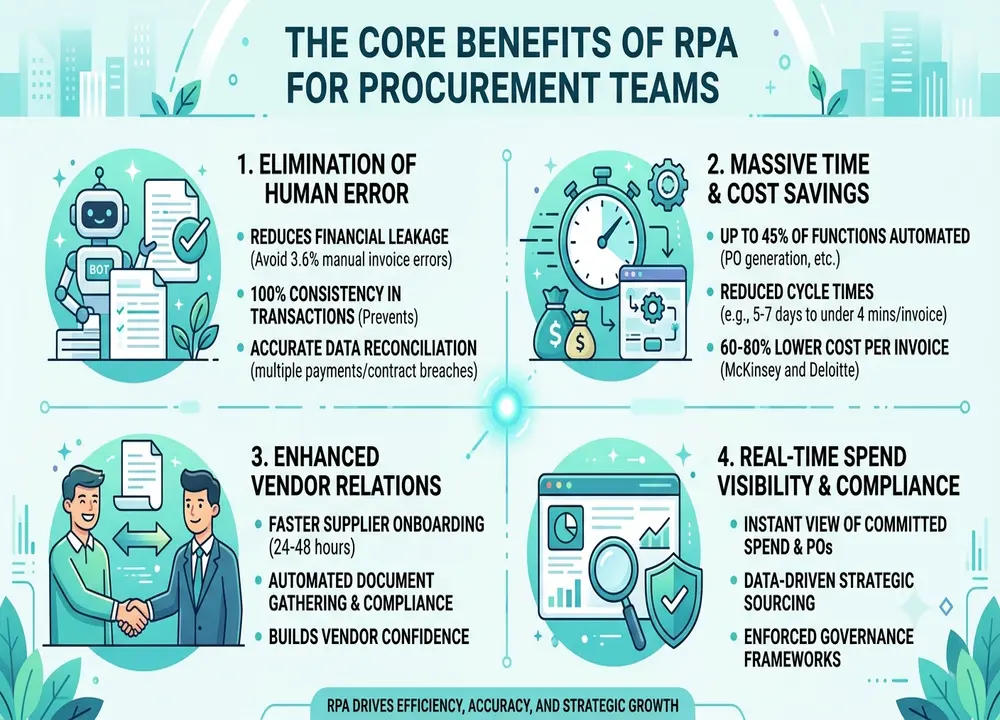
RPA for procurement approach is a platform with a case based on quantifiable, replicable benefits in four key areas: accuracy, speed, cost, and relationships with vendors. This is what the research and the actual deployments demonstrate over and over again:
1. Elimination of Human Error
Procurement is not only slow when operated manually but the system is structurally unsound. A study conducted by the Institute of Finance and Management (IOFM) approximates the number of manual invoices that have errors to be as high as 3.6%. In a procurement operation with thousands of transactions each month, every single such error is translated into financial leakage, multiple payments and breaches of contracts. RPA bots get into the system, authenticate nand reconcile data with 100% consistency in every single transaction.
2. Massive Time and Cost Savings
According to an estimate of the McKinsey study into procurement automation, up to 45% of procurement functions such as PO generation, invoice matching, supplier data validation and others can be completely automated with the existing RPA technology. In a typical 3-way match workflow, the use of invoice processing automation will reduce cycle times that are normally 5-7 business days to less than 4 minutes per invoice. The financial benefits are no less substantial: Deloitte estimates that the procurement automation will allow reducing the cost of an invoice processed by 60-80% in comparison with completely manual operations.
3. Enhanced Vendor Relations Through Supplier Onboarding Automation
The impact of RPA on supplier relationships is one of the least recognized advantages of RPA. Supplier onboarding automation eliminates the weeks of document chasing, manual compliance checks and lack of consistency that normally frustrates new vendors.
The entire onboarding process is automated by bots such as gathering registration documents, tax IDs and compliance certificates, financial health data validation and the creation of vendor master records, which is done within 24-48 hours. More rapid and stable onboarding creates vendor confidence and decreases the chances of the procurement process being slowed by administrative bottlenecks.
4. Real-Time Spend Visibility and Compliance
As bots constantly refresh the ERP records and spend dashboards, procurement leadership can see real-time committed spend, open POs and outstanding invoices. This real-time data stream can be used to make strategic sourcing decisions quicker and to make sure that governance and compliance frameworks are enforced at all times, not merely when an auditor demands a report.
Manual vs. RPA-Enabled Procurement
The following table shows the difference in the operation of the most popular procurement activities:
| Procurement Task | Manual Process | RPA-Enabled Process |
| Purchase Order Creation | 2–4 hours per order and prone to data entry errors | Seconds; bots auto-populate from requisitions with zero errors |
| Invoice Processing | 5–7 days average cycle time and manual matching required | Under 4 minutes and automated 3-way matching 24/7 |
| Vendor Onboarding | Weeks of back-and-forth and inconsistent document checks | Standardized in 1–2 days; automated compliance checks |
| Three-Way Matching | Manual reconciliation across ERP, PO, and invoice | Fully automated reconciliation with instant exception alerts |
| Spend Reporting | Hours of manual data aggregation from multiple systems | Real-time dashboards updated continuously by bots |
| Supplier Communication | Delayed, inconsistent email follow-ups | Automated status updates and notifications in real time |
Key Use Cases: Implementing RPA in the Procurement Process
The concept of RPA in Procurement Process implementation presupposes considering the particular workflows in which bots can add the most direct and quantifiable value. The following are the top three use cases that would be implemented in the construction, energy, hospitality and manufacturing industries in 2026.
Automated Purchase Order Generation
Purchase order creation is the most prevalent point of procurement automation. A procurement analyst in a manual setting gets a material requisition and manually enters the data into an ERP system, chooses the right vendor, uses contract pricing and forwards the PO to be approved. A task that normally takes 2-4 hours per order.
Using RPA, a bot understands the incoming supply requisition, be it an email, an ERP workflow or a project management system and fills in the PO fields automatically. Using pre-approved vendor and pricing rules, mark any anomalies and send the finished PO for approval that can be approved by clicking a button. The whole process takes a matter of seconds. In high-volume operations, which deal with hundreds of daily requisitions such as businesses dealing with energy project procurement processes, this automation alone can recover thousands of analyst hours annually.
Streamlining RPA in Procure to Pay (P2P) Cycles
One of the most complicated and prone to errors processes in procurement is the Procure to Pay cycle. It covers the whole process of requisition approval up to the payment of the vendor and includes various handoffs, document comparisons and approval layers. RPA in Procure to Pay can change that by automating the most labor-intensive aspect, three-way matching.
In three-way matching automation, a bot will retrieve the purchase order in the ERP, the goods receipt note in the warehouse system and the supplier invoice in the accounts payable and compare all three documents in real time. When all things are in order, the invoice is automatically approved to be paid. Should there be an exception quantity mismatch, pricing variance or no receipt, the bot indicates the exception and directs it to a corresponding reviewer with a complete audit trail. This is especially revolutionary in teams that handle automating FFE procurement workflows, where large-volume orders of fixtures and equipment will involve steady and error-free payment processing.
Vendor Onboarding and Compliance Management
The process of adding a new supplier to an authorized vendor list normally requires gathering tax certificates, business licenses, insurance certificates, and financial references. Then, manually input all of this into the vendor master data system. In the case of industries such as healthcare or hospitality, there are additional layers of verification required for regulatory compliance. This ability is of invaluable help to the teams working in procurement in healthcare facilities, where compliance with vendors is not a mere operational choice but a necessity that must be met by the regulatory bodies.
RPA manages the vendor master data management through the automation of all supplier documentation, its collection and validation. Bots are able to match submitted credentials with publicly available compliance databases, mark out-of-date certifications and automatically provide onboarding status messages to the vendor. In the same way, businesses that specialise in restaurant procurement automation have automated vendor management to maintain the supplier credentials at various locations at the same time.
Ready to Automate Your Procurement Process?
Find out how RPA transforms procurement efficiency today.
Real-World Application Scenario
Scenario: A medium-sized construction company has 300-500 material POs monthly and 12 ongoing project sites. Their 4 person procurement team estimated that they spent 60% of their time on data entry, invoice matching and vendor follow up. This left them with little bandwidth to do strategic sourcing or contract negotiation.
With the implementation of an RPA solution on their P2P cycle, PO generation time reduced by 3.2 hours on average to less than 90 seconds per order. The time of invoice approval was reduced to same-day processing (6 days). The procurement department used its gained time to manage supplier relationships and optimize contracts and helped to cut material costs by 18% in the next two project cycles.
The Real Challenges of Deploying RPA in 2026
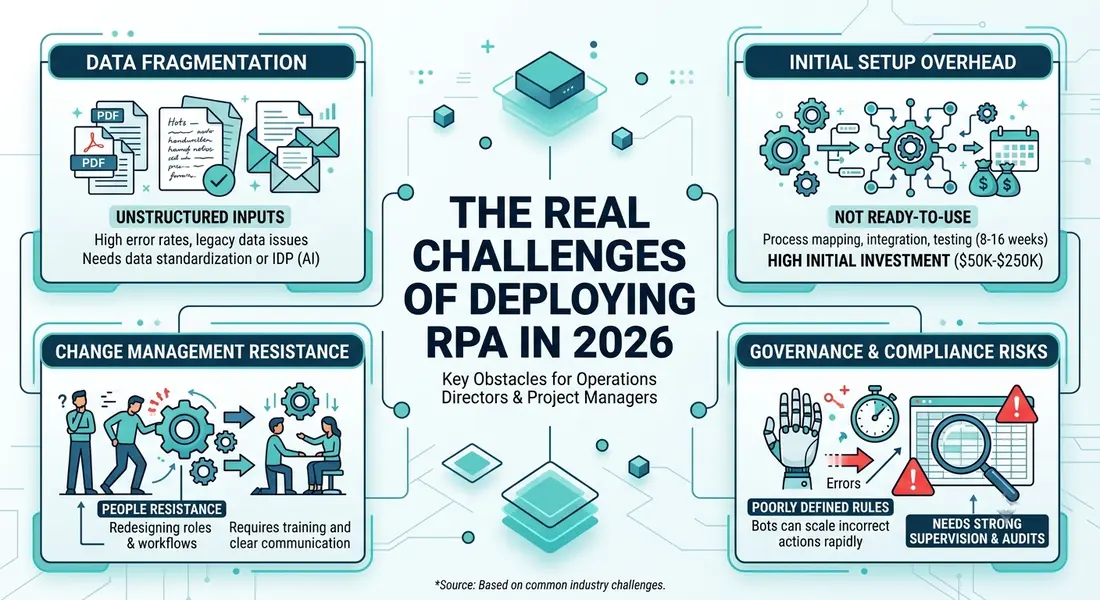
Editorial integrity demands responding to what RPA is incapable of, and in which implementations are truly weak. These challenges are key to understanding how any operations director or project manager develops a realistic automation roadmap.
1. Data Fragmentation and Unstructured Inputs
RPA bots are good at structured data, which is rule-based. They are not very effective at dealing with totally unstructured inputs: a poorly scanned PDF invoice with distorted text, a supplier email with non-standard formatting or a contract addendum as a handwritten note.
Error rates of bot failures and higher human intervention needs are more common when data quality in procurement is inconsistent, like in legacy-heavy organizations, which constrains net efficiency gains. This can be solved either by enhancing upstream data standardization or using RPA in conjunction with AI-based document processing ( Intelligent Document Processing or IDP ) to extract more powerfully.
2. Initial Setup and Scaling Overhead
RPA is not a ready-to-use solution. The first implementation roadmap involves process mapping, bot development, testing of ERP integration, and user acceptance testing, which takes a period of 8-16 weeks in a typical mid-sized deployment. System integration challenges are especially acute in companies using several legacy ERPs or custom-made procurement platforms, where each system can be expected to have its own bot workflow to be configured. Initial cost estimates of organizations that have implemented RPA at scale indicate the initial investment of between $50,000 and $250,000 based on the complexity of the processes and the vendor selected.
3. Change Management Resistance
The deployment of technology is a half-battle. Change management in procurement automation training procurement departments to collaborate with bots, redesigning roles and addressing resistance to change is always listed as the second most frequently cited enterprise survey barrier to successful RPA implementation (after data quality problems). Teams that take the time to invest in formal training, articulate communication regarding role development and executive sponsorship are always quoted with accelerated adoption and better ROI in the long term.
4. Governance and Compliance Risks
Bots poorly set up might perform the wrong actions at scale. A bot that has a poorly-defined pricing rule or an uncontrolled vendor-approval workflow might make hundreds of incorrect transactions before a human notices the error. Governance and compliance in RPA entails the establishment of strong bot supervision, exception and frequent audit reviews. These are at times neglected in the fervor of initial deployment but vital to the long-term operation integrity.
Best Practices for a Successful RPA Implementation
To the procurement directors and operations managers assembling their automation strategy, the distinction between a successful and a failed deployment lies in the execution discipline virtually all the time. The best practices below are consultant-level practices based on the organizations that have successfully implemented RPA at scale:
| Best Practice | What It Means in Practice |
| Define Clear KPIs | Set measurable targets before deployment such as reduce invoice cycle time from 7 days to under 4 minutes |
| Standardize Before Automating | Fix and document manual workflows first; automating a broken process just accelerates the errors |
| Run a Pilot Program | Start with one high-volume, low-risk process before scaling across departments |
| Maintain Human-in-the-Loop | Keep strategic decisions and high-value financial approvals under human review |
| Invest in Change Management | Train procurement teams on working alongside bots; address adoption resistance proactively |
| Monitor and Optimize Continuously | Use bot analytics dashboards to track performance and refine rules over time |
Define Measurable KPIs Before You Start
The most frequent implementation error is implementing bots without establishing an understanding of what success is, in quantifiable terms. Establish pre-go-live specific efficiency gains in procurement performance: Invoice cycle time, from 7 days to less than 4 minutes, is an actionable KPI. Improve procurement efficiency. Specific objectives provide your team with a well-defined reference point and offer management the figures to assess the return on investment (ROI) of RPA precisely.
Standardize Your Processes First
RPA is not an activity that mends a broken process; it speeds it up. Document a workflow comprehensively, examine any inconsistencies and fix any workarounds before handing the workflow to a bot. A machine trained on a chaotic process will run chaos at machine speed. Automation does not have standardization as a bottleneck; it is the precondition.
Maintain the Human-in-the-Loop (HITL) Principle
Human procurement professionals should retain high-value contract decisions, strategic sourcing negotiations and high-level vendor relationship management. The most successful RPA implementations establish explicit escalation limits: transactions over a specified dollar amount, new vendor types or contract changes will always go through a human approver. This HITL principle is not an automation constraint but it is a governance design option that safeguards your organization and bots can do the high-volume, lower-risk work at scale.
Omni Build Pro suggests that companies entering the world of procurement automation should start with a small-scale pilot of one high-volume process. Either PO generation or invoice matching and only proceed to a complete P2P automation system. Such a gradual strategy reduces implementation risk, provides initial quantifiable victories and instills internal trust to be able to expand adoption.
Conclusion: The Future of Procurement Automation
The procurement role in 2026 has two options: remain a cost-absorbing, delayed, and risky manual operation or take advantage of automation to become a competitive advantage source. RPA in Procurement is not a technology that is experimental anymore. It is an established operational model with reported ROI in industries including construction and energy, healthcare and hospitality.
Properly executed RPA can turn procurement, rather than being a sluggish transaction hub, into a strategic capability. When adopted strategically through clean process documentation, clear KPIs, controlled bot processes, and a commitment to change management. The procurement teams no longer waste their skills in manual data entry but use their expertise in supplier strategy, spend optimization and contract innovation.
The winning organizations in procurement in 2026 are not the ones with the largest number of teams but the ones with the smartest automation systems that can be configured to their benefit. In case you have not yet assessed your existing supply workflow as prepared to be automated, it is time to start that assessment.
Frequently Asked Questions
What are the procurement activities that can be automated by RPA?
Purchase orders, invoice processing, data entry, compliance checks, and spend reporting can be automated by RPA.
How long does RPA implementation take?
The average project time of most procurement RPA initiatives is 8-16 weeks with enterprise-wide projects potentially requiring several months.
Does RPA replace procurement professionals?
No. RPA enables repetitive work and teams can concentrate on the strategic procurement processes.
What is the ROI that can be achieved in procurement with RPA?
Most organizations realize cost savings of 60-80% and implement cost savings in 12-18 months.
Does RPA integrate with the existing ERP systems?
Yes. RPA can be integrated into systems such as SAP, Oracle, Microsoft Dynamics, Coupa and Jaggaer without significant alterations to the systems.