
Procurement will no longer be just a buying process for companies by 2026. The trend in competitive businesses is to develop procurement systems that integrate planning, sourcing, purchasing, vendor management, invoicing, and payment as a single strategy. The change minimizes cost leakage, enhances the cash flow, and improves supplier relationships.
One of the biggest business issues that end-to-end procurement addresses is the lack of connection between decisions. Departments make their own purchases, resulting in duplicate vendors, bargaining variances, slow approvals and low spending visibility. These gaps are sealed by enforcing an integrated procurement model, which controls the entire purchasing ecosystem, starting with demand creation to supplier payment.
This guide describes the entire procurement lifecycle, sourcing methodologies, current procurement and future procurement best practices in 2026. You will also understand the effects of procurement on profitability, trust with vendors and business resilience in the long term.
Understanding the Full Ecosystem
Modern procurement is more of a chain than a collection of tasks. The stages influence each other. Failing to make the initial stage clear leads to higher costs of the final stage as well as failure of the vendor relationship. Procurement has become a full ecosystem for businesses since global supply chains are unpredictable and prices are influenced by inflation continue to impact the construction, manufacturing and service industries.
Procurement executives have become spend trackers. They keep track of the vendor performance, price fluctuation, reliability in delivering goods and services and risk exposure. An integrated procurement system makes the system resilient in that it enables businesses to respond more quickly when suppliers fail, shipping delays occur or the prices of materials go high.
This ecosystem attitude is important since procurement is the direct determinant of continued operation. One order of missed materials may stop the whole construction process.
The Scope of Operations in Modern Procurement
Procurement covers more than purchasing. It involves planning of internal demand, supplier research, contract negotiation, compliance checks, purchase order workflows, invoice approvals and final settlement. Firms that make procurement decisions at disjointed levels tend to experience unchecked expenditures and poor forecasting.
Integrated procurement, on the other hand, provides complete spend visibility. This transparency assists the leadership in anticipating cash needs, preventing overdependence on suppliers and enhancing budgetary precision. McKinsey surveys frequently point out that in cost-intensive industries, optimization of procurement has the potential to boost EBITDA margins by 3-10%. In particular, when sourcing and contract management are handled by the procurement team.
Supplier trust is also affected by procurement. Vendors like dealing with buyers who make payments at the right time and those with effective communication and give correct purchase orders. Companies that optimize their procurement processes enhance supplier loyalty thereby enabling the companies to negotiate better prices when there is a high demand.
Categorizing Modern Acquisition Methods
Various types of items are purchased by different organizations and each of them will have to be procured specially. Unless companies implement a single approach to all things, they tend to be delayed and inefficient in their costs.
Direct vs. Indirect Sourcing
Direct procurement deals with products that have a direct influence on the production or delivery of the project. Direct procurement in construction encompasses concrete, steel, timber, electrical, HVAC equipment and mechanical parts. In production, it consists of raw materials, machine components and assembly.
Indirect procurement involves those items that facilitate the operations and not the project output. They consist of office supplies, software subscriptions, marketing services, laptops, cleaning contracts and facility maintenance.
Services vs. Goods Procurement
Examples of service procurement include consulting, engineering design, legal services, IT support and facility management. It needs to be defined in terms of scope and powerful contracts. Service procurement usually leads to concealed cost increases without adequate scope control.
The procurement of goods is based on tangible goods, including high-grade steel, heavy equipment, furniture and safety materials. It involves quality checks, delivery schedules, warranty checks and compliance testing.
According to the procurement frameworks of the World Bank, an unclear scope of the services is still one of the largest causes of procurement conflicts and slow execution of the contract. Standardized service level agreements and payments based on milestones are some of the ways businesses avoid these problems.
Want to streamline end-to-end procurement?
Contact Omni Build Pro today for smarter sourcing, automation and savings.
The Strategic Journey of Sourcing
The success of procurement lies in sourcing. Firms that hasten in the choice of their suppliers end up paying more and experiencing performance problems in the future. Strategic sourcing is concerned with market intelligence, supplier benchmarking and negotiating power.
Market Analysis & Vendor Discovery
Data-supported supplier discovery is employed by smart companies. They consider the vendors based on the past purchasing history, financial strength, compliance and delivery track record. An organized end to end sourcing process begins with market research up to the onboarding of suppliers.
Supplier analytics is becoming more popular in sourcing teams in 2026. These tools monitor market trends, commodity prices and supplier risk profiles. IBM reports on supply chain show that organizations implementing predictive procurement analytics lessen supply chain disruptions by a third since they recognize risks sooner.
Competitive bidding is also a powerful sourcing strategy. Competitive tendering also assists businesses to avoid price manipulation and gives them a fair choice of suppliers. It also enhances bargaining strength.
Ethical Selection and Sustainability in 2026
Companies have come to assess suppliers in terms of environmental standards, working conditions and transparency. Diversity of suppliers is also a significant factor. Businesses prefer suppliers who will help minority-owned businesses, female-run suppliers and local supply chains.
A PwC sustainability survey indicated that over 70% of consumers are more inclined to purchase brands that exercise sustainable business practices. This is affected by procurement teams since they select suppliers and materials that are in line with the sustainability objectives. Reusable products save on the cost of disposal. Moral suppliers decrease reputational risks.
Navigating the Functional Phases of Procurement
The success of procurement requires continuity in every step. Structured businesses do not experience procurement bottlenecks, budget leakage and supplier conflicts.
Milestones of Success: Each Procurement Life Cycle Stage
The full procurement lifecycle involves plan, requisition, source, evaluate, contract, purchase, receive, invoice and payment. Each procurement life cycle stage have to be documented, approved, and accountable.
The demand and budget are defined by planning. A requisition generates an internal request. Sourcing identifies vendors. Bids of suppliers are compared against each other. Contracting finalizes terms. Purchasing issues make purchase orders. Receiving verifies deliveries. Pricing is accurate in invoicing. The cycle is completed with payment.
This system will avoid unnecessary expenses and reinforce internal control. It also enhances forecasting accuracy since procurement data is based on actual demand trends.
Internal Requisitions and Spend Control
The first area where procurement can prevent unnecessary spending is internal requisitions. A lot of companies end up spending money due to unapproved purchases by employees. This issue is referred to as maverick spending.
Aberdeen Group studies frequently document that maverick spending may take 10-20 percent of total organizational expenditure, whereby organizations do not have procurement controls. It implies that a company with a yearly expenditure of $5 million might lose up to $1 million of the spending through unchecked purchasing.
This problem is addressed by standardized requisition workflows. They make sure that each purchase request contains a definite purpose, project code, budget reference and delivery schedule. Financial strategy can then be used to approve, reject or amend requests by procurement teams.
The category-based approval levels are also implemented in modern procurement systems. As an illustration, office supplies can require a manager to approve, whereas construction equipment could require finance and procurement leadership approvals.
From Order to Settlement The Financial Bridge
Goods delivery is not the end of the procurement. The last phase links purchasing with accounting. This phase identifies how procurement enhances cash flow or becomes a financial disaster.
Closing the Loop with Accurate Payment Systems
A good monetary bridge assures that the purchasing records, invoices and delivery slips are similar. This keeps the company safe against overbilling, duplicate payments and fraud.
An organized end to end procure to pay process is one that makes sure that all purchase orders are directly linked to invoice verification and release of payment. This system enhances financial forecasting since the finance teams are aware of the amount of payments awaiting.
Research published by Gartner indicated that organizations that automate procure-to-pay processes can cut costs related to invoice processing by as much as 70%. This decrease occurs due to the automation that does away with manual approvals, frequent follow-ups, and invoice disputes.
Invoice Automation and Three-Way Matching
An automated invoice is no longer a luxury but a necessity. It decreases errors in manual entries and accelerates the payment of vendors. Compliance is also enhanced by automation since all invoices should pass through the same verification process.
The three-way matching is one of the most powerful procurement controls. It makes comparisons between purchase orders, delivery receipts, and supplier invoices. In case the figures are not identical, the system will warn the invoice before payment.
This control safeguards profits since it does not allow companies to pay due to missing goods or exaggerated invoices. An effectively structured end to end procure to pay process minimizes disagreements and strengthens the trust between the suppliers as they get their payments much faster and more precisely.
Implementing Best Practices for Procurement in 2026
Best practices in 2026 are related to data, risk planning and supplier performance management.
Data-Driven Decision Making
Procurement executives are no longer using intuition to monitor performance but use procurement KPIs. The following are these KPIs: percentage of cost savings, supplier lead time, purchase order cycle time, contract compliance rate and vendor defect rate.
Financial KPIs that are related to procurement also include gross profit margin and operating cost ratio. The cost of materials decreases as a result of procurement, which leads to an instant increase in the profit margins.
McKinsey procurement studies show that organizations that implement advanced procurement analytics are likely to save 5-15% more than those that rely on manual procurement tracking.
Budgeting is also enhanced by data-driven procurement. The teams are able to predict material requirements using past demand. They are also in a position to detect price spikes at an early stage and enter contracts before prices start to rise.
Risk Management and Buffer Planning
Procurement resilience is determined by risk management. World shocks are still affecting the availability of materials. Construction companies experience delivery delays, manufacturing companies have problems with shipping, and service industries encounter problems with their vendors.
Multi-supplier sourcing, safety stock planning and contract-based price locking are some of the buffer strategies that procurement teams create nowadays. They also have backup lists of vendors of critical materials.
The World Economic Forum indicates that the disruption of supply chains has emerged as one of the leading business risks in the world. Firms that diversify suppliers minimize the risk of dependency and have a consistent project schedule.
Supplier financial checks also fall under risk management. In case a vendor is in bad financial health, it might delay or not fulfill a contract. The procurement groups need to ensure that they are dealing with stable suppliers prior to contract signing.
Contract Standardization and Compliance Control
Contracts establish a long-term stability in procurement. Badly composed contracts result in conflicts, setbacks and budgeting overruns. Powerful contracts characterize prices, delivery dates, fines, warranty, and payment conditions.
Standard contract templates enable companies to minimize legal risk. They also make sure that all supplier agreements have a similar compliance and dispute resolution framework.
Savings are also safeguarded by contract compliance. When departments do not use contract suppliers, it denies them the negotiated prices. Centralized supplier catalogs and strict purchase order controls are the solutions to this problem developed by procurement teams.
Leveraging Professional Expertise
A lot of organizations find it difficult to handle procurement within their organization due to a lack of expertise, systems or manpower. This leaves a big choice which should you develop procurement capability internally or outsource procurement management?
The Build vs. Buy Dilemma
In-house procurement offers direct control; however, it needs expert procurement managers, supplier relationship systems, contract expertise, and data reporting tools. Outsourcing also lessens the workload but this needs good monitoring of the vendor.
This is a common problem with construction and engineering companies since procurement deals with a variety of project categories, suppliers and contract forms. An organization that deals with multiple projects at the same time might not be able to monitor the performance of the vendor and pricing stability.
Organizations are also likely to outsource when they are growing at a rapid rate. Outsourcing enables them to scale procurement without developing a complete internal procurement department.
External Partnerships and Specialist Support
Businesses are assisted in streamlining sourcing, vendor selection, contract negotiation and procurement automation by external procurement experts. They also carry with them supplier networks and category expertise that other companies often lack internally.
Procuring specialized end-to-end procurement providers typically offer procurement structures, cost benchmarking and contract compliance frameworks. They also fulfill mass categories of procurement like construction materials, hospitality procurement and sourcing energy infrastructure.
The companies in construction, real estate development, and utility sectors are the most benefited, since procurement is very likely to influence the project schedules. The external procurement specialists also contribute to the minimization of disputes through clean documents and uniform workflow.
Procurement Applications Across Industries
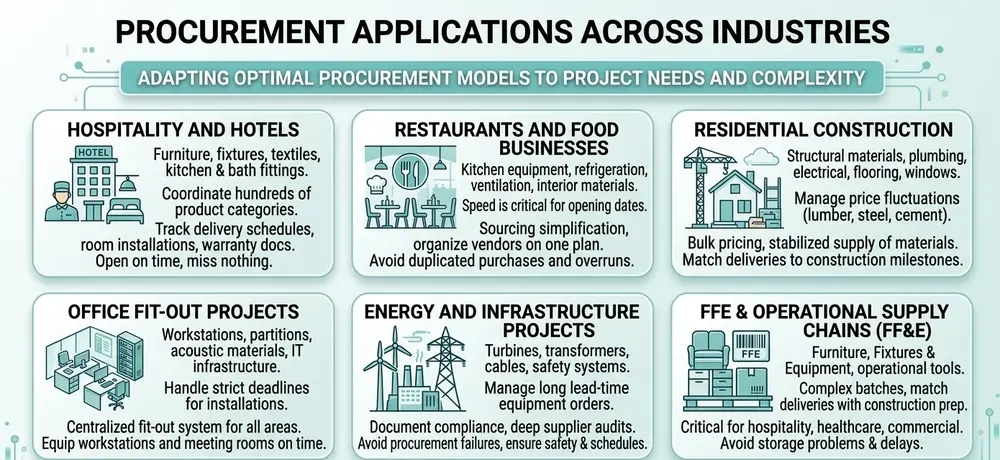
The strategies of procurement vary according to the needs of the industry. A hotel project procurement system is not the same as that of a residential development. The optimal procurement models adapt depending on the type of project and the complexity of the supplier.
Procurement for Hospitality and Hotels
Furniture, fixtures, lighting, textiles, kitchen equipment, and bathroom fittings are specific procurements that are needed at the hotel. They also need the coordination of the vendors, as hotel procurement usually deals with hundreds of product categories.
This is handled by many businesses in the form of hotel procurement management systems, which monitor delivery schedules, room-by-room installations, and warranty documents. With a systematic plan, the hotel will be ready to open at the right time without missing anything.
Procurement for Restaurants and Food Businesses
The restaurant procurement is concerned with kitchen equipment, refrigeration, ventilation, seating and interior materials. Speed in delivery by suppliers is also a need in restaurants due to the direct effect of opening dates of the businesses.
Most of the owners use restaurant procurement solutions as a way of simplifying the sourcing process and organizing various vendors on a single procurement plan. This will minimize cost overruns since duplicated purchases will be avoided and miscommunication with suppliers will also be avoided.
Procurement for Residential Construction
The residential projects need to be procured in terms of structural materials, plumbing services, electrical fittings, windows, flooring, paint and fixtures. Purchasing in residential is prone to price fluctuations because of lumber, steel and cement volatility.
Residential procurement solutions enable builders to enjoy bulk prices and stabilize the supply of materials. This will also help minimize project delays since the suppliers will match delivery schedules to construction milestones.
Procurement for Office Fit-Out Projects
Furniture, partitions, lighting, flooring, acoustic and IT infrastructure are elements of an office that need to be procured. This type of procurement is a sensitive one since there are strict deadlines when it comes to office projects.
Most companies use office fit-out procurement strategies to align suppliers, delivery schedules and eliminate delays on installations. A centralized fit-out procurement system will make sure that every workstation, meeting room and utility area is equipped with the necessary equipment on time.
Procurement in Energy and Infrastructure Projects
Energy projects have complicated procurement needs as they consist of turbines, transformers, cables, safety systems, and documentation of compliance. Long lead-time equipment orders also have to be dealt with by procurement teams.
Organizations often assign specialized teams for energy project procurement management because one procurement failure can delay entire energy production schedules. Close supplier audits are also a requirement of these projects since the quality of the equipment directly influences the level of safety of the operations.
Procurement for FFE and Operational Supply Chains
Furniture, Fixtures and Equipment are needed in many big projects. This group encompasses all the room furnishings and working tools. This is usually handled by teams via FFE & OSE procurement planning, particularly in hospitality, healthcare and commercial projects.
FFE procurement involves thorough schedules since it deals with a large number of items that come in batches. By matching deliveries with the construction preparation, procurement teams should avoid storage problems and construction delays.
Why a Unified Procurement Strategy Wins in 2026
The key to winning the battle in 2026 is creating procurement systems that have links between all processes. They save money by doing away with duplicate vendors. They enhance the performance of suppliers by monitoring the supplier KPIs. They enhance cash flow by matching payment cycles with the purchase planning.
Scalability is also supported by a single procurement strategy. Companies that grow into new locations find it difficult to keep a procurement manual. However, with procurement as a single system, it becomes easy and predictable to expand.
An end-to-end procurement cohesive model also helps in building better vendor relationships. The vendors have confidence in companies that are well communicated, where there are proper purchase orders and where the companies pay on time. Such trust tends to result in improved pricing of the contracts and preference for delivery at the peak seasons.
Conclusion
Coverage of the entire procurement plan enhances cost management, operational risk management, supplier confidence, and long-term profitability. When the sourcing, purchasing, invoicing, and payment are handled by a single structure within organizations, then financial clarity and project stability are realized.
The future of businesses lies with those that consider procurement as a strategic business operation and not a back-office operation. An integrated strategy enhances resiliency, minimizes waste and reinforces decision-making in all departments. Companies that are excellent at procurement are excellent at cost intelligence, since all buying choices influence the bottom line.
Should you wish to adopt a smarter end-to-end approach to procurement that allows greater control over the suppliers and their prices, Omni Build Pro will help you create a scalable procurement system aimed at the growth of any business in the modern world.
Frequently Asked Question
What is end-to-end procurement in simplistic terms?
End-to-end procurement involves the entire process of purchasing, beginning with the identification of requirements and concluding with the payment of suppliers and evaluation of supplier performance. It provides improved governance, financial savings, and vendor responsibility.
What is the importance of procurement integration to business growth?
Procurement integration brings sourcing, contracts, purchasing, and finance onto a single workflow. It minimizes time loss, enhances budget management, and assists businesses in growing more quickly without being cost-blind.
What role does procure-to-pay automation play in enhancing profitability?
Automation minimizes mistakes in manual invoices, speeds up approvals, and reduces overpayments. It enhances better cash flow management and reduces administrative expenses, thereby boosting overall profitability.
What are the largest risks of ineffective procurement management?
Ineffective procurement results in excessive expenditure, supplier lateness, ineffective contract management, and contract compliance. It also heightens the risk of fraud and leads to project disruption as a result of poor vendor performance.
What can businesses do to enhance supplier performance in 2026?
Scorecards, monitoring the accuracy of delivery, auditing quality, and clear KPIs can help businesses to improve the performance of their suppliers. A good relationship with suppliers also enhances price and dependability.
Is the company supposed to outsource procurement services?
Outsourcing is ideal when a business does not have procurement knowledge or desires rapid scaling. Nevertheless, companies should select reputable partners and be completely transparent in reporting and cost management.