Many firms lose money each day, and they don’t even know about it. In today’s world, firms have realized the hidden costs that impact their bottom line.
This process can’t work well without the role played by indirect procurement, since this is where companies learn how to spend their money in the right direction. In this guide, you will learn how indirect procurement can be your competitive edge for 2026.
What Is Indirect Procurement?
Indirect procurement is the procurement of goods and services used for daily business operations but not for manufacturing activities.
Here are some examples of indirect procurement in different sectors by exploring real-world:
- Facilities management
- Information technology (IT)
- Marketing and advertising
- Professional services
- HR services
- Travel and entertainment
- Office supplies and miscellaneous
- Training and development
- Utilities, Maintenance and Repairs
Facilities Management
Facilities management is a very big part of any company. All kinds of activities fall under it, regardless of whether it is cleaning the office or taking care of equipment. These services make sure that everything runs smoothly and safely, but they are quite expensive and highly efficient.
Information Technology (IT)
It includes all technology-related procurement to keep the organization connected and functional. Nowadays, the role of technology is critical in modern business operations. IT procurement can enhance efficiency while controlling costs. Investing in software platforms like cybersecurity and digital tools to improve their productivity and support decision-making.
Marketing And Advertising
Advertising is one of the key elements for your company because it assists in attracting customers. It includes brand promotion that encompasses online advertising, design creation, and even SEO strategies. Marketing also includes many activities that ensure maximum profits through proper planning.
Professional Services
Indirect procurement includes external support such as legal advisors, auditors, consultants and financial experts in professional services. These services are not directly involved in production, but they help manage the organization’s risks, improve operational performance and ensure regulatory compliance, which ultimately adds value to the business.
Hr Services
It includes external solutions that support the workforce management. HR services cover payroll systems, onboarding tools, performance tracking systems and employee engagement tools. These services help organizations to attract skilled talent and ensure compliance with labor laws and internal policies for organizing an efficient workforce.
Travel And Entertainment
The travel and entertainment segment of indirect procurement includes airfare, meals, client meetings, business trips, entertainment costs and corporate events. These expenses help employees to connect with clients and support operations because they require careful monitoring. Their cost may fluctuate depending on company policies and travel frequency.
Office Supplies And Miscellaneous
It includes essential items that are required for day-to-day business with low value purchase. For example, printers, papers, basic office equipment, stationary, computers and furniture. These essential items maintain productivity and ensure smooth daily operations across all departments.
Training And Development
Any programs that help employees to develop new skills necessary for their work or careers are known as training and development. It includes leadership seminars, coaching services, and e-learning platforms. HR teams often manage these programs.
Utilities, Maintenance And Repairs
Your utilities are the essential services to keep your office space or facilities operational. They include water, electricity, internet, heating, and air conditioning. Your facilities team likely manages these because your facilities will require regular maintenance or one-time repairs.
Direct Vs Indirect Procurement: Key Differences
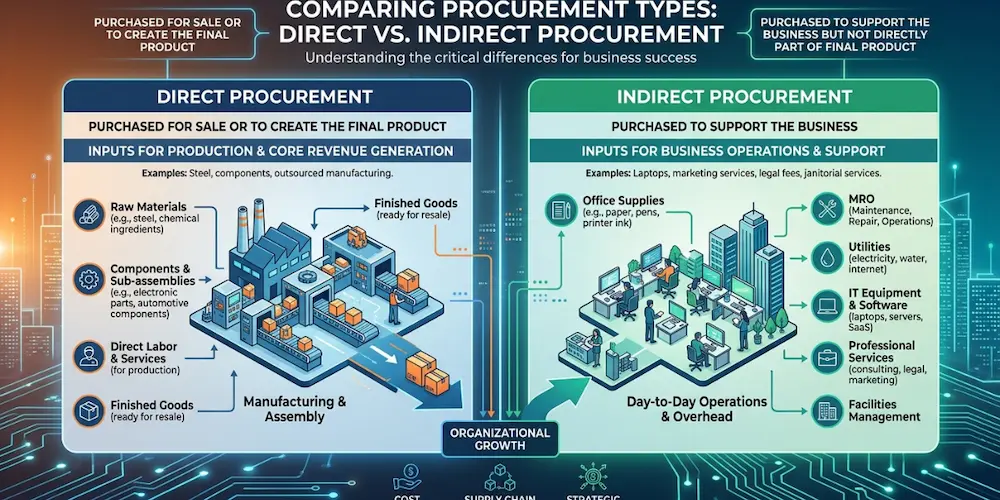
Two basic methods that can be used in the supply chain management system include direct procurement and indirect procurement. The purpose of direct procurement is to ensure the availability and quality of the raw materials needed for manufacturing. On the other hand, indirect procurement is aimed at keeping the organization’s structure cost-effective.
Comparing Direct And Indirect Procurement
| Aspect | Direct Procurement | Indirect Procurement |
| Definition | Buying things and services that are directly used in production or providing core services | Buying things and services that help run a business but aren’t part of the final product |
| Purpose | Makes products that make money | Helps with daily business tasks |
| Connection to Product | Directly becomes part of the finished product | Not part of the final product |
| Examples | Raw materials, parts, tools for making things, and machines for making things | Cleaning, marketing, IT, and office supplies services |
| Impact on Production | Without it, production stops. | Operations become less efficient, but production may still go on. |
| Supplier Relationship | Long-term, strategic partnerships | Usually short-term or transactional |
| Cost Management Focus | Quality, dependability, and a steady supply | Keeping costs down, being efficient, and easy to use |
| Procurement Strategy | Highly planned and demand-driven | Decentralized and flexible |
| Risk Level | High (directly affects income) | Moderate to low |
| Departments Involved | Operations, supply chain, and manufacturing | Administration, finance, IT, and HR |
The Indirect Procurement Process
It helps to control the cost, improve visibility and stay compliant with the procurement policies. Here are some steps involved in indirect procurement from start to finish.
1. Identifying Needs
When stakeholders identify the need for a product or service that supports business operations at the beginning of the process, it enables better demand planning, aligned with the preferred vendors and strong pricing leverage.
2. Supplier Selection And Management
When a need is defined, procurement suppliers review preferred issues and REF. Their evaluation criteria involve price, service quality, risk level, payment terms, support level and compliance. Indirect procurement often covers a lot of different areas, so standardizing supplier evaluations makes sure that quality is always high and costs are lower. Long-term relationships with vendors also make service better and lower risk.
3. Purchase Order And Delivery
The team creates a purchase application to generate a purchase order after selecting and approving a vendor. Standardized workflow approval makes sure that the right people look over each purchase based on how much it costs, what category it is in, and what department it is in. Documented POs keep people accountable, make sure that the goods and services match the order, and make future audits easier. Check the quality of the items or services you receive before you close the order.
4. Invoice Processing And Payment
Invoice processing and payment consist of checking whether the invoices sent by the suppliers match the purchase orders. It is a vital stage that ensures you keep your finances balanced and maintain good supplier relations.
Are hidden indirect costs reducing your profits?
Most businesses lose up to 15–25% budget but saved with automation.
Common Challenges In Indirect Procurement
There are problems that come with managing indirect procurement. Here are six of the most common challenges that teams run into: not being able to see everything, having too many suppliers, and not following the rules.
1. Limited Visibility And Control
Where there is no single system that will enable an organization to monitor its expenditures, then it will be difficult to know or manage how much money the organization is spending. Monitoring, identifying wastage, and reducing unnecessary purchases will be quite challenging.
2. Fragmented Supplier Base
When a company uses a number of vendors for identical goods and services, there is fragmentation within its supply chain. Due to such fragmentation, it becomes difficult for the firm to manage relationships, bargain for better prices, and ensure the same level of quality among all vendors.
3. Manual Processes And Inefficiencies
Where everything depends on manual processes such as invoicing, approval, and record-keeping, there may be delays and errors. Not only will this make the process inefficient, but it will also lead to inaccuracies in financial reporting and decision-making.
4. Decentralized Purchasing
Decentralized purchasing means that various departments operate independently and come up with their individual purchasing policies without having an organized structure. In this way, it is difficult to keep track of prices because these may vary, there may be a repetition in purchases, and there will not be any control over expenses. The benefits of centralized purchasing include coordinated planning and budgeting.
5. Lack Of Proper Risk Management Strategies
The indirect procurement process is associated with some risks, such as failure to comply with agreements, noncompliance risks, and operational risks. In order to mitigate the risk of depending on one supplier, it is important to have an organized risk management strategy that includes listing suppliers, examining alternatives, and maintaining diversity among suppliers. Procurement systems help in monitoring suppliers’ performance and sending alerts in case of contract or compliance risks.
6. Compliance Issues
It is difficult to ensure that every purchase adheres to the internal and external policy since each procurement process is different depending on the organization. It can cause misuse of money, failure of audits, and other risks.
Best Practices & Core Strategies For Managing Indirect Procurement In 2026
Many companies find it hard to keep their expenditure under control. The inefficient procurement process causes a lot of problems for the organizations. In order to deal with such issues, a company should develop an approach that involves more visibility and efficiency.
Centralize And Standardize Processes
Where there is centralization of procurement, all the departments will follow the same procedure for procurement. Standardization of procedure will ensure consistency and help to avoid any inefficiency in terms of procurement practices.
Leverage Technology And Automation
The use of technology and automation makes the work process of organizations much easier and faster. It helps companies to perform operations more effectively by improving their accuracy and gaining more insight into their spend.
Consult A Group Purchasing Organization (GPO)
Using the services of a Group Purchasing Organization (GPO) enables firms to leverage their combined purchasing strengths. It is considered a form of strategic sourcing and supply chain management. Through collaborative efforts in buying with other firms, one is able to enjoy favorable prices, better negotiation capabilities, and qualified suppliers.
Build Strategic Supplier Relationships
Developing good relations with the suppliers results in good communication, timely problem-solving, and enhanced service provision. However, it also helps organizations to get better terms for themselves.
Working With The Finance Department
Working with the finance department ensures that the procurement process meets the financial goals of the business. The interaction between these two departments may lead to sound financial management practices, including proper forecasting and accounting of all expenses.
Educate Staff On Indirect Procurement
It is important to note that educating employees will play a crucial role in improving efficiency in procurement. Educating employees about the indirect procurement policies will help build an environment of responsibility.
The Role Of Procurement Software In 2026 In Indirect Procurement
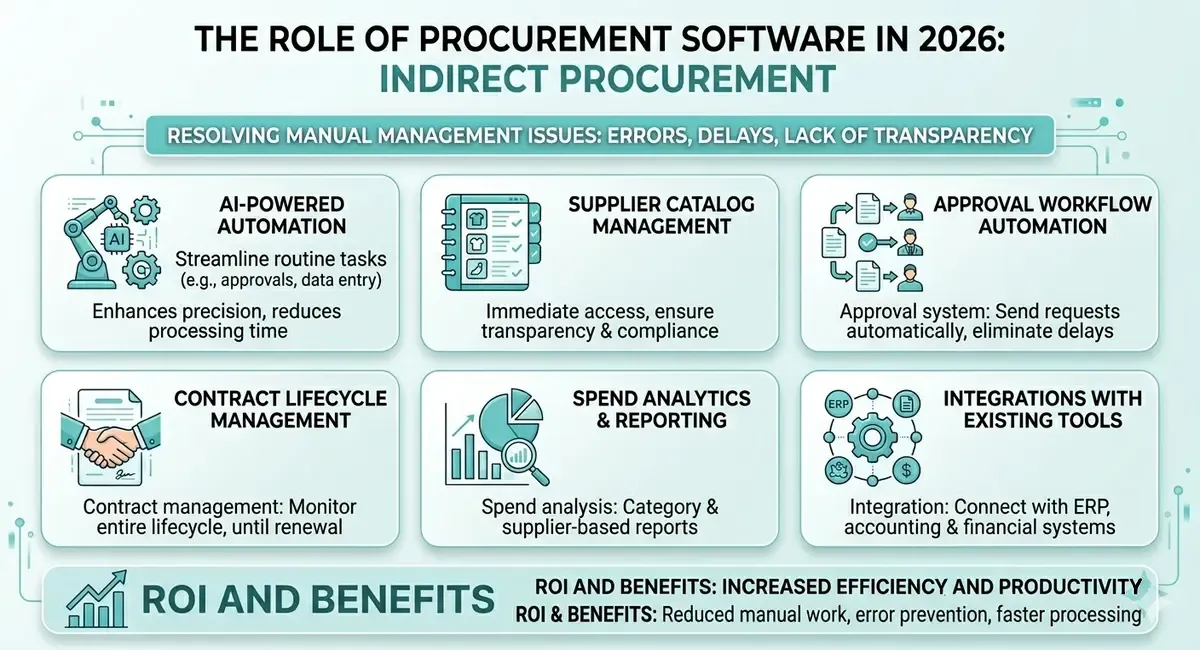
Manual procurement management of indirect procurement is known to cause mistakes, delayed processes, and a lack of transparency. However, with the use of procurement software in 2026, all of the problems that can occur from manual procurement management will be resolved.
Ai-Powered Automation
Procurement automation driven by AI makes it easier for firms to automate routine tasks like approvals, data inputting, and matching invoices. It minimizes human involvement, enhances precision, cuts down processing time, and enables employees to concentrate on more important procurement activities.
Supplier Catalog Management
A good supplier catalog gives one immediate access to all verified suppliers, their prices, and products. It ensures transparency and compliance within the organization and improves procurement decision-making.
Approval Workflow Automation
This approach enables purchase requests to be automated since they can be sent to appropriate managers depending on the criteria determined. It helps to eliminate delays, has no need for reminders, and provides an efficient process of approving purchase requests.
Contract Lifecycle Management
Contract Lifecycle Management is a strategy for contract management throughout the entire process, even after the contracts have been renewed or terminated. This strategy focuses on the management of contracts developed between the organizations and the suppliers.
Spend Analytics And Reporting
With the help of advanced reporting tools, companies can analyze their procurement cost according to different categories, suppliers, and departments. Many advantages can be gained through this process.
Integrations With Existing Tools
Integration of the software procurement tools with other applications enables procurement software to integrate easily with ERPs, accountants, and financials. It helps improve the efficiency of data transfer between different systems and prevents redundancy of data.
Roi And Benefits
The ROI of procurement software is derived from the reduction of manual labor, the minimization of mistakes, and the shortened time for approval processes. It will allow organizations to become more productive and efficient in their procurement process.
Conclusion
Indirect procurement is the hidden engine that keeps businesses running efficiently while controlling operational costs. From facilities and IT to HR services, it supports daily operations and strengthens long-term stability.
By adopting smarter procurement strategies today, businesses can reduce unnecessary expenses and build stronger operational resilience heading into 2026. Organizations that optimize this area early gain a clear competitive advantage.
Now is the right time to review your procurement practices and identify inefficiencies. With expert support from Omni Build Pro, businesses can turn operational spending into measurable savings and improved performance.
Frequently Asked Question
What Is The Main Difference Between Direct And Indirect Spending?
Direct expense has a direct connection with the production of goods or services. But it includes the expenses like raw material, labor, etc., which get incorporated into the final product. Direct expenses have a direct effect on generating income. In contrast to this, indirect expenses encompass all such expenses that help in running a business.
How Can A Business Reduce Its Indirect Costs Quickly?
Indirect costs for an organization can be minimized easily through the processes of concentrating purchases, streamlining suppliers, and cutting any unnecessary expenses that may arise. Automation of the process of approvals through procurement software helps in minimizing costs. Subscription and contract review are additional ways of reducing costs easily.
Why Is Indirect Sourcing Often More Difficult To Manage?
Indirect sourcing is harder to manage because it is decentralized, fragmented, and lacks standard purchasing standards. It involves many departments, frequent low-value purchases, and a large number of suppliers, which reduces visibility and control. Unlike direct sourcing, demand is also less predictable, making planning and cost control more difficult.
Does Technology Play A Role In Modern Procurement?
Yes, technology plays a key role in modern procurement by automating processes, improving spend visibility, and enabling data-driven decisions, which makes procurement faster, more accurate, and cost-efficient.