Do you know that poor procurement management eats up a large portion (almost 9.2%) of businesses annual revenues? If you want to proceed with procurement with cost-effective solutions, you should go with the latest tools and software for procurement because, in 2026, procurement isn’t simply about acquiring materials and a skilled workforce; it’s about strategic and insightful planning.
You must go with some strategic plans and logistic options for the procurement process workflow; otherwise, it can directly affect the business performance, budget, and resources. If you source, select, and manage suppliers in practical ways, it can help meet the timeline, ensure smooth construction, and control costs. A well-managed procurement also reduces material waste and legal issues.
In this blog, we will discuss the 9 steps of best procurement to guide you on how you can improve your procurement process to maintain project quality, transparency, and speed. This will be helpful for you, especially if you are going to procure for the first time. Let’s analyze how to optimize this workflow step-by-step.
Procurement in Detail
The process of obtaining supplies to finish a project with operational objectives and financial stability is known as procurement. In this, business owners identify what supplies are needed, select reliable suppliers, and pay invoices. The objective of properly making use of the right procurement is to get the appropriate supplies at the correct time without compromising the quality or cost.
Appropriate and effective procurement will help to ensure a smooth purchasing process. Procurement is the basic need of every business. Whether you’re a construction contractor tracking down raw materials and shop drawings, an office manager outfitting your team with ergonomic furniture, or an IT director sorting through software licenses, digital procurement is your go-to.
The old way of sourcing materials has run its course. Businesses are moving on, turning to digital platforms and modern tools to get things done faster and smarter. Let’s have a look at why modern methods of procurement are important in 2026.
Why are Modern Procurement Workflow Processes important in 2026?
Digital transformation is changing what’s possible for businesses. From supply chain hiccups to shifting compliance rules and fraud, companies now have the tools to handle it all. Better yet, smarter procurement means fewer delays from suppliers, less risk, and more money staying where it belongs. This also improves the financial transparency, cuts costs, and increases efficiency. Additionally, it also enhances decision-making and develops sound relationships with suppliers. If you are struggling to manage purchasing costs during the procurement process in construction projects, Omni Build Pro is here to help.
The 9 Practical Steps of the Procurement Process Workflow
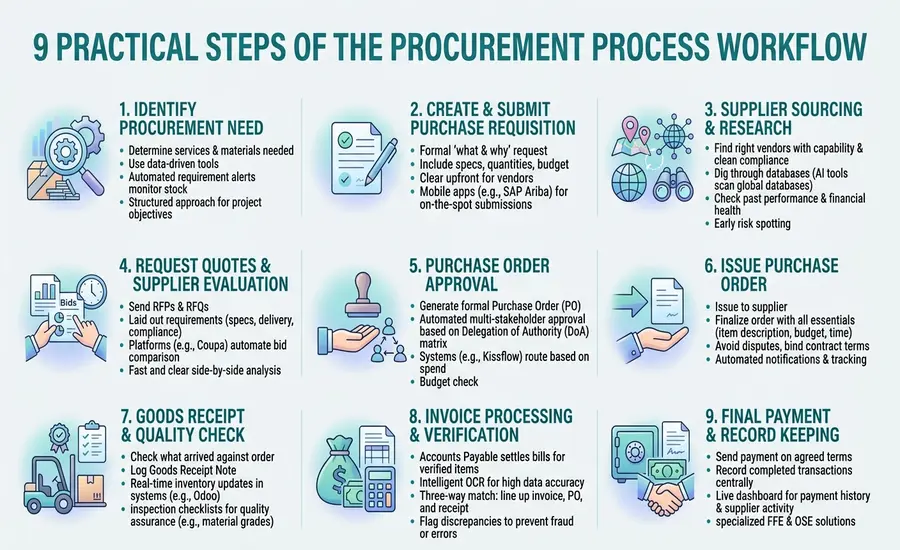
We divide the procurement process workflow into 9 steps to make it easy for you to understand. With a clear concept of the process, the business person can easily reduce the complexities and bring flexibility to the procurement process. Let’s read each step to make your procurement modern and error-free.
The following 9 steps of the procurement process workflow and how digital transformations have modified them to bring fruitful results are explained in detail.
1. Identify Procurement Need
First, you need to identify what services and materials are needed for your business operations and new project. To do this, you need to use data-driven tools instead of manual methods that help determine requirements and budget cycles without missing any information.
You can also use automated requirement alerts that monitor stock and notify the team when it is about to run out.
This avoids material shortages and unnecessary delays. Furthermore, most organizations rely on informal purchase requisitions that can lead to unauthorized costs and communication gaps. But when you use a properly structured procurement approach, you can ensure that the purchasing process is run within project objectives.
2. Create & Submit Purchase Requisition
Once you know what you need, the next step is putting together a purchase requisition. Think of it as your formal way of saying, ‘here’s what we need and why.’ Before you hit submit, double-check that everything is in there: the specs, the quantities, the budget. The clearer you are upfront, the easier it is for suppliers to deliver exactly what you’re after. Leave something out, and you’re looking at back-and-forth delays that nobody has time for.
These days, internal teams don’t have to wait to get back to their desks. With mobile apps like SAP Ariba, requisitions go in on the spot, from anywhere. Everything is tracked digitally, spending is easier to keep an eye on, and approvals that used to take forever now move at a much quicker pace.
3. Supplier Sourcing & Research
Once your requisition is sorted, the next challenge is finding the right vendors, ones who can actually deliver, have the financial backing to stay the course, and have a clean compliance record. Digging through supplier registries the old-fashioned way just doesn’t cut it anymore.
That’s where AI-powered tools come in. Platforms like SAP Ariba and Coupa do the heavy lifting, scanning global supplier databases and automatically checking past performance, financial health, and operational capacity all at once. The result? You spot potential risks early and only move forward with suppliers you can genuinely count on.
4. Request Quotes & Supplier Evaluation
With a solid pool of qualified suppliers in hand, the procurement team sends out RFPs and RFQs, essentially formal documents that lay out exactly what’s needed, from material specs to delivery windows and compliance requirements.
What used to mean drowning in spreadsheets and emails looks very different now. Platforms like SAP Ariba, Coupa, and Jaggaer take incoming bids and do the heavy lifting automatically, pulling out pricing, payment terms, and delivery schedules straight from supplier documents and lining them up in a clean side-by-side comparison—no more manual sorting. The team gets a clear picture of their options faster, and making the right call becomes a whole lot easier.
5. Purchase Order Approval
After selecting the winning bid, the procurement team generates a formal Purchase Order (PO). To maintain strict internal spend controls, this PO must pass through an approval workflow. Small businesses may only require a department manager’s sign-off, whereas large enterprises route POs through an automated multi-stakeholder workflow dictated by the company’s internal Delegation of Authority (DoA) matrix.
Cloud platforms like Kissflow and Oracle Procurement Cloud take the guesswork out of the process. Approvals are routed automatically based on how much is being spent, so the right people are always in the loop, and no money goes out the door before it’s been properly checked against the budget.
6. Issue Purchase Order
Once final approval is obtained, it is time to issue a purchase order to the supplier to finalize the order and inform them that we are ordering the materials or services as per the project requirements. This report mentions all the essential points from the company name and item description to the budget range and delivery time.
The main benefits of this report are that both parties understand each other’s requirements and can avoid disputes and misunderstandings. It also binds them to follow the contract terms. Automated notifications, audit trails, and supplier tracking features further reduce disputes and ensure that both buyers and vendors clearly understand project requirements and purchasing conditions.
7. Goods Receipt & Quality Check
When the delivery arrives, the receiving team checks what came in against what was actually ordered, making sure nothing is missing, damaged, or off-spec. A Goods Receipt Note is logged to record the quantities and condition of everything that came through the door. Systems like Oracle NetSuite, Zoho, or Odoo update stock counts automatically, so inventory records stay accurate in real time.
For materials where quality really matters (consider construction components or specialized parts), the system doesn’t just log the delivery and move on. It automatically kicks off an inspection checklist, prompting the team to verify material grades, batch numbers, and certifications before anything gets cleared for use. It’s a built-in safety net that keeps substandard materials from ever making it to the job site.
8. Invoice Processing & Verification
Invoice verification ensures the finance department settles bills only for items successfully delivered and verified. In 2026, modern Accounts Payable (AP) software leverages intelligent Optical Character Recognition (OCR) and AI to achieve over 99% data extraction accuracy, eliminating manual entry errors.
Before any invoice gets paid, the system runs a quiet but important check in the background. It lines up the supplier’s invoice against the original purchase order and the warehouse receipt, making sure the price, quantity, and delivery all tell the same story. If something doesn’t add up, it gets flagged immediately. This keeps fraudulent billing and accidental double payments from slipping through, and on the flip side, it helps the team catch early payment discounts before the window closes.
9. Final Payment & Record Keeping
Once everything checks out, the finance team sends payment according to whatever terms were agreed upon: Net 30, Net 60, or otherwise. But the process doesn’t just end there. Instead of the paperwork disappearing into a filing cabinet, modern systems automatically record the completed transaction in a central database.
That means buyers can pull up a live dashboard at any time to see payment history, track supplier activity, and spot billing trends as they develop, no digging through old records required. We also offer specialized FFE & OSE procurement solutions to ensure your furniture, fixtures, equipment, and operating supplies are sourced accurately, on time, and within budget.
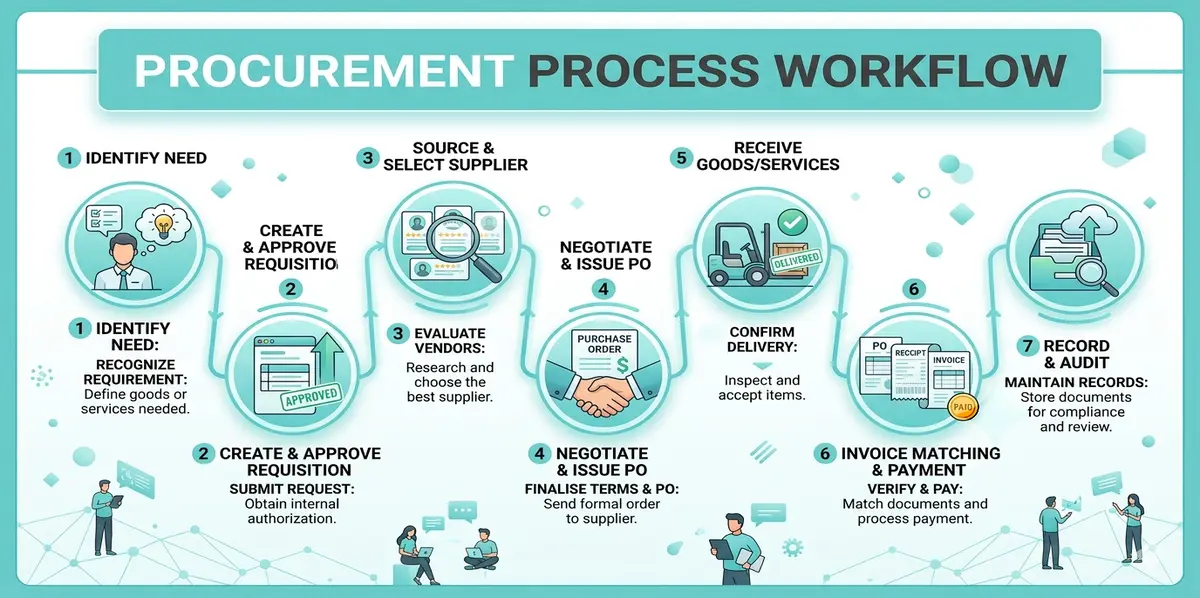
Visualizing the Journey: The Procurement Process Flow Chart
The team finds it challenging to understand the lengthy and complex manual purchasing process. However, it may be simpler to understand and remember if it is shown graphically. The procurement process flow chart is an essential tool in this situation. It provides diagrams and eliminates the need for dozens of pages of documentation. When you use a digital tool, you can analyze the activity from sourcing suppliers to final payments. It also controls risk factors and costly errors to improve accuracy and transparency.
Step-by-step diagrams reduce confusion and improve communication. Additionally, through this procurement process flow chart, you can ensure that the procurement team is following the same process and avoid missing any details. We provide you with a streamlined purchasing process for procurement in healthcare facilities, corporate, construction, interior, or any other field. This makes purchasing more efficient and reliable.
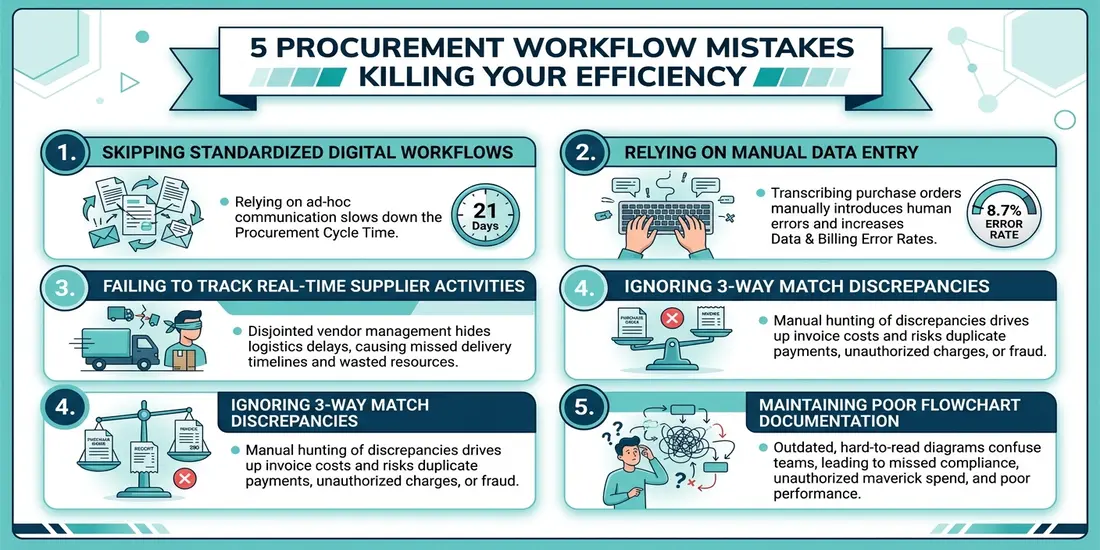
5 Procurement Workflow Mistakes Killing Your Efficiency
● Skipping Standardized Digital Workflows
Operating without a structured digital pipeline forces teams to rely on ad-hoc communication, dragging out your Procurement Cycle Time to a sluggish 21 days.
● Relying on Manual Data Entry
Forcing team members to transcribe purchase orders and asset data manually introduces massive human error, driving your system’s Data & Billing Error Rate up to an unstable 8.7%.
● Failing to Track Real-Time Supplier Activities
Managing vendors through disjointed emails leaves your supply chain blind to logistics delays, leading to missed delivery timelines and resource waste.
● Ignoring 3-Way Match Discrepancies
When discrepancies aren’t caught automatically, your finance team ends up spending valuable time manually hunting them down. That drives up the cost of processing every single invoice, and leaves the door open for duplicate payments, unauthorized charges, and outright fraud to slip through unnoticed.
● Maintaining Poor Flowchart Documentation
Using outdated, hard-to-read process diagrams confuses your operational team, resulting in missed compliance steps, unauthorized maverick spend, and crippled team performance.
Ready to Improve Your Procurement Workflow?
Optimize procurement processes with expert guidance for better results.
Importance of Automated Procurement Workflow In 2026
As businesses strive for seamless procurement in 2026, when supply chain compliance becomes a major priority and costs are skyrocketing, they are migrating from paper and email to digital procurement workflows. This enables you to clearly view spending activities, monitor orders, and budget constraints so that you can act in time and avoid losses and budget overruns.
There are tools that can be used to improve and build on your procurement process workflow. For instance, AI is used to avoid supply delays and to provide economic recommendations. ESG (Environmental, Social, Governance) Compliance support in purchasing in a regulated and sustainable environment. Moreover, Blockchain contracts enhance transparency and decrease disruption. Here is the table below that can help you understand more clearly how you can see a difference in your procurement with automated tools.
| Workflow Performance Feature | Manual Process | Automated System (2026) |
| Procurement Cycle Time | 21 Days | 4.2 Days |
| Data & Billing Error Rate | 8.7% | Less than 1.0% |
| Average Cost to Process an Invoice | High (Due to manual 3-way matching) | Reduced by up to 80% |
Conclusion
While a standard procurement workflow is not an option in 2026, it is critical to protect the purchasing process from losses and improve business growth. It reduces supplier delays, unnecessary costs, and compliance risks from the need to identify with the final stage of payment. It also enhances your decision-making ability and budget control, saving you more money.
If you are still on the old manual procurement method, you need to change your strategy and methodology to bring success and growth to your project. A modern purchasing process can not just improve visibility and keep you on budget, but also create measurable value.
Our team provides efficient procurement strategies that improve cost control and project performance. Rely on the leading experts at Omni Build Pro for seamless procurement support.
Frequently Asked Questions
What is the main role of procurement workflow in businesses?
It increases purchasing efficiency, improves transparency, and speeds up decision-making. It also lowers risk factors and confusion in procurement to build strong relationships with suppliers.
How can you find trustworthy vendors?
You can find the best suppliers by researching the market, reviewing suppliers, and comparing quotes.
What tools are most commonly used in digital procurement workflow management?
For the majority of organizations, it comes down to a combination of cloud-based procurement suites, ERP systems, and supplier relationship management platforms. Tools like SAP Ariba, Coupa, and Oracle NetSuite tend to do the heavy lifting, handling everything from approval workflows and vendor management to keeping spending firmly within budget.
Should small businesses also follow the procurement network workflow?
Yes, it’s great for small businesses too. It helps them control unnecessary expenses, record shopping lists, and improve their financial discipline.