
Every dollar a business spends on materials, equipment or outsourced services moves through some version of a buying process, whether or not anyone in the company has ever written it down. Understanding the Procurement Process Steps that take a simple need and transform it into a completed purchase can be the difference between the project. That is completed on time and the one that is quietly draining money due to duplication of orders, deadlines and suppliers that have not been properly vetted. We have seen unsystematic buying become systematized, repeatable, and disciplined at Omni Build Pro more than once, and in this guide, we will show you how that transformation occurs, one step at a time.
What Is a Procurement Process?
Imagine a mid-sized business that is urgently in need of new office furniture, a construction company that needs 3 job locations of structural steel at the same time, or a hospital that needs to replenish the supply of surgical equipment before it runs out. With all that, there must always be one person who notices the necessity, chooses what to purchase, where to purchase it, haggles over a price and ensures that the purchase actually arrives in good condition to be used.
The whole series of decisions is the procurement process, a well-organized process that begins with a purchase requisition and concludes with an invoice paid. Companies that do this informally, as an ad-hoc activity, are likely to overspend, order the same thing in multiple departments and lose track of where their money is really being spent. Companies treating it as a formal procurement lifecycle can reap the reverse: they have predictable costs, better relationships with suppliers and fewer job site surprises.
Why a Structured Procurement Process Matters?
The figures present a good argument to formalize what most companies continue to do informally. Amazon Business has found in its 2025 State of Procurement Data Report that 47% of procurement decision-makers are experiencing the largest challenges of operational efficiency and process complexity, followed by 32% who cited supply chain disruption as their top operational risk this year. In different studies highlighted by Deloitte and DocuSign, research revealed that ineffective contract management costs companies about $2 trillion annually around the world, a figure that can be traced back, to a large extent, to procurement teams not following the steps to identify bad terms before signature.
On the positive side, companies that have automated some purchasing processes have reported significant improvements: PLANERGY 2025 procurement trends study revealed that the processing efficiency in mid-sized companies that automate their procurement increased by 40%, and a study backed by Accenture, which is discussed by Zycus, reported that the productivity improved by 40% when AI tools were added to the procurement decision-making process. In other words, a well-defined process is not a bureaucratic overhead; it is one of the more certain cost-control measures that a business possesses.
| Procurement Challenge | Typical Impact | What a Structured Process Fixes |
| Untracked or maverick spending | Budget overruns, duplicate orders | Centralized purchase requisitions |
| Weak supplier vetting | Late or defective deliveries | Formal supplier selection & evaluation |
| Rushed contract terms | Unfavorable pricing, legal exposure | Dedicated contract negotiation & award stage |
| Manual invoice matching | Payment delays, disputes | Standardized invoice approval & payment workflow |
The 7 Steps of the Procurement Process
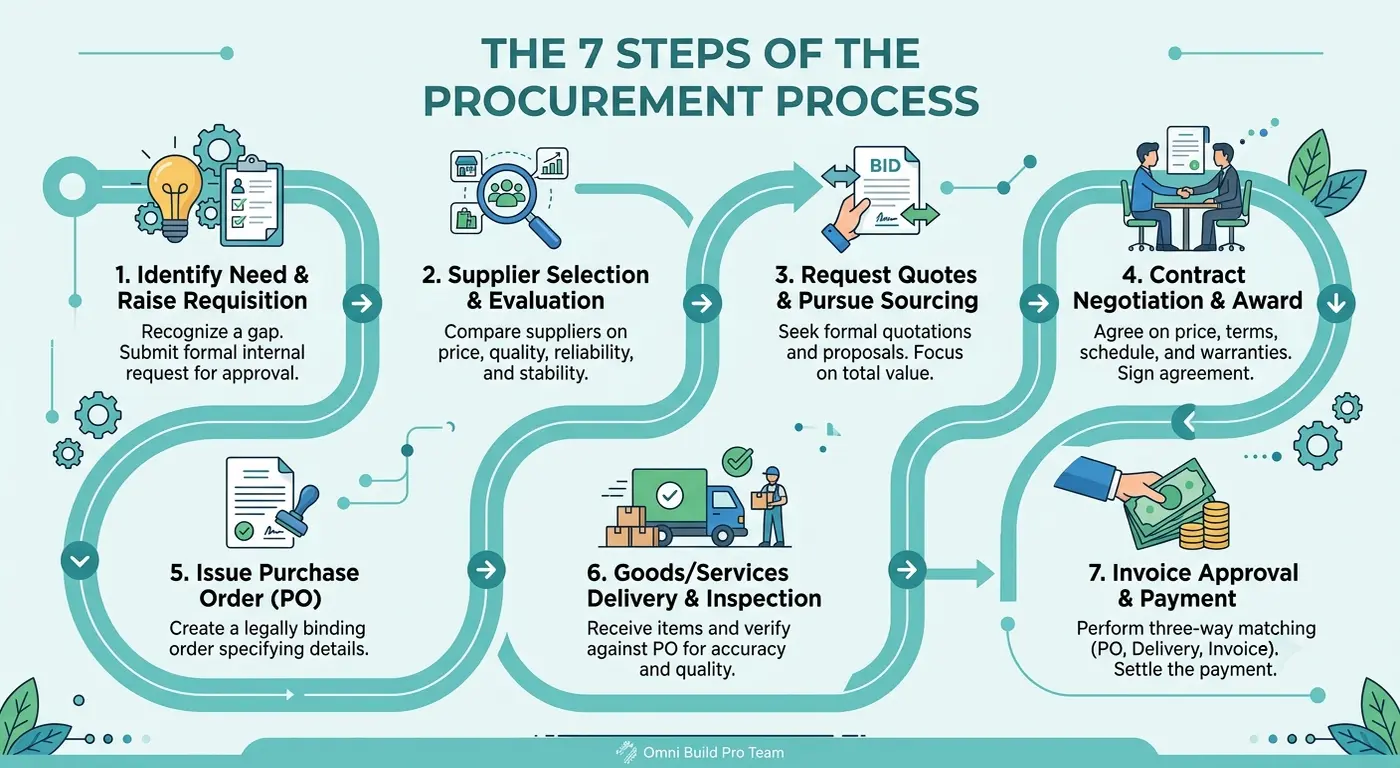
Step 1: Identify the Need and Raise a Purchase Requisition
All purchases start with a disconnect between what a team has and what it actually needs to continue a project and bridging that gap in the right direction is the first of the Procurement Process Steps that are worth getting right. A site manager sees that the concrete supply is dwindling, or an operations lead sees that the office needs new monitors before the next hiring round, anyhow, the need must be recorded, not talked about in a hallway.
Here purchase requisition comes in, a formal internal request that can specify what is required, how much, when and why. The requests are usually channeled through a manager or a departmental head to be approved prior to any supplier being contacted and thus avoiding the type of unauthorized expenses that easily swell the budgets. This is one of the most frequent reasons why companies lose insight into how they spend.
Step 2: Supplier Selection & Evaluation
After a requisition has been approved the actual decision-making process begins: who is to actually perform this order? This is known as supplier selection and evaluation, whereby the businesses compare the suppliers based on the price, reliability, past quality experience and financial stability of a supplier instead of defaulting to the supplier who replied to the phone first.
This is a typical step that construction and infrastructure buyers can take advantage of, considering construction project management experts, who are aware of the vendors capable of meeting the site deadlines and those who constantly miss them. A stringent assessment often takes into account previous delivery record, qualifications, capacity and even the risk exposure of a supplier, as an indebted supplier may abandon a project in the middle of construction. Firms that do not undergo formal assessment, but make decisions based on custom or expediency, will always find that they have been fooled by suppliers until it is too late to ship a consignment.
Step 3: Request Quotes and Pursue Strategic Sourcing
Having a list of potential vendors who have successfully passed the qualification process, procurement departments transition into sourcing. In which formal quotations are sought, proposals are evaluated and occasionally competitive bids are conducted on bigger purchases. It is also here that strategic sourcing stands out from the pack of price-shopping: rather than picking the lowest quote number, strategic sourcing considers the overall value, such as delivery timeframes, payment conditions and future cooperation possibilities.
This is the point at which many businesses will resort to outside professional procurement solutions, especially when a purchase is an expert piece of equipment or materials that the internal team lacks the expertise to procure. Having several quotes in writing also leaves a paper trail that safeguards the business in case a disagreement occurs in the future with regard to price or scope.
Step 4: Contract Negotiation & Award
It is in negotiation that the terms of a deal are actually made, rather than accepted. Contract negotiation & award discusses pricing, delivery schedules, warranty, penalty clauses in the case of late delivery, and milestones in payment, and it is an important thing to consider, as so many poorly written contracts become an expensive liability down the line.
In a business where a number of construction projects are running in parallel, specialized procurement for construction projects can frequently entail negotiating a framework agreement that fixes the price of a number of sites concurrently, instead of having a new negotiation each time. When the terms are agreed upon, the winning supplier is officially given the contract, and both parties sign an agreement that will form the basis of all that comes after, including what transpires in case of a failure.
Step 5: Issue the Purchase Order (PO)
Having signed a contract, procurement sends a formal purchase order (PO), a legally binding document which states precisely what is to be purchased, at what price, in what quantity and by what date. The PO is the working point of the rest of the transaction: it is what finance refers to in approving payment, what the warehouse refers to on delivery and what both parties refer to in case there is ever a dispute about what was actually ordered.
Most procurement departments are currently automating the creation of POs based on the approved requisition and contracts, and this reduces the number of transcription errors that previously found their way into the system as a result of someone typing order details into different systems.
Step 6: Goods/Services Delivery & Inspection
It is the stage in which the paperwork is put to the test. Goods/services delivery & inspection refers to the actual physical inspection of goods/services received against ordered goods and ensuring that the goods received are the correct quantity, correct specifications and correct condition before they are accepted into inventory or utilized on site.
This may spread to elaborate receiving policies in the case of construction and hospitality customers. Full FF&E and OS&E procurement support may involve checking furniture, fixtures, equipment and operating supplies against manufacturer specifications before a single piece of furniture or equipment gets into a guest room or job site. It is much less expensive to intercept a faulty shipment here before it is signed than it is to find out the trouble after it is installed, when returns and rework are sucking holes in the budget and the timeline.
Step 7: Invoice Approval & Payment
The final step closes the loop: invoice approval & payment. After accepting goods or services, the invoice of a supplier is compared with the initial PO and the delivery receipt is compared with the invoice and the money is exchanged only after the three-way matching is done. Any discrepancies during this stage, such as a delivery that is below what was invoiced, are flagged and sorted out before payment is dispatched, not afterward.
One can also avoid making payments twice on the same order or missing the payment deadline, which safeguards the relationship with suppliers, as they prefer customers who will make their payments on time. This process is in fact the final phase that completes the procurement lifecycle of that purchase, although the relationship with the supplier will often last long after it.
Steps in the Procurement Process
| Step | Focus | Primary Output |
| 1 | Need Identification | Purchase Requisition |
| 2 | Supplier Selection & Evaluation | Vendor Shortlist |
| 3 | Sourcing & Quotes | Comparative Proposals |
| 4 | Contract Negotiation & Award | Signed Contract |
| 5 | Purchase Order Issuance | Approved PO |
| 6 | Delivery & Inspection | Verified Goods/Services |
| 7 | Invoice Approval & Payment | Completed Transaction |
Having the Steps in the procurement process in one place, such as the table above, is what can keep teams that are organized and those that lose track of where an order is. Such a quick reference also facilitates easier training of new staff or a purchase transfer in the middle of the process without losing context.
Simplify Your Procurement Process Today
Talk to the Smart Constructs team.
How the Process Adapts Across Industries
Although the basic template remains unchanged, the actual form of a 7 Step Procurement Process appears to be different based on what a business actually purchases. The lead times, quality inspections and supplier relationships of a hotel developer sourcing furniture and linens are of a completely different nature. Than those of an energy company sourcing turbines or a corporate office sourcing workstations, although all of them are technically going through the same seven stages.
When it comes to hospitality clients, a step-by-step process often implies organizing dozens of vendors within the tight opening schedule, hence the reason why most hotel developers rely on specialized hotel project procurement solutions to ensure that the furniture, fixtures, and operating supplies are delivered in the correct order, and not at the same time.
Energy projects introduce a new set of pressures, such as long lead times on bespoke equipment, adherence to strict compliance requirements, and supplier risk, which can cause a project to stall for months should one component be late. In this case, a rigorous step-by-step procurement process may be of even greater importance, and energy sector procurement expertise is often the difference between a project that is on time and one that is stalling because nobody identified a part as a high-risk item in time.
The same pressure is slightly less but not insignificant in the case of corporate offices: balancing out furniture, technology and workspace fit-outs in a variety of locations. Effective office and workspace procurement management keeps these purchases consistent in quality and pricing, even when they’re happening in several cities at once.
Common Challenges in the Procurement Lifecycle
Despite a comprehensive seven-step model, there is still a lot that can go awry in the process. A common blind spot is simply concentrating on unit price without considering the total cost of ownership (TCO), the maintenance, downtime, and replacement costs that accrue throughout the life of an asset and can frequently overshadow the initial purchase price.
Another is treating every purchase the same way, regardless of indirect vs direct procurement distinctions: buying raw materials that go directly into a product demands far more scrutiny than ordering office supplies, yet many companies apply identical approval chains to both, slowing down low-risk purchases unnecessarily.
Another area that companies do not put sufficient resources into until a supplier suddenly collapses in the middle of the contract is supplier risk management. Creating a procure-to-pay (P2P) system, which links requisitions, purchase orders, and invoices within a single platform, coupled with real spend analysis / spend visibility, provides the finance and operations units with real-time visibility of money flow rather than finding it in a quarterly audit. A robust supplier relationship management (SRM) and definite procurement policy rules and compliance considerations complete the image and ensure that purchasing remains the same despite personnel and vendor turnover.
Measuring Procurement Success: Metrics That Matter
The results of a procurement process are the only measure that makes it as good as possible, and that is why the best teams measure a few main indicators instead of following their impressions. One of the most significant indicators is compliance with the contract: studies by the Procurement Metrics That Matter report by Ardent Partners revealed that the best-performing procurement teams retain about 75% of the spend under negotiated contracts, whereas the average ones retain about 60% on the table on average – a difference that directly translates into the savings that one can leave on the table.
Another benchmark useful is the cost per purchase order; industry estimates of the cost of processing a single PO by the Center of Advanced Procurement Strategy indicate an average cost of several hundred dollars when labor, systems, and communication overhead costs are included, which is a solid argument in support of automating repetitive orders of very low value instead of running them through the same manual approval process as major purchases.
Another indicator is market growth, which should be monitored. Verified Market Research estimates that the global procurement software market will grow to approximately $9.5 billion by 2028, a trend that is indicative of the number of businesses eager to invest in a solution to monitor their spend, automate the approval process, and store supplier data in a single location instead of across multiple spreadsheets. All these figures are irrelevant by themselves, but what is interesting about them is that you can compare your own contract compliance rate, PO cost and supplier on-time delivery rate with them on a quarter-by-quarter basis to determine whether your process is improving or is merely busy.
Best Practices to Improve Your Procurement Process
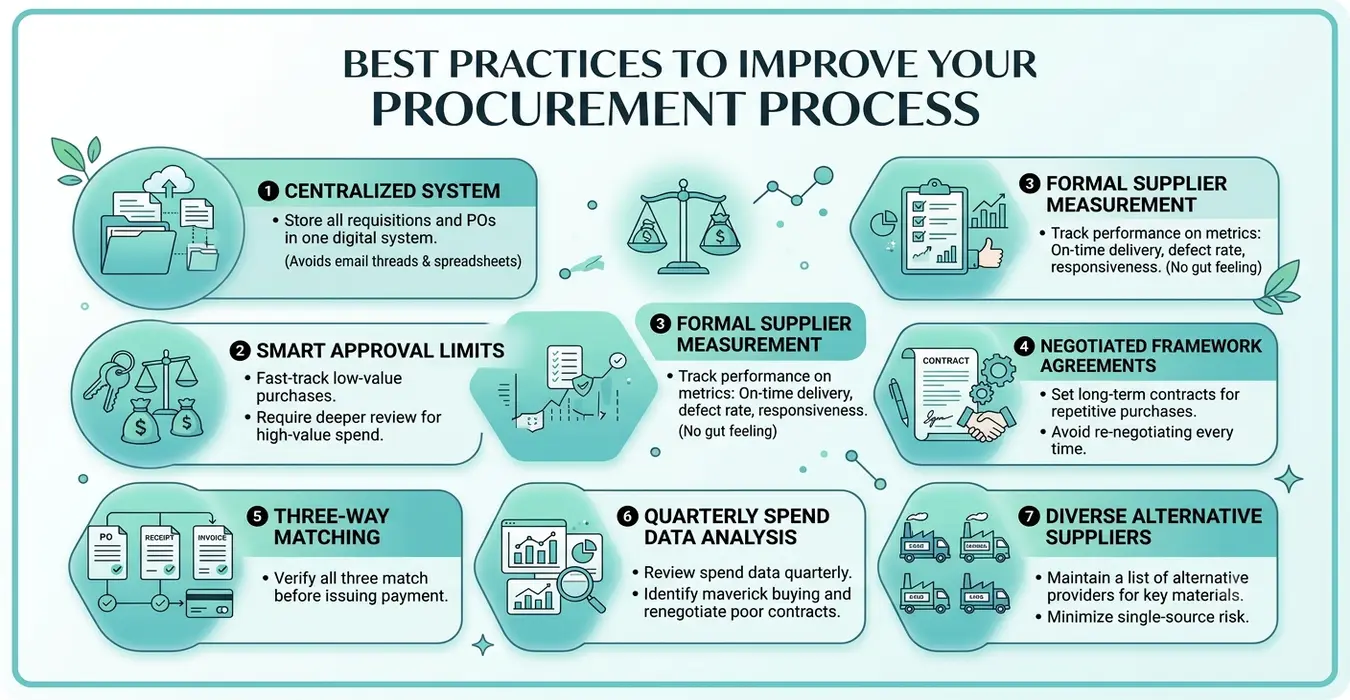
- Store requisitions and purchase orders in one system instead of email threads and spreadsheets that are spread out.
- Establish approval limits that are low enough to fast-track low-value purchases and delay high-value purchases to allow close examination.
- Measurement of supplier performance (formally) on-time delivery rate, defect rate, responsiveness, and not by gut feeling.
- Enter into negotiated framework agreements on repetitive purchases rather than negotiating each time afresh.
- Do three-way matching (PO, receipt, invoice) before issuing any payment.
- Look at the spend data quarterly to identify maverick buying and renegotiate the poorly performing contracts.
- Have a list of alternative providers of key materials to minimize single-source risk.
How Does Omni Build Pro Support Your Procurement Process?
It is one thing to formalize seven steps on a piece of paper and another to execute them over dozens of live projects over an extended period. That is the difference the Omni Build Pro Experts strive to narrow down to clients daily, designing requisition workflows, shortlisting suppliers, and entering contracts that stand the test of actual project execution.
Whether it be the assistance of a client sourcing structural materials, furnishing a new hotel facility or standardizing purchasing across many offices, our group applies the same disciplined structure described in this guide but customized to the realities of each business. It is not about a cleaner process on paper but fewer late shipments, fewer budget surprises, and better and more reliable supplier relationships over time.
Conclusion
A powerful procurement process is not very glamorous, yet one of the surest means a business will defend its margins and its timeframes. Between the initial purchase requisition and the last invoice, all the steps are in place to identify issues early enough before they turn into costly issues. Regardless of whether you are dealing with a single project or buying in a dozen different locations, the structure that the Omni Build Pro is based on can be adjusted to your size. Even a handful of these steps done correctly are likely to result in savings in cost and reliability that can be observed in a single quarter.
Frequently Asked Questions
What are the 7 steps in a procurement process?
These are: need identification and purchase requisition, supplier selection and evaluation, sourcing and requesting quotes, contract negotiation and award, purchase order issuance, delivery and inspection and lastly invoice approval and payment.
What is the difference between procurement and purchasing?
Purchasing is one step in the procurement process, the process of making and paying for an order. The broader process is procurement, which involves establishing need, assessing the suppliers, negotiating the contracts and managing the relationship even after the purchase has been made.
What is the average time of a procurement process?
It differs significantly depending on the size of the purchase and the industry. The office supply order, which is a daily order, can be closed within a day or two, whereas a construction materials contract with a competitive bidding and negotiation process may take a few weeks or months between the requirement and the actual signing of the contract.
What is the distinction between a purchase requisition and a purchase order?
A purchase requisition is an internal request seeking approval to purchase something. Once an external, legally binding document is sent to a supplier after the request has been approved and a vendor is chosen, it is called a purchase order.
What are some of the ways small businesses can enhance procurement without costly software?
Begin with the essentials: a common requisition form, a lean approval process, a running sheet of supplier performance, and a culture of verifying invoices against POs before making payments. A lot of the benefits of a formal process are due to consistency rather than the tools that are employed to implement it.
What is the role of technology in procurement today?
Online procurement systems are increasingly automating the routing of requisitions, the creation of POs and the matching of invoices, reducing the amount of manual data entry and providing teams with real-time visibility into spend. Procurement leader surveys indicate a steady increase in automation and AI-assisted sourcing in the coming years. Although in most cases, these technologies are used in conjunction with human resources instead of substituting judgment decisions with algorithms.