Any building project operates on two aspects: a plan and resources to implement it. There must be somebody to obtain the steel, to get the necessary subcontractors, to negotiate reasonable costs, and to ensure that all arrives on site when the crew requires it. That job falls under construction procurement management, and it determines nearly all the final results on a job site, including the final budget and the handover date.
Procurement is usually a background activity to the owners and contractors. It isn’t. A weak procurement plan results in greater schedule slippage than virtually any design issue. This guide will explain what construction procurement really involves, why companies should take it seriously, the steps involved in an effective procurement process, and how companies like Omni Build Pro apply these practices to real projects.
What Does Procurement Management in Construction Actually Involve?
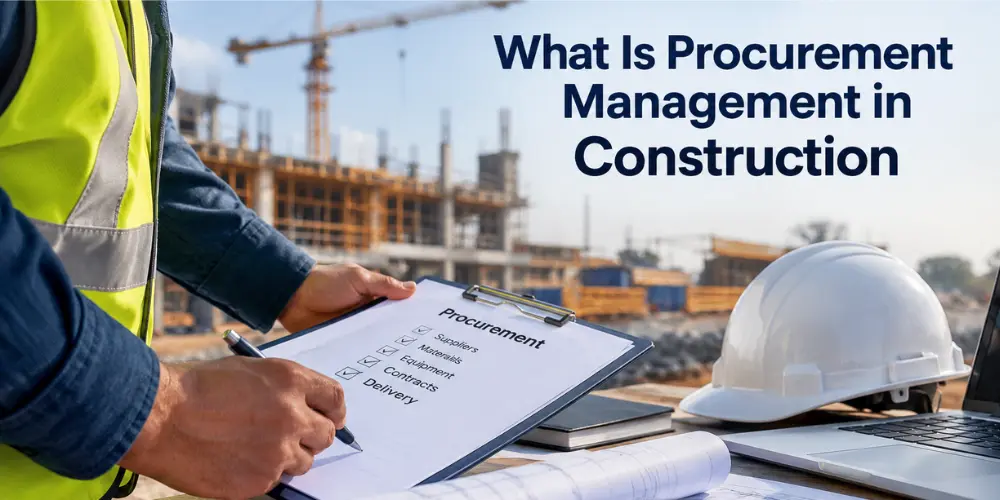
Simply, procurement management in construction means knowing what a project needs. It involves finding the right suppliers and subcontractors to deliver those requirements. It also includes negotiating contracts and ensuring timely delivery so the work does not stall. Procurement covers materials, equipment, labor contracts, and specialty services.
Imagine it as the line between a drawing of a design and a completed wall. An architect may be able to spec a particular kind of steel beam, but somebody must then find a supplier who is able to bring that specific beam, at the appropriate price, on the appropriate day. That is the construction procurement underway.
Good procurement is not merely purchasing at a low cost. It is a question of striking a balance between the three factors which always act in opposite directions: cost, quality and timing. A supplier may have the lowest price but he may take three weeks longer to deliver. A second one may deliver in a hurry but compromise on the quality of materials. That is the tension Procurement teams live in daily.
Why Procurement Management Matters on Every Project
Ask any project manager what keeps them up at night, and material delays will likely be on the list. Procurement drives much of this risk, which is why project teams should give it more attention than it usually receives.
The following are some of the things that strong procurement management safeguards in a job:
- Budget accuracy. Bulk purchasing and negotiated contracts ensure that the material costs are within the estimate rather than falling out of control.
- Schedule reliability. Coordinated delivery windows imply that crews do not have to stand around and wait until materials are brought on site.
- Build quality. Verified suppliers and specifications eliminate the chances of poor materials getting into the building.
- Legal protection. Properly prepared contracts define duties and thus conflicts due to late deadlines or broken products are less difficult to solve.
- Supply chain resilience. Backup vendors allow a procurement team to switch quickly in case a major supplier gets into trouble.
Omit any of these and the project ends up absorbing the cost later; normally in the shape of change orders, idle labor or a customer who begins to pose difficult questions.
The Construction Procurement Management Process, Step by Step
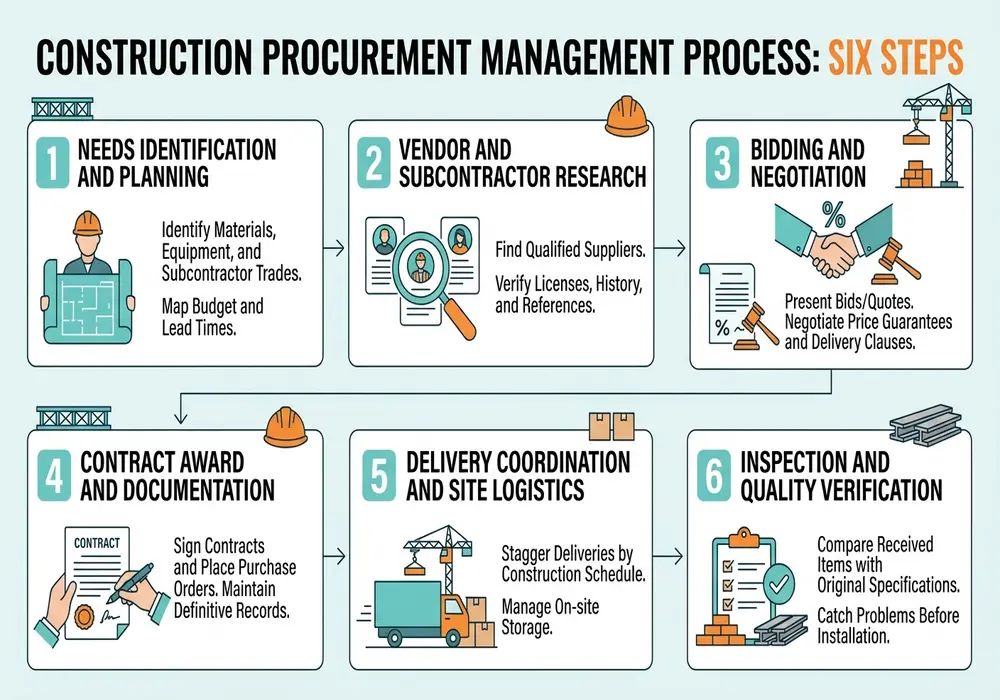
A construction procurement management plan generally involves six stages. Avoiding one will hardly save time; it will only postpone the issue to a later date.
1. Needs Identification and Planning
The team reviews the architectural and engineering drawings before placing any purchase orders. This review helps the team create a complete list of materials, equipment, and trades that require subcontracting. This phase closely connects with the initial Planning and Procurement for Construction work, where the budget targets and lead times are mapped onto the project schedule.
2. Vendor and Subcontractor Research
Next comes the search for qualified suppliers and trade contractors. The teams verify licensing, previous project history, financial stability and references.A vendor may offer a fantastic price, but if they regularly miss deadlines, choosing them can create unnecessary risks.
3. Bidding and Negotiation
Shortlisted vendors present their bids or quotes. This is where a procurement strategy comes in handy. Good negotiators do not simply pursue the best price; they will negotiate price guarantees, delivery clauses and penalties against late deliveries.
4. Contract Award and Documentation
The team signs contracts and issues purchase orders after both parties agree on the terms. Definitive records in this case eliminate the he-said, she-said conflicts that bring projects to a screeching halt in the middle of construction.
5. Delivery Coordination and Site Logistics
The team should receive materials in the correct sequence, not just on the scheduled delivery date. It would be impractical to dump all the materials on the ground in the first week. This would cause havoc in terms of storage, cause safety risks, and the procurement teams would stagger deliveries on the construction schedule.
6. Inspection and Quality Verification
Once materials or finished subcontracted work is received, someone compares it with the original specification prior to it being signed off. It is much cheaper to catch a problem before installation than after it has been installed.
Who Actually Handles Procurement on a Construction Team
In smaller projects, one project manager may handle procurement, scheduling and site management. More complex projects typically allocate the task to a specialist procurement manager or a team of specialists in a construction management firm.
That team typically works alongside:
- Project managers, who confirm what the schedule needs and when
- Architects and engineers, who define exact material specifications
- Site supervisors, who flag delivery problems or quality issues as soon as they show up
- Finance teams, who track spending against the approved budget
It is important to have clearer handoffs between these groups than one would think. A procurement manager who uses an outdated drawing set will place an order for the wrong sizes of windows. A site supervisor who is not aware that a shipment has been missed for a week will book a crew to do something that they are not ready to begin yet. The failure of most procurements is due to a breakdown in communication somewhere along this chain, not one bad decision.
How Technology Is Changing Construction Purchasing Management
Teams run the procurement process using spreadsheets, and they still use them on some smaller projects. However, in the last ten years, construction purchasing management has moved towards dedicated software by far, and with a purpose.
Modern procurement platforms let teams:
- Monitor purchase orders and delivery status on a real-time basis, rather than making phone calls to vendors.
- Compare bids between vendors using historical price data.
- Flag budget overruns automatically with costs being registered against every line item.
- Documentation of the share is shared with site teams in real time, reducing the number of out-of-date drawing sets or overlooked spec changes.
This does not substitute for good judgment or good relationships with vendors. But it does eliminate much of the manual tracking that would take up a week of a procurement manager’s time, and use that time instead to engage in negotiation and vetting of vendors.
Choosing the Right Construction Procurement Strategy
All projects are not to be procured in the same way. The strategy is based on the size of the project, level of risk and the degree of control that the owner desires over the selection of a vendor. Some of the usual Procurement Methods that are applied in the industry include:
- Design-Bid-Build: Design is done before handing over the plans to contractors who place bids on the designed plans. Straightforward, but slower to start construction.
- Design-Build: It is a construction method that involves the same team to do both design and construction, thus making the process of procurement faster, as not many parties are required to sign off.
- Construction Management at Risk (CMAR): A construction manager comes on board at an early stage and leads procurement decisions prior to the design even being completed, which helps to keep the costs under control at the very beginning.
- Integrated Project Delivery (IPD): The procurement decision-making is collectively shared among owners, designers, and contractors and distributed among them.
One of the most common construction procurement errors owners make is choosing the wrong procurement method for the project type.Even a small residential remodelling does not require IPD, and a major infrastructure project would hardly be appropriate for a strict design-bid-build solution.
Construction Procurement Planning: Where Projects Usually Go Wrong
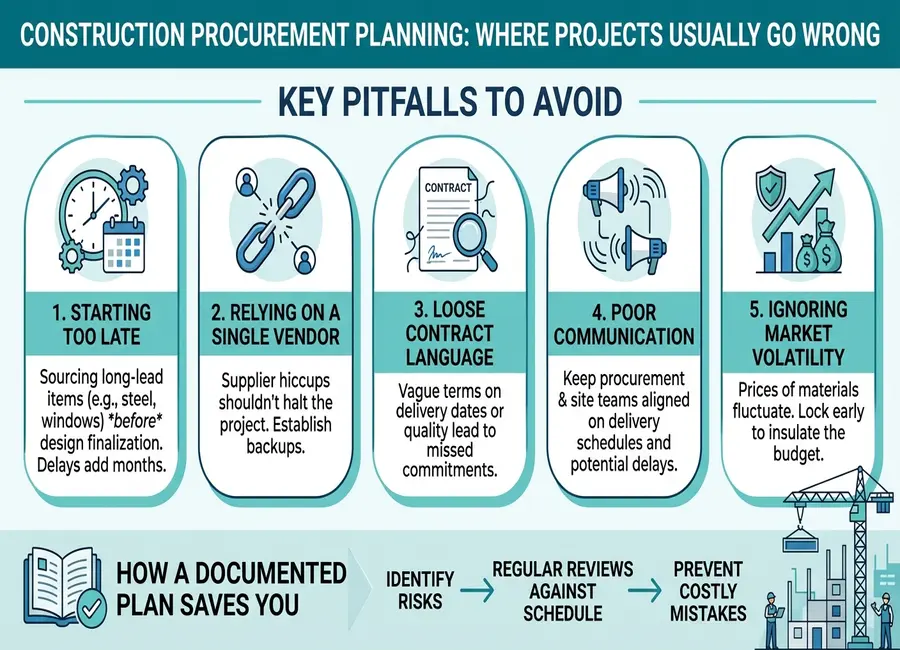
Even seasoned teams encounter the same handful of procurement issues. Note these early saves to save later on:
- Starting procurement too late. Delaying the start of sourcing long-lead products such as structural steel or personalized windows until the design is finalized can add months to a schedule.
- Relying on a single vendor. A single hiccup on the part of a supplier should not be sufficient to halt a project.
- Loose contract language. Generalized terms in terms of delivery dates or quality criteria leave room to default on commitments by vendors.
- Poor communication between procurement and site teams. When the site crew is not aware of a delayed delivery until the truck does not arrive, the entire schedule suffers.
- Ignoring market volatility. Prices of materials are fluctuating, occasionally drastically. Early price locking insulates the budget against shocks.
A documented construction procurement management plan helps teams identify most of these issues before they become costly. Teams regularly review the plan against the actual project schedule.
A quick example. Imagine a mid-size commercial project where the procurement department orders tailor-made curtain wall glass six weeks before the project needs it on-site, based on the vendor’s standard lead time. Then the supplier of glass to the vendor runs out, and the schedule extends to eleven weeks. The framing crew has no backup vendor or early warning system so they complete their section and do not have anything to surround it with.
The delay disrupts the entire schedule, forces the team to reschedule subcontractors for the next phase, and leaves the customer wondering why the project is falling behind. A single oversight in checking supplier risk can result in weeks of wasted time. A strong procurement strategy can prevent this problem by monitoring vendor risks and keeping a backup supplier on file.
How Procurement Connects to Construction Supply Chain Management
Procurement doesn’t operate in isolation. It is a component of a broader construction supply chain management system which encompasses manufacturers, distributors, freight carriers and the site itself. A three-state delay at a steel mill can affect the framing crew on-site.
That is why experienced procurement teams monitor the entire supply chain, not just their direct vendors.
They observe the markets of raw materials, track shipment schedules, and have backup suppliers ready in case of anything that has a long lead time. It is the difference between the projects that remain on schedule and those that do not that takes into account the treatment of procurement as an element of a broad supply chain, not a mere purchasing exercise.
Cost Considerations Every Procurement Plan Should Account For
Costs of materials and labor do not often remain constant over the life of a project, and a procurement plan that does not take this fact into consideration is likely to have run out of budget halfway through. Some cost considerations to consider when creating any construction procurement strategy:
- Price escalation clauses. Fixing a price with a vendor on the entire project may backfire when the vendor refuses to pay it when the cost of materials surges. Previously agreed-upon escalation clauses provide both parties with a reasonable means to deal with price fluctuations.
- Bulk purchasing discounts. The simple ability to order materials in bulk quantities and across various project stages, instead of in small quantities on frequent orders, can often open up significant savings.
- Currency and import risk. International sourcing of specialty materials must consider exchange rate changes and importation duties as well as the unit price.
- Storage and handling costs. Early purchases to secure a price only benefit if the site has a secure place to keep the material until the time it is required. Otherwise, the savings will be consumed by damage, theft or rented storage space.
All these are not complex factors but it is the combination of all of them in a procurement plan that ensures that the actual expenditure of a project is not that much different than the initial estimate of a project.
Building a Reliable Project Procurement Management Plan
A written plan transforms procurement into a reusable system. An effective Project Procurement Management Plan will generally cover:
- Complete list of materials, equipment, and services required, linked to the project schedule.
- Vendor lists that are pre-qualified and have backup options on essential items.
- Well-defined purchase order approval processes for purchases over a specific dollar threshold.
- Clear quality guidelines and checkpoints.
- Risk register of price volatility, supplier reliability and lead-time exposure.
Projects that have a documented plan are more adaptable when something does go wrong, as the team is already aware of the backup vendor or of the contingency budget.
How Omni Build Pro Handles Construction Procurement
At Omni Build Pro, procurement is not a back-office function that is glued to project management. We provide construction procurement services that include vendor vetting, contract negotiation, delivery scheduling, and quality inspection for industrial, commercial, and residential construction and specialized procurement such asFF&E, OS&E, and energy sector procurement.
Our pre-construction services also incorporate procurement planning, which means that sourcing decisions are made early, even before ground is broken. That early start is usually the only major contributor to maintaining a material budget and delivery schedule of a project.
Whether the project requires a single subcontractor or an entire supply chain, our team manages the entire process from start to finish. Therefore, clients do not have to spend much time pursuing vendors but see the project come to life instead.
Need Construction Procurement Help?
Get expert procurement support for your next project.
Final Thoughts
Procurement often receives less attention than design or site work, yet it can determine whether a project finishes on time and within budget or faces costly change orders. The difference between reacting to problems and preventing them at the beginning is a well-defined process, trusted vendors, and a documented plan.
When your next project requires a procurement partner that takes the sourcing part as seriously as the build itself, contact Omni Build Pro for a detailed quote.
Frequently Asked Questions
What is the distinction between procurement and purchasing in construction?
Buying is one transaction: to obtain a particular product. Procurement encompasses the whole process surrounding that purchase which involves planning, selecting the vendor, negotiation, contract management and the coordination of the delivery.
Who takes care of procurement in a construction project?
A procurement manager, general contractor, or construction management firm usually oversees this process in close collaboration with the project manager, architects, and site supervisors.
What are the causes of the majority of delays in procurement in construction?
Most of the delays associated with procurement include late vendor selection, single-source dependency and lack of communication between the procurement team and the site teams.
When do you think procurement planning should begin on a project?
Preferably, procurement planning should start at the design stage, particularly where materials or equipment have very long lead times, and not when it comes to construction.
Is procurement management a factor in construction quality?
Yes.Procurement teams vet vendors and inspect materials, directly affecting the quality of the materials used in the finished structure.
Which software are construction teams using to procure?
Most teams have specific construction procurement or ERP systems where purchase orders, vendor bids and budget spending are all viewed in a single location, as opposed to operating everything (spreadsheets and email) separately.
Can poor procurement increase the risk of legal disputes?
Yes. A typical cause of conflict between the owners, contractors and vendors is vague contract conditions regarding delivery schedules, quality, or payment schedules.