
Procurement and Acquisition Why the Confusion?
Just imagine: a developer has managed to purchase a large-on-large property at last; top location, perfect view, possibly even a tea stall nearby. Everyone’s excited, and then the boss says: Okay, Procurement team, let us begin zoning it!
And that is when the procurement team looks surprised and asks, When did we turn into city planners?
Welcome one and all to the world of procurement and acquisition, where two totally dissimilar items are usually thrown into the same basket like a pair of socks that do not match, and this mix-up can result in some very costly headaches.
So, here is the kicker: 85% of construction projects go over budget and tend not to overrun by a few dollars. The average project costs 28% more than it should have. It isn’t a rounding error, that is, the cost of a small yacht.
So what do you think brings about a huge portion of this mess?
Confusion between Procurement vs Acquisition. They apply the words as though they carry the same meaning when it is not the case. It is similar to believing that a wedding and a marriage are identical, but the fact is that the first one is the reception, and the second is a long-term obligation (with a paper).
So let’s break it down:
Acquisition is a matter of obtaining property, land, buildings, licenses and so on. Procurement refers to acquiring something that you want to construct, things, services, vendors, contracts and approximately 400 emails.
In this blog, we will dispel all confusion. No jargon, no textbook definitions that remind you that you are in a night class. It is just a matter of plain talk to point out how being aware of the distinction between the two will save your project from becoming off the rails ( or off the budget)
Ready? Let’s unravel this tangle a bit and perhaps even laugh a bit at it.
Definition and Core Differences
Have you ever googled procuring vs acquiring at 11:47 PM when you are having a project meltdown? It is kind of like alligator versus crocodile or cement versus concrete; you can use one in place of the other, but they are actually not the same. Well, let us get it straight. Through love, comedy and construction dust.
What is Acquisition ?
Acquisition is just about ownership transfer. You are buying an asset, a piece of land, some development rights, some licenses and perhaps even a structure that has not been painted since 1987. The thing to remember about this is: when you do the acquisition, it is yours ( or, at least, you have the rights to it). Imagine it this way, you are purchasing the land upon which a hospital is to be constructed, that is acquisition. In case you are getting the legal permits to operate, it is also known as acquiring. Are you getting the beds in the hospitals? That is the work of other people, perhaps of the procurement team.
What is Procurement?
Procurement is a different beast altogether, though. It entails sourcing, selecting and contracting individuals, goods and services required to realize your project. Negotiating with furniture vendors, onboarding contractors and deciding on the correct flooring that does not sound to each step like a carnival in a haunted castle, this is procurement. That is where terms such as procurement lifecycle are used: seeing what you need, sourcing, negotiating, signing contracts and controlling the supplier relations.
In a nutshell, acquisition brings you the stage, whereas procurement brings you the lights, curtains and the cast and the dramatic fog machine.
What is the Mix-Up all about?
During the bustle of strict deadlines and mobile cranes, the difference between Acquisition and procurement tends to slip away, particularly in the case of healthcare, office and hospitality projects. One day, you are purchasing a building, and the next day, you are trying to understand who has ordered 500 ergonomic chairs ( and forget Desks). Here at Omni Built Pro, we have witnessed an untold number of projects go wrong because of a basic mistake of poor handoff between the acquisition team and the procurement team.
Actually, government procurement statistics indicate that, on average, overruns of projects amount to 46%, and a massive cause of that is none other than this confusion.
And yes, misusing the wrong term may not ignite a fire, but it may add a 6-month time lag and an exceedingly annoyed finance department.
The Bottom Line
Procure/acquire? To not be misled by the wording. The Acquisition grants you a go signal to begin. Procurement ensures that you end up with something word-building. And still in doubt? Do not worry, we are only warming up. In the next section, we are going to go into more detail to look at how these rules align within your project schedule and, more importantly, why you should never get their roles confused with one another, similarly to asking your electrician to do the plumbing work. Spoiler: It is not so good.
The real-world Acquisition
Come on, a Theory is awesome, but no one walks around a job site yelling, OK, where is it, quick! Start acquisition planning! (Well, unless they do not prefer to be disregarded) Yeah, let us get ready to get stuck in a bit and discuss how acquisition and procurement actually function with respect to the following: in construction, FF&E projects, hotels, offices, and healthcare builds. Spoiler: one sells you the space, and the other fills the space without inducing a budget breakdown or a supply revolt.
Construction: the process of getting the dirt vs the process of getting the goods
Acquisition in construction
The first step is the place where your boots are. That means:
- Purchase of the land
- Zoning and permits
- Hamming out development rights
Enjoy this bit, the large, key step in your acquisition planning commitments, when someone is telling you yes, now you are allowed to erect something here without going through any kind of legal machinations.
Procurement in construction
Having got the land, how do you operate it? Procurement in construction comes into play there:
- Hiring subcontractors
- selecting materials
- Fit-out management
- Contract Negotiation and Award Handling
The decision of the source selection here can either break your project or make it. Select the wrong vendor, and now your drive is taking 6 weeks to arrive, and is built out of something that has strikingly similar properties to cardboard.
Hotels: Buy the building with an acquisition. Procurement delivers the sleep.
Acquisition side:
Suppose you are coming up with a Boutique Hotel. You get the building, the land and all the legal permits to operate it as a business premise. Barring any unforeseen disaster, there you go, you still have a very expensive and very empty shell.
Procurement side:
Now the real magic comes, FF&E procurement: beds, linens, mini bars, lighting, breakfast spoons, and the inexplicable decorative cushions nobody ever sits on. Now include OS&E in the equation: operational supplies such as towels, kettles, cleaning carts, and your hotel is suddenly guest-ready ( and perhaps a surprise review from an influencer ). It is the acquisition that brings the hotel. Procurement will allow you to have the beds, linen and light inside it. Not quite sold on the fact that these roles need to mesh together?
Well, 68% of projects cite delays attributed to supplier renegotiations or tariffs, which is a procurement issue related to the timing of an acquisition.
Essentially, when you purchase a building prior to the tariffs on imported marble blowing up, you are doing well; otherwise, have fun telling the investors about the new vinyl floors. Find out more about procurement in hotel construction here.
Healthcare: Silence is the most costly error
Healthcare acquisition: In medical builds, the acquisition includes
- Licensing approvals
- Environmental Compliance
- Clinic, Hospital and lab real estate
You cannot simply place a dialysis center in a place of your choice; the acquisition planning on this part is sticky and very regulated.
Healthcare Procurement: After that, it is time to consider the Procurement of healthcare facilities, that is to say:
- Hospital-grade FF&E ( beds, surgical table, diagnosis machines)
- Firm Supplier selection processes
- Training and certification staff timelines
In this case, vendor management is essential. You are not purchasing chairs; you are purchasing precision-adjusted equipment, which makes a difference in lives. No pressure.
Corporate Offices: A Place where space is transformed to function through Procurement
Corporate Acquisition: The first thing office developers do is to obtain:
- Floors or whole buildings
- Occupancy certificates
- Legal clearances
That’s an acquisition. It is a white sheet of paper.
Corporate Procurement: At this point, your team comes in with Procurement for FF&E and OS&E:
- Non-wobbly desks
- Lighting free of migraines
- AV systems, modular meeting rooms, ergonomic chairs
When there is weak vendor management or the contract negotiation process is deserted, whole schedules go to ruin. And you know what it is? Delays. Missed handoffs. Budget creep. The same goes for that other stat we quoted above: 68% of projects get delayed because of supplier renegotiations. Yep, even a snack bar may provoke a crisis.
So, what did we learn?
Somewhere along the lines, it is obvious: the space comes through acquisition. Procurement then transforms it into something serviceable, functional and at least stylish enough to please the second cousin of the CEO. And though they appear to be overlapping on the timelines often, they require various skill sets, planning instruments, and personnel. At Omni Build Pro, we live to ease out that connection between the teams without having the supplier mess ruin your architectural masterpiece.
Need clarity on procurement and acquisition?
Our team simplifies sourcing for your next project.
When the two overlap or clash
Then comes the beautiful ballet of procurement and acquisition. You never know when one is going to come to the party in sneakers and the other will come in a tux. And the tricky bit of it is that these two processes do not always come in a very neat linear way. The acquisition life cycle vs procurement life cycle overlap, and as long as no one is paying attention, they can end up stepping on each other’s toes, usually at the worst of times.
The furniture Fiasco ( aka. Ordering before owning)
Suppose you have just signed the contract for your fantasia custom office furniture, streamlined desks, healthy chairs, and enough lamps to illuminate a football field. Problem? You are not actually the purchaser of the space. Now you have 12 crates of high-quality office furniture arriving at a place that technically isn’t yours. This means you either pay for storage, apologize to vendors, or, worst of all, violate contract terms. (Not a great Monday.)
Too early contract signing takes the other side of this argument, pretending you are still negotiating acquisition terms over a hospital facility. In the meantime, procurement jumps over all the hoops in selecting vendors, signing contracts, sourcing materials, and establishing a schedule. Boom, the takeover collapses. You are now caught up in a procurement plan to purchase a non-existent building, with legal staff fascinated by post-award compliance documents.
The timing is everything
This scenario can be described as one of the most significant errors that we managed to observe in the field: the late introduction of procurement teams to the process of acquisition. It is kind of like getting your walls sealed and expecting your plumber to continue his trade, but not in a pretty way.
Indeed, studies indicate that projects usually take 20 % more time to complete in instances where the procurement professionals do not sit on early acquisition planning.
That is not merely a time problem; that is real money, human resources, manpower expenses, mate.
Lining up the life cycles
The first communication. Procurement and acquisition departments must communicate frequently and early enough; no one is fond of surprises unless it is a cake. Be aware that the acquisition lifecycle versus the procurement lifecycle may occasionally run simultaneously. No problem, but everyone must be informed, and sequencing should be controlled. Share documents. Talk timelines. Flag risks. Awkward questions such as, Hey, do we own this building yet, so before we install 400,000 lighting fixtures. It is better to be uncomfortable than expensive.
Pitfalls of post award
Also, post-award compliance is a hot topic despite the signing of the contracts when the schedules are not aligned. You might have signed contracts on delivery dates, milestones or penalties, but now the deal has fallen through and you are rushing about trying to renegotiate delivery times, stop deliveries or squeeze in the schedules. And vendors? They are not taking care of several jobs or dealing with logistics abroad. Any wrong move in this line of action can cause penalties, tensions and bad vendor relations that will seep into other projects.
Mistakes Builders Make (and How to Fix Them)
Cmon, we all know that even the finest constructors cheat once in a while. Nor limiting ourselves to corners cut in concrete (no, please). We are discussing the consequences that emerge when teams twist up or simply overlook the connection between procurement and acquisition. The result? Project overruns, schedule setbacks, furious suppliers and one extremely clammy project manager hitting refresh on their incoming mail every 12 seconds. Here are the well-known pitfalls to go through, and what you should do to avoid the errors.
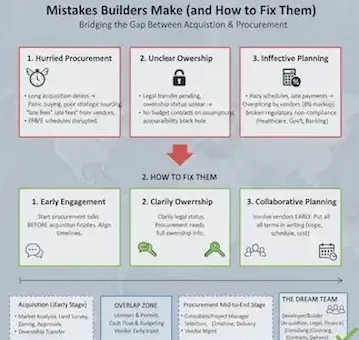
Mistake 1: Hurried procurement due to too-long a time of acquisition time
That is the scene you know. Acquisition crawls, taking too long to obtain permits, the legal department is on vacation, and the site visit is postponed again and again. One second it is, boom! Acquisition is today, and now procurement has one week to do work that could take three months. The result? Panic buying. No breathing space, strategic sourcing suffers, and vendors are looped in so late that they start charging “wait too long” prices. Whole FF&E procurement schedules are dragged into acquisition, lead times have doubled, and the only thing on time is the coffee machine (which isn’t even ordered).
Mistake 2: Nobody is certain of who owns what, so nobody monitors the money
This is a good one: procurement tries to keep costs in check, but ownership status remains pending. Perhaps the legal transfer hasn’t occurred. Perhaps the building technically belongs to someone else or someone’s cousin. In any case, you cannot set budget parameters or conclude contracts since nothing is fixed. This forms a black hole of accountability and kills cost control in procurement. You are purchasing on assumptions, making decisions without a clear picture, and entering into contracts that could backfire if ownership changes during the project.
Mistake 3: Overpricing because of ineffective procurement planning
When vendors smell disaster, they strategies accordingly.
70% of contractors are late paid, and so many would raise their offer by 8% even before they have started plying their trade.
Why? To ensure against a delay in cash flows, which are normally occasioned by confused procurement planning and hazy schedules. This may not only be bad business, but a trust problem. As soon as the credibility of procurement is departed with, the best project delivery process can fail, and then, there is that bit where we should not ignore the facts that in regulated industries, you can simply go off the standards of procurement and find that it is, in fact, rather hazardous. Medical services, government and banking procedures are stringent. Skip over them, and your project might not ever get to the ribbon cutting.
Fix it before it fails
How then can one avoid all this?
- The procurement discussions should be initiated early enough before the ink on the acquisition dries up
- Explain the status of ownership. Procurement must have the two keys.
- Include the vendors in the planning process, and not the panic stage
- Put everything in print acquisition terms, scope of procurement,
And in the case of working in a workspace transformation, then be ahead of it through the right. Office space fit-out procurement.
UP NEXT: Now that we have dispelled the misunderstanding, compared roles and found out what may go wrong so far. So, what about doing it right? In the section below, we will lay out the perfect handoff between procurement and acquisition and how the proper handoff transforms shambles into synchronization because Smart is the new hard.
Visual Explanation
Ahem, to be honest, not all of us like to read paragraphs about workflows, and hey, some of us ( we are not judging you) are of the type, just give the diagram already.
So here it is: the whole journey of acquisition and procurement processes became an easy, picture-friendly guide that you can screenshot, post on your project wall or even show more dramatically at your next team conference. However, even before we give you the virtual whiteboard marker, it is important to go through what this timeline and responsibility map will involve.
- Procurement vs Acquisition lifecycle in the construction projects, ok, then let us begin with the project timeline, since this is where most of the mess/inspiration takes place. Think of a horizontal line, which is like this;
|———-Acquisition Lifecycle ————-|—————Procurement Lifecycle———–|
So here is the breakdown of that: the acquisition cycle ( early stage) begins before the establishment of construction. Covers;
- Market analysis
- land survey and bargain allowance, and zoning
- e n v and regulatory approvals
- ownership transfer
This is your compliance requirement intensive background. Obviously, there will be no project without this; it will be only a Pinterest board and a dream.
The mid to end-stage of the procurement life cycle begins when there is an acquisition finalized ( and in some cases, before). Covers:
- Assessment of needs and budgeting
- material, services, FF&E, Strategic sourcing
- Source selection
- contract bargaining and selection
- installation and delivery
- vendor management and post award compliance
It is where dreams are turned into reality (and reality is given budget limitations).
Overlap zones: the interesting parts
There will be no clean separation between the two life cycles. Actually, this is where they coincide and where most projects hit either greatness or trouble:
Licence and permits
This information is required by the procurement team often in order to start compliance planning, which is technically part of acquisition.
Cash flow planning and budgeting
This is the business of everyone. Acquisition takes care of site cost, legal and licensing. Procurement understands how much cash there is to play with.
Vendor early input
FF&E, OS&E, building products vendors: frequently, before a single ownership has changed hands, they may need to be contacted, notably in case of lengthy lead times or design-to-order requirements.
The question is who does what and why it matters.
Here we can give some roles to this madness. Short character breakdown, so to speak, the cast list of your next big production.
Developer/Builder
- leads acquisition planning.
- oversights, legal approvals, locality location
- Financial responsibility in the early stages
Consultant/Project Manager
- calls the shot between acquisition and procurement timeline, complaints and Sequencing coordinates
- ensure the other party is clued in on what the other is doing and when
Procurement manager
- Involves vendor management, Sourcing and contract awards
- Make sure that purchases are made in accordance with the standards of procurement
- Monitors milestones after contract and project delivery process
This is a dream team that, when aligned correctly, consists of three people. What happens when they do not match? What you get instead is late orders, disoriented suppliers, fire funding and moving finish lines. Putting it all together (why that image is important), it is not exclusive to the acquisition vs procurement timeline to be used during meetings with more fancy vocabulary. It’s all a matter of avoiding.
- A 2m furniture delivery at a location that you do not even own yet
- vendors who vanish when a delivery is due, since no one informs them about the time of delivery
- project schedules that extend into the next fiscal year ( and your tolerance)
Why visualising these workflows, and in particular those overlap points and zones of ownership, teams are better aligned, schedules that previously had slack are more focused, and what went wrong? Late-night emergency meetings can be designed to history. And to the folks planning out work spaces, FF&E environments or other types of special purpose facilities, the difference between a Messy project and a controlled, confident delivery should be the answer to who is doing what and when.
What smart builders do differently (and why it works)
So now you may be wondering, after all this, how successful projects actually get done? Hint: They do not depend on luck, crossed fingers, or 87 copies of the same spreadsheet. Smart builders know the secret to painless, cost-effective delivery is simple: procurement and acquisition in equal parts. But what are the brightest teams doing differently? Let us unpack it.
- Early involvement of procurement professionals in acquisition planning
- Anticipating supply risks before contracts are signed
- Budgets created through teamwork, not over the fence
This matters because procurement in construction is more than buying materials; it’s sequencing, strategy, and coordinating stakeholders. Properly managed, schedules stay tight, suppliers remain committed, and projects run smoothly.
They plan, not just buy
Furniture, fixtures, and equipment (FF&E) planning is a science. Smart developers integrate FF&E into the critical path of a project; it’s a parallel stream, not an end process. Architectural teams who count FF&E with design deliver spaces that are both attractive at opening and functional for years.
Team up with experts who understand
Let’s be realistic, your team can’t do everything. That’s where Omni Build Pro comes in. We specialize in bridging the gap between what’s bought and what’s built. Our project-based procurement process is construction for each client, from office fit-outs (FFE planning) to large hospitality projects and high-compliance builds like healthcare. Whether mid-project chaos or future planning, we coordinate the cogs before they clash. Check our construction procurement services to see how we manage sourcing, vendor selection, compliance, and coordination.
The closing words
The competitive advantage is coordination. In construction, it’s not the fastest team that wins, but the one that understands timing, handoffs, and communication. Successful constructors do not see procurement and acquisition as separate silos they treat them as a system. to painless and cost-effective delivery is just one thing: procurement and acquisition in EQUAL PARTS. But what are the brightest teams up to? How does that make the difference between them and the rest? Let us unpack it.
Frequently Asked Question
What is the difference between procurement and acquisition in construction?
It is an acquisition, the ownership of a property, the purchase of land, permits and a Green Signal to a project, both legally and when it comes to buying a house itself. It is the point at which you get the rights and properties required to develop. Procurement, however, is more about sourcing, choosing vendors, purchasing materials, logistics and making sure that all that is needed to implement the project is therefore, mergers place you in the construction. Procurement gives you what you fill the stuff with.
Q2: When should a project team use acquisition instead of procurement?
Use acquisition when getting meaningful assets permission, such as buying property, zoning approval or licensing. They are base materials, which ought to be established first before the actual construction or outfit can occur. But procurement comes in once you have already acquired those assets and you are ready to procure everything that includes FF&E, and even the services and vendors. Most often, the two overlap with one another; however, they must not be confused.
How does procurement and acquisition impact project cost control?
They both have a significant impact on the budget, only in different ways. Acquisition with poor timing or unintelligibility can delay the process that propels procurement into a rush mode, where prices are elevated, restricted to fewer vendors, and there is disorderliness when scheduling.
The procurement side may have unnecessary expenditure as a result of a lack of planning or coordination, as is the case with the entry of Vendors at the last stages or alterations after the contract. When done well, the two processes also lead to good cost management in the procurement process and fluid project delivery process overall.
Can procurement and acquisition overlap in the same project?
Yes, and yes, they frequently do complicated installations ( such as hotels, hospitals and corporate offices, procurement and acquisition come together at major milestones, such as permitting, budgeting, as well as initial vendor coordination.
For example, the FF&E suppliers may be asked to give their contribution in the acquisition process so that the schedules and fit-out program are kept in compliance with the requirements. The Secret is how to contain that overlap through open communication and recorded roles; otherwise, the overlap is a collision.
What are the steps involved in acquisition for FF&E projects?
In FF&E-related projects, acquisition-related processes are usually concerned with the attainment of:
- Space ( rented or bought)
- space alterations, approvals, and Furnishing
- monitory and legal ownership of the project location
This phase preconditions FF&E procurement that, in its turn, involves furniture, fixtures and equipment planning, vendor selection and the planning of the delivery. In case acquisition is not managed in the right way, the process of procurement either slows down or descends into stagnation and high budgets.