Imagine it is Monday morning, you come in late with your coffee in one hand and your phone in the other to learn that the all-essential component required to make the day work is not shipped. It is not a time to consider options or bargain. Somebody rushes into order at the 11th minute, and most likely to be out of budget just so to get the wheels rolling. Crisis (Just barely) avoided.
So let us jump one week ahead. The same firm, same group, but this time they are seated around a conference table, analysing the performance of their suppliers, looking at the contract schedules, forecasting needs in the coming three months as supply chain Gurus. No panicking, no hurry, but rather informed decisions.
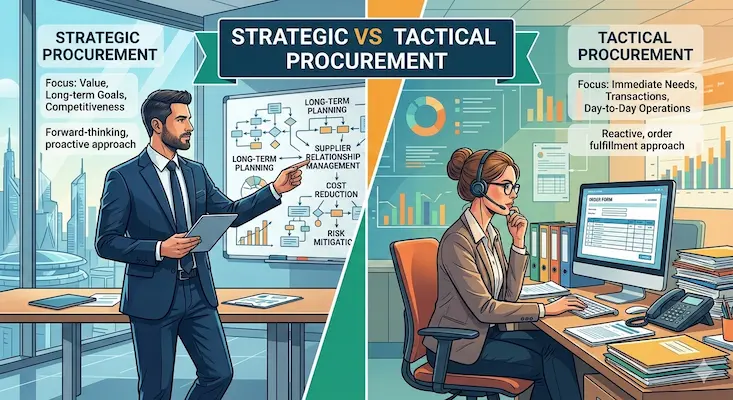
That contrast? It is the struggle between strategic and tactical procurement. There is tactical procurement on the one hand, which is done with speed, with responses and usually in reaction to an emerging need or an unexpected difficulty. It is like ordering takeout instead of defrosting your dinner. In contrast, strategic procurement is more far-reaching in its mission, looking at long term value, supplier relationships, minimising risk and bringing purchases in line with larger business concerns.
What is tactical procurement?
In the case of strategic versus tactical procurement, it is the tactical side that is continually on a sprint. It is nimble, narrow, and hardly gets time to hold long meetings or multi-tab spreadsheets. Tactical procurement is concerned with the here and now, the chunk of the supply chain, which means we need this item now, not in the next quarter. In its most fundamental sense, tactical procurement is transactional, short-term and in many cases is reactive. It facilitates the daily activities of a company: it makes some repeat orders, deals with inventory shortages, addresses the problem with the urgent needs and responds to the local shocks.
Here, speed is the game. Decisions are rapid and made with little information, since the purpose of the action is not to develop a 12-month Sourcing plan but to keep the operation going, and though it would appear to be easy, it is not simple-minded.
Nobody wants their work to turn into a disaster, so to avoid the scenario, effective work from management, stable communication with vendors and proper utilisation of any procurement Technology tools are necessary to control the process of tactical procurement management. With this said, though, there are risks involved in tactical procurement. The reactive environment has less scope for negotiation, a greater chance of overspending and no reserve to secure any risk. Like fighting the small fires every day, you might remain in business, but you are not exactly fireproof.
What is Strategic Procurement?
Tactical procurement can be seen as firefighting, and strategic procurement as ensuring the building is not flammable in the first place. When it comes to the real-life tug of war between tactical procurement and strategic procurement, the strategic tier is the long-range. It is intentional, evidence-based and not necessarily motivated by what is most pressing; it’s concerned with what will produce value in the long term. This is where buying things becomes procurement, in that they mold the course of a business.
Strategic procurement is the stuff of planning, prediction and coordination of purchasing activities to higher business purposes. Instead of focusing on the price, it takes into consideration the total cost of ownership. This is taking into consideration not only the cost of the material but storage, transport, maintenance, life cycle and even environmental impact. That is where procurement becomes a lever not just in keeping costs under control, but in supplier relationship management, risk management, and even leveraging innovation through procurement. Rather than panicking in contacting three suppliers, strategic purchasing means thoughtful selection of collaborators with the use of RFQs, multi-year contracts and evaluation parameters.
In this respect, Technology has a larger role; strategic teams use procurement platforms, spend analytics and supplier dashboards to identify trends, predict disruptions and optimize processes. At Omni Build Pro, we have strategic procurement in our blood. We understand what you require today, but we also examine your business cycles, develop sustainability sources and enable you to extract value you never imagined existed within your supply chain.
Strategic vs Tactical Procurement Differences
The strategic versus tactical procurement differences cannot only be understood simply as a theoretical construct, it is, in fact a practical shift which will directly affect the flow of your projects, the viability of your budgets and the health of your supply chain when the inevitable curveballs finally roll down the pipe (and believe me when i say they tend to roll down that pipe).
To begin, we can give a rapid side-by-side breakdown of the two:
| Aspect | Strategic procurement | Tactical procurement |
|---|---|---|
| Planning Approach | long term, proactive planning | short term, reactive planning |
| Supplier Relationship | focus on supplier partnerships | focus on vendor transactions |
| Cost Strategy | emphasis on total cost of ownership | emphasis on lowest upfront price |
| Decision Basis | backed by data, forecasting and Analytics | Based on immediate operational needs |
| Management Style | driven by category management and strategic goals | task driven and project specific |
| Risk & Market Focus | supports market analysis and risk mitigation | prioritizes speed and availability |
| Technology Usage | uses procurement Technology tools for Optimisation | relies on basic ordering tools or manual processes |
The only thing this informs us is that strategic Procurement is your plan to go; tactical procurement is your Band Aid, and both of them are required, but it is about knowing when to put it into a different gear or pace to achieve the competitive edge.
According to, McKinsey revealed that Procurement leaders outperformed their peers by 42% during economic disruptions, mostly due to more effective planning, enhanced sourcing and better supplier relationship management.
Companies with Systematic FF&E procurement workflows reap the benefits of these differences in the sense that they do not face the urge to buy without knowing the actual need later and panic. Basically, the difference between strategic and tactical procurement comes down to purpose and outcome.
When to use Tactical Versus Strategic Procurement?
One thing is knowing the theory behind tactical procurement vs strategic procurement, and another is trying it in the real world scenario. There, the interesting bit happens ( where budgets get either made or broken).
Here is how we can apply it to reality:
How tactical procurement can be used;
Tactical purchasing flourishes in a country of wall-to-wall pressure. It is your first Resort when what you must do is solve a problem in Haste instead of laying a 5 year plans strategy.
Make use of tactical procurement where:
- A location is short of the safety gear, and it should be replaced today.
- Your team has miscalculated the number of tiles, and there is an urgent order to be placed under a deadline.
- One of the suppliers collapses, and the backup vendor needs to be made within a time limit of 24 hours.
- You are dealing with single purchases of small or consumable things.
When it is Smart to Strategically Procure
Strategic procurement is best in cases where cost effectiveness, conformity and planning are the main priorities. It is not so much about fixing as making the solution just right.
Apply strategic procurement:
- When you are planning a hotel grand opening and want to organise FF&E, MEP, lighting and textiles in quantity.
- You are developing a supplier network of repeat Buying especially on various projects.
- You desire to negotiate contracts to more favourable terms and use analytics to reduce TCO.
- It can align with bigger business objectives such as sustainability, innovation or expansion.
Actually, intelligent planning has the capacity to yield great Returns. A worldwide financial services company saved more than 3 million in one single year due to contract renegotiation and profound supplier analytics, which were part of a more extensive procurement change. The percentage of traditional services ranges between 77.8 and 96.3%. ( Source: Acquis Consulting)
At Omni Build Pro, we have experienced how the appropriate measure gets made at the appropriate time that saves money, lessens stress, and hence builds saner businesses.
Hybrid Procurement Approach for Modern Teams
Procurement is no longer black and white in the present dynamic industries. It is neither tactical nor strategic. It is simply a matter of how you can merge both. Not many companies live in their own bubble. Other needs come up at the last minute, and some realize themselves in quarters or in years. That is why modern teams are shifting towards a hybrid procurement mode: a flexible model that incorporates short-term responsiveness and long-term planning. It enables corporations to think intensively and not take action slowly.
Benefits of Aligning Both Types Strategically
The actual benefit is alignment. Everything becomes more efficient when tactical and strategic procurement are connected, and that is, when tools, data and goals merge. The preferred suppliers are not a secret to tactical teams. Strategic teams obtain real-time visibility of spend. Finance then ceases to wonder why we spend so much on overnight deliveries.
Role of digital Tools, analytics, and Supplier Portals
It is where technology is in the lead. Sourcing dashboards, automated approval processes and other integrated procurement technology tools bring transparency to every single purchase, and most importantly, with the power of advanced analytics, businesses can mitigate risks, identify inefficiencies, and investigate new possibilities with procurement in ways that were almost unreachable a decade ago.
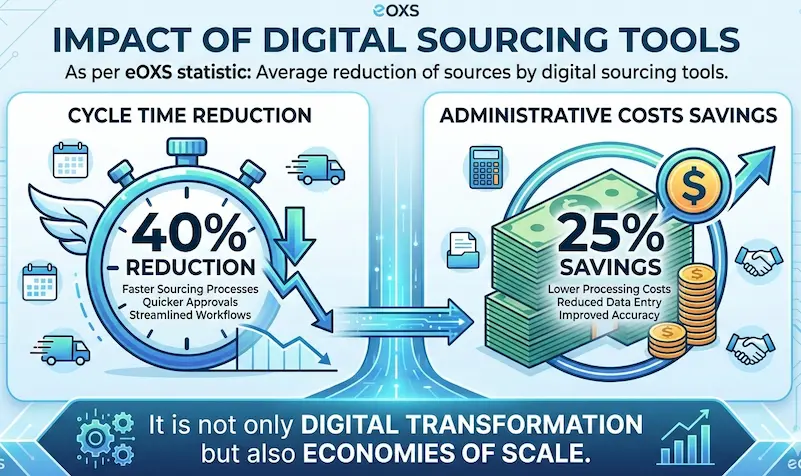
Indeed, as per eOXS, the average reduction of sources by digital sourcing tools is 40% reduction in cycle times and 25% savings in administrative costs. It is not only digital transformation but also economies of scale.
Mention the Procurement Maturity Path.
The procurement capability of an organization keeps evolving as the organization changes. A new team can emphasize the transaction speed more. However, that will evolve over time into supplier networks, contracting strategies and supplier relationship management. It is not a matter of choosing a side, rather it is a matter of evolving into a side that collaborates. That is where we enter the game.
As experts in procurement strategy, our part is to make sure businesses find a good balance between both models so that they are not in reactive mode all the time, nor in planning mode all the time. We create systems that evolve, scale and run in the real world but not in slide decks. Because in the end, procurement isn’t just a function, it’s a force and hybrid models? They make that force faster, smarter and more reliable.
Conclusion: Procurement That Delivers Real Impact
Modern supply chains demand more than transactional buying. Real impact comes from balancing strategy, speed and innovation. A hybrid procurement model combines tactical agility for immediate challenges with strategic planning for long-term growth. It allows businesses to respond quickly to disruptions while building resilient supplier partnerships and cost-efficient systems for the future.
This integrated approach drives measurable results across diverse sectors, including hotel developments, office buildouts, and energy infrastructure projects.
At Omni Build Pro, we help organizations transform reactive purchasing into forward-thinking procurement systems that protect margins and accelerate performance. Explore how a smarter procurement strategy can elevate your next project and deliver lasting business value.
Frequently Asked Questions
What is the main difference between strategic and tactical procurement?
The distinction between strategic and tactical procurement lies in the time span, goals and relationships. Tactical addresses immediate needs and cost while strategic focuses on long term value, supplier partnerships, and future growth.
When should a company use strategic vs tactical procurement?
Use tactical procurement where speed is Paramount: in case of an emergency restocking, short lead time components or surprise scope changes. It is most applicable to industries that are rather dynamic or those that have daily mishaps and business. And strategic procurement, in its turn, is best suited to schedule large-scale projects such as Hotel openings or National expansion.
Is Tactical Procurement outdated in modern supply chains?
No, not in the least. Tactical procurement is not a thing of the past; it simply has to change. Teams can automate low-value purchases, follow up on urgent orders, and yet they can have control over their spending with the help of adequate procurement Technology tools.
How do strategic and tactical procurement impact cost savings?
Strategic procurement concerns TCO, supplier negotiations and risk reduction and is more substantial in the long term in terms of cost savings. With that said, tactical procurement contributes to the minimization of short-term wastage and downtime charges as well.
Can one team manage both strategic and tactical procurement?
Yes! When they are given the proper tools and form. Most contemporary teams can combine the two functions quite well with the help of a custom distribution of the workload via categories, priorities and online workflows.