
You saved some dollars on paper towels this quarter. Well done, procurement superhero! However, your heating, ventilation, and air conditioning (HVAC) system malfunctioned once again, and its emergency repair bill caused your budget sheet to tear up.
Now your question is, did I save anything at all?
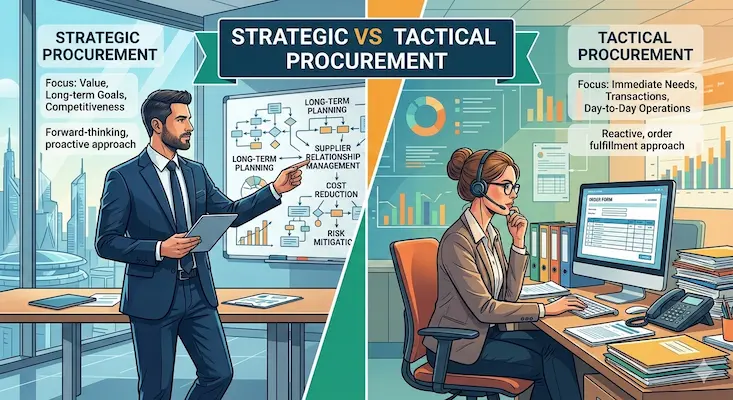
Hello to the daily dilemma of procurement, where Cost Avoidance vs Cost Savings does not represent the same thing, no matter how semantic. It is the thin border of being an expert in budget planning or the perfect excuse to have someone approve a last-minute PO on a Friday night. In the smart procurement world, the terms are thrown like they are the same thing in meetings, dashboards, and vendor performance reviews; they are not. Knowing the distinction is not merely some procurement trivialities. It is the difference between reactive spending and a proactive strategy.
Let us analyze it.
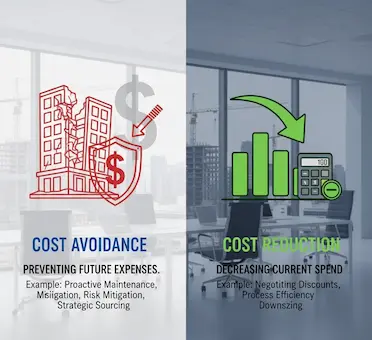
- Cost Savings is the classic: you pay less in comparison to what you previously paid. It is clean, it is traceable, and it puts a smile on the face of your CFO.
- Cost Avoidance, however, is a bit trickier; it is the spending that did not have to occur.
Consider: bargaining over secretive charges, rebating better deals before rates increase, or dumping businesses that charge you 75 bucks to send a box of nails.
The kicker here is:
According to Deloitte, procurement can deliver up to 5-10% in cost reductions annually when both avoidance and savings are tracked. (Source: Planergy)
Then why do so many teams insist on one side and ignore the other? More likely, due to the fact that savings is more aesthetically pleasing in print, and avoidance involves a little more narration. But that is what we are here to repair.
What Is Cost Avoidance and Cost Savings in Procurement?
To speak frankly, procurement terminology may seem like a business puzzle. We also gained technical savings as a result of preventive forecasting, and we saved risk exposure by way of early-stage vendor realignment. Translation: We were smart with spending and did not screw up.
However, in the case of Cost Avoidance and Cost Savings, the distinction between the two is important not only in reporting these figures, but also in procurement training to achieve actual results that do not turn into future fire drills.
Cost Savings: The Bottom Line That the Whole World is Crazy About
This is the golden baby of procurement measures. Cost savings are simply that you are not paying as much as before; you can even show it with a receipt and a spreadsheet.
Definition:
Cost Savings refers to a decrease in spending. It occurs when a customer bargains for an improved price, shifts to a less expensive source of supply, or the cost reduces the required specification without decreasing value.
Consider it in this manner:
You were paying 30 dollars a piece for office chairs. You have brought the price down to 28 dollars for a bulk order of 500 chairs. Boom, that will save 6.6 percent, or a thousand bucks back in the budget.
No intrigue, no spreadsheets blowing up, it’s cold, hard math. The savings are very large since they can be measured, reported, and your finance people will adore you (an achievement on its own). But do they tell the whole story? Not quite.
Cost Avoidance: The Invisible MVP
And that is where it gets interesting. The cost avoidance does not always happen in the ledger, but definitely in the sanity of operations.
Definition:
The proactive way of preventing future or unnecessary costs is termed Cost Avoidance. It is all about making choices that lessen the risk, minimize incidences, or avoid costs even before they come about.
Real-life example: You might have chosen a cheaper HVAC supplier that has its units with a five-year lifespan and that need maintenance. Instead, you selected a slightly more cost-prohibitive up-front cost on a model that has more longevity of ten years, and that also has less breakage. After several years, the cost of that choice will result in a $36,000 emergency maintenance and lost time savings.
And that is cost avoidance via preventative maintenance, but even when it does not appear as a neat line item, that is the type of predictive procurement that preserves budgets and keeps buildings out of a winter-themed escape room.
Cost Avoidance vs Cost Savings: Key Differences That Matter
Cost Avoidance vs Cost Savings may initially appear to be twins in the procurement world, but at the foundational level, they are more like brothers in regard to investments, with one classically putting down cash on stocks early vs the other simply enjoying a decent clearance sale. They both have merits. Yet, when you desire a robust and future-proof procurement strategy, you need to know where the differences matter the most strategically, financially, and operationally.
This is what we will do.
| Aspect | Cost Savings | Cost Avoidance |
|---|---|---|
| Focus | Immediate spend reduction | Future spend prevention |
| Visibility | Highly visible in reports | Often invisible |
| Impact | Direct budget impact | Indirect impact |
| Timing | Happens at point of purchase | Happens before the need arises |
| Examples | Price negotiations, volume discounts | Risk mitigation, switching to long-lifespan equipment |
| Tracking | Easy with procurement metrics | Requires forecasting and documentation |
| CFO Reaction | “Nice job saving 10%.” | “Oh wait — did we really not spend that much?” |
| Relation to TCO | Reduces unit cost | Reduces long-term total cost of ownership |
The Numbers Expose what the Stats say. Whereas the two cost-saving strategies are used in smart procurement, mature organizations understand that the sweet spot lies in creating a balance between the two.
CAPS Research notes that the top-level procurement units record an average of Cost savings 3.1% 2.0% cost avoidance (Source: SpendHQ)
That 2.0 percent might appear more modest, but keep in mind you are avoiding higher bills in the future, service, and materials that will pop up in the middle of the night at some point, and you may have heard the kinds of nightmares a vendor has caused, and you never want to repeat again.
Strategy vs Spreadsheet: Why this Difference Matters
Time to get into the strategy chair. In the event that you make your procurement choices solely with reference to budget vs actual, you will only experience cost savings since that is what you record. The key to spending money at the best possible price, but with a good understanding, is to monitor both.
That means:
- Thinking outside the price tags
- Considering the total cost of ownership (TCO)
- Incorporating preventative measures, contract, service level agreements, and vendor selection
That is to say, it is not a question of getting the cheapest ladder; it is a question of getting the ladder that will support you when halfway up it.
Smart procurement requires smart thinking.
Cost avoidance does not imply cheapness, but it implies strategic spending. It is the art of inquiry: What might go wrong in the future, and how do we stop it in the present? And cost savings? And that is your strategic victory when you celebrate a 12 percent reduction on a supplier quote. Desirable, gratifying, and readily reportable. You can not afford to have a sustainable procurement strategy without either.
And so when you find yourself in a position of making that question of whether you want to think about cost avoidance vs savings, then the answer would be, you guessed it, yes. You require both, and when you don’t know where to start, we have procurement strategy experts who will assist you in creating a plan that fits all the boxes without putting your wallet into the reception room.
How to Track Smart Procurement Using the Right Metrics
You understand what is even more frightening than paying a high cost to a low-quality vendor? Being unaware that it had occurred. So it is not that smart procurement is only about making great decisions, but also about quantifying the value of this decision in a way that resonates with the business, the finance department, and even your cynical cousin in accounts who still thinks of procurement as a group of people who simply order stuff. Be it Cost Avoidance or Cost Savings, the trick is in the measurements, i.e., the ones that do not stop at per-unit prices and begin showing a complete picture of procurement ROI, supplier efficiency, and long-term operational fitness.
Now, let us break down the most important procurement metrics that every value-driven pro ought to be monitoring and how they will make common choices, outrageous success.
Hard vs Soft Savings: The Traditional KPIs
Here’s where you should begin, but you shouldn’t end here.
- Hard savings entail decreases in outlay. Example: Negotiation over 35 dollars to 30 dollars/unit.
- Soft savings cover the efficiencies such as shorter lead times, ease of contract terms, or improved payment terms.
They do not appear in the ledger forthwith, but they definitely count. Smart teams monitor the two since soft savings easily turn into hard cash with time as they are scaled up. Here, imagine that it is like compound interest, procurement version.
Supplier Consolidation & Category Management Measures
It is said that less is more sometimes. Consolidation of suppliers will eliminate redundancy, increase power in contract negotiations, and lead to better volume pricing.
Real-world example:
In one example, a procurement team reduced the number of janitorial supply vendors to a single vendor. Result?
15 % fall in the unit prices, 18 % reduction in inventory wastages (Source: Proqsmart)
Category management is important here, classifying the spend in a manner that enables you not only to buy smarter, but also to manage smarter. Tip: It also makes supplier review every three months a lot less painful.
Procurement Analytics: The Super Power in Your Decision- Making
When Shared Service Groups access analytics in real time, they cease to respond to spend and instead forecast value. The most important tools and indicators to monitor:
- Spend under control
- Variation of price among suppliers
- Actual vs projected savings
- The proportion of compliance with contracts
- Time cycles of procurement
The right dashboard helps you benchmark yourself against the industry leaders, see where you are falling short, and draw out insights that really work to drive performance, more than PowerPoint slides.
The Secret Levers: The Contracts and Preventive Maintenance
Desire to be seen as a procurement genius, but you happen to be stingy? Negotiate master contracts and plan to prevent maintenance.
- Entering into longer contracts using escalation terms? Cost avoidance check
- The option of increased service-level guarantees that minimize emergency downtime? Hidden savings check
- Putting more money into equipment that has improved MTBF (mean time between failures)? TCO check
They are not high-tech tools, but they will take a punch in the long-term planning of sourcing, and they do not save money; they may protect the operations.
The Proper Way to Measure ROI
Good procurement does not lead to cost-cutting, no matter what it means. It is concerned with providing investment back by means of:
- Improved relationships with suppliers
- Sustainable sourcing
- Risk mitigation
- Efficiency of operations
The harvest of ROI of procurement resides in the merger of short-term and strategic gain. And you can demonstrate it, line by line, contract by contract, including the appropriate procurement metrics and category insights.
As an example, when maximizing FF&E or OSE sourcing within a new build or the renovation of a hotel, it is essential that Avoidance (not just price per unit) is followed.
You can find our primer on cost-conscious FFE sourcing to learn how savvy decisions will help alleviate the budget next year.
At Omni Build Pro, we understand that measurement is not some kind of data recording, but it is a story, a story of the wiser procurement decisions. If you are cutting down expenses, mitigating potential danger in the future, or streamlining your supply chain to improve its flexibility, then the relevant metrics will be your best friends.
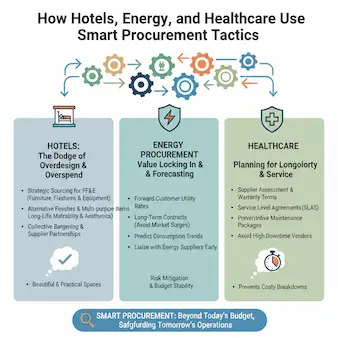
How Hotels, Energy, and Healthcare Use Smart Procurement Tactics
The truth is, it is not enough to live with procurement success in the spreadsheets. It reveals itself in the real world, at the place of work, in the sectors where the budget flows are lean, schedules are skeletal, and nobody wants to get unnecessary headaches. Over-designed hotel lobbies, the rocketing energy rates, and emergency repairs to the medical equipment, etc., cost avoidance procurement, the form of procurement that not only saves on cost but also avoids costs, is what keeps the teams on the front line ahead of the frantic firefighting quotient with a calculator. That is how industries such as hospitality, energy, and healthcare are doing it right and what we can learn from it.
Hotels: The Dodge of the Overdesign and Overspend
There is a legitimate pressure in the hospitality business to appear luxurious without having to drain the bank. However, over-designing an area with higher-specification objects that do not require it is one of the easiest tasks to deplete a budget and still fail to impress the guests. Aesthetics, durability, and functionality are all finding their bearings and becoming synonymous as smart hotel operators start utilizing the concept of strategic sourcing, where the danger was previously present (overspending on furniture, fixtures, and equipment (FF&E)).
Rather than falling back on luxury options everywhere, they are embracing cost-avoidance: finding alternative finishes, multi-purpose items, and long-life materials that do not have to be replaced with each season. Through avoiding expensive design changes, unwarranted stockholding, and utilizing their collective bargaining ability through their supplier partnerships, they construct beautiful yet practical spaces without it costing them crazy.
Wonder how we assist hospitality teams to make those calls? Find out how we value our approach to hotel procurement and how you can stay trendy and wallet-friendly.
Energy Procurement: Value Locking in and Forecasting Energy
Let us discuss utilities because you can be thrown when you look at those utility bills to find out that there is a big surprise, but imagine that on a multi-property commercial basis. Procurement procurers in the energy sector are taking their time and checking volatility by forwarding customer utility rates, charging for long-term contracts. It is a typical cost avoidance approach:
Avoid market surges by discussing rates prior to surges.
By predicting consumption, understanding consumption trends, and liaising with energy suppliers at an opportune moment, organizations eliminate their risk exposure, no casual power top charges, and no middle-of-the-night budget insomnia. It is also winning on the risk mitigation factors, especially in the manufacturing or construction industries, where delays caused by the power outage or skyrocketing fuel prices threaten to hobble an entire project.
When developing an energy procurement strategy, consider reading through our work on energy procurement, which may help you plan rather than pay the cost of hindsight.
Healthcare Planning for Longevity and Service
Nobody wants to postpone the treatment of a patient due to a faulty sterilizer or due to an unreliable supplier who disappeared after the guarantee has expired. This is the reason why procurement in health sectors emphasizes more on supplier assessment, terms of warranty, and service-level agreements (SLAs). Cost savings? Of course, it is normal to negotiate the wholesale price per unit item on disposables or equipment. However, cost avoidance manifests itself in better vendor choice:
- Selection of equipment, such as those with an extended warranty period.
- Giving priority to suppliers on preventative maintenance packages
- Prevention of vendors that have had high downtimes or respond horribly to service
Such decisions may not reflect in a line-item discount, but they prevent costly breakdowns, rescheduling, and compliance issues, which have a very true cost. The hospitals and clinics under us receive assistance with respect to the price and performance balance.
Read more about our facilitation in the procurement of healthcare products and why long-term service is just as important as the sticker price.
By focusing not only on forecasting but on smart sourcing, industries do more than reduce expenditures; they create strength. It could be negotiating today to prevent surprises tomorrow, or sourcing smarter to skip the ills of the future, but smart procurement is not only about the current budget; it is also about safeguarding operations tomorrow.
Should You Focus on Cost Savings or Cost Avoidance First?
Ah, the old procurement argument: will we opt to achieve immediate cost savings, or is it better to attempt to prevent costs that are yet to be incurred? Spoiler alert: it is not a black or white answer. However, it is strategic.
We have experienced this scenario too many times at Omni Build Pro: the teams work hard, slash the prices, and have their first significant victories, which they proudly call a day. Meanwhile, lurking threats are silently and patiently awaiting to make the following quarter the next rollercoaster in finances. The thing is that both cost savings and cost avoidance are important, but the key to successful procurement leadership is to understand when to put which first.
Savings first, Avoidance builds second.
When your procurement team is still becoming successful, it is a good idea to engage at the cost-saving level. It is way faster to establish, not hard to monitor, and it can provide you with good early victories. You bargain for a lower unit price, change the vendor to a cheaper supplier, or qualify for bulk discount bingo; you now have the finance department on your side.
These instant successes:
- Increase the credibility of procurement
- Instill trust in the visibility of spending
- Assist in the creation of a baseline benchmark
However, once your procurement strategy has matured, it is high time you move beyond discounts and begin reducing the costs that will be incurred in the future before they come as budget-buster surprises. Cost avoidance then comes in ( forecasting, contract, optimization, preventative apparatus, and risk-conscious sourcing ).
Veridion says that cost avoidance in procurement often begins to bear ROI as they evolve to the stage of advanced sourcing. Translation? Once you develop the muscle to prove and monitor them, you deserve to evade their costs.
The Total Cost of Ownership (TCO)
way of thinking Procurement teams play with unit cost too often, as this is just the top of the iceberg, with no sight of what lies underneath:
- Maintenance expenses
- Replenishment period
- Downtime risk
- Terms of warranty
- Penalties of non-compliance
By converting your mindset to TCO (Total Cost of Ownership), which replaces upfront pricing, you begin to obtain the whole financial picture. Having a slightly higher price and a longer lifespan or serving conditions, a product could be cheaper overall. And, to be quite frank, CFOs celebrate a long game.
Let the Balance be Data Driven
The good news is that you do not have to depend on guesswork. Using procurement analytics, you will be able to:
- Monitor the hard and soft savings
- Find out preventable spend using trend analysis, and comparative analysis with the industry players
- It is important to measure the ROI of long-term contracts and not be limited to one-time wins. Smart businesses can implement smart decisions; that is, they make smarter, more than cheaper decisions by using a combination of spend data and a set of metrics measuring risk.
At Omni Build Pro, we assist companies in putting these kinds of insights into their everyday sourcing rhythm, creating ironclad sourcing playbooks to create both short-term and long-term value.
Then the question is, what will you focus on first, cost savings or cost avoidance?
Begin with what is in your hands:
- When you are creating credibility, you must talk about savings
- When you are willing to grow smart, it is time to switch to Avoidance
Yet balance is always the goal. Since the most successful procurement strategy does not only pursue numbers, but also predicts them.
Ready to Maximize Value Across Every Procurement Decision?
You may be looking to make hard and fast savings, or you may be trying to dodge the costly surprises that can sink your next quarterly statement, but one thing is certain: smart procurement is a serious competitive edge. However, the development of such a strategy does not take place accidentally. It requires vision, experience, and a bit of assistance from those who understand how to make spending strategic.
At Omni Build Pro, we facilitate the realization of immediate value and long-term resilience by assisting procurement teams to unlock this. Our blend of data-wise choices, contract optimization, and sourcing based on specific industries helps you to discover the quick wins without getting into cost traps in the future. This is not merely about cost savings; it is about organizing an engine that can drive a wiser growth in procurement.
Collaborate with our procurement strategy experts to develop a sourcing system that is not just simple but one that adds value at each stage.
Frequently Asked Questions
What is Cost Avoidance?
Cost avoidance involves the proactive activities of an organization to help prevent the future expenses, once they threaten to take place. In contrast to cost savings, which may also be referred to as cutting real expenditures, cost avoidance is focused on strategic choices that prevent the costs from emerging in the first place.
Examples of how this can be done include options such as equipment that has longer lives or in the negotiation of service contracts with the prevention of maintenance to reduce the cost of repair or replacing the equipment in the future. Cost avoidance will not always be listed as an item in a report, but it is in full support of risk mitigation, long-term budget management, and total cost of ownership (TCO).
What is Cost Savings?
Cost savings are the quantification of the reduction in actual spending against a baseline or past spending levels. It usually occurs when the procurement team seeks more favorable pricing, achieves a volume discount, or changes vendors or materials to a more cost-effective source. Suppose you used to buy office supplies at 30 dollars each unit, and now, with a new contract, you are buying them at 27 dollars. That $3 saving multiplied by the amount you order is what you will save. They can easily be quantifiable and monitored, and thus extremely evident in financial reporting; they are the preferred measure of stakeholders of a quick success.
How can I calculate cost avoidance vs actual cost savings?
It is easy to determine actual cost savings as a formula:
Variation of price = (Old Price – New Price) x Quantity Purchased
Example:
Old price: 30 dollars per unit
New price: 28/unit
Number: 500 items
Savings = (30-28) 1000 = 1000 dollars saving
Projecting cost avoidance takes a little additional calculation and write-up. You will need to identify a probable price that has been avoided and explain how it might have arisen, e.g., a rise in price that was negotiated away, a sizable maintenance problem forestalled through more intelligent sourcing.
It is usually measured against the internal benchmarks or quotes given by the suppliers, data on the market trends, or historical spending patterns.
What is the difference between hard savings and soft savings?
Hard savings are the cuts in expenditure that reflect in your financial statements, the ones that money loves to see. These include:
- reduced unit prices
- Bulk prices
- Eliminated fees
Soft savings, on the other hand, either increase efficiency or decrease risk, yet do not decrease the dollar amount on the books immediately. Examples include:
- Less lead times
- Enhanced service tiers of suppliers
- Preventing subsequent expenditure (so-called cost avoidance)
The combination of the two is what is needed because hard savings are useful in the present, whereas soft savings will foster success in the future.
Why isn’t cost avoidance always visible in the financial statements?
Since cost avoidance avoids spending even before the occurrence, it does not cause a change in actual spend until it is reflected in the traditional financial statements.
Nothing bought or sold = nothing put into a ledger.
It does not mean that it is not valuable. As a matter of fact, numerous procurement departments have learned to monitor cost avoidance, track the avoided spend situation, and prove cost avoidance ROI in the long term by using procurement analytics and in-house monitoring tools. Cost avoidance is a massive factor in strategic sourcing and budget forecasting, and the minimization of the bottom end of total cost of ownership when it is executed correctly, though it may remain unnoticed on a balance sheet.