
When you look at the financials of any major build, the numbers don’t lie. Procurement accounts for 40-80% of construction companies’ spending, according to industry insights from McKinsey. That means how you buy is just as critical as what you build. Choosing the right Procurement Methods isn’t just a back-office administrative task anymore. On the contrary, it is the very foundation of project profitability and timeline management in the 2026 construction landscape.
We have decades of experience in FFE and OSE procurement at Omni Build Pro. The team bypassed supply chain bottlenecks and cost overruns in order to spare our clients the trouble. We have also experienced that being inflexible will put you in a position to fail.
The key to a successful delivery is to make your procurement approach fit the unique aspects of your project, and this is what makes the difference between a smooth delivery and a project that runs over budget.
The Procurement Methodology in the Contemporary Construction
What is an effective sourcing strategy nowadays?
An effective procurement structure outlines the process of risk reduction, cost management, and ensuring your schedule does not slip.
It is not possible to select a strategy out of a hat because it worked five years ago. The contemporary supply chain is too unpredictable to be guessed.
Why Different Procurement Methods Are Necessary?
When we look at standard guidelines from organizations like the Project Management Institute (PMI) or ISO standards for supply chain management, the consensus is clear: defining the rules of engagement early is non-negotiable. The reality is that construction procurement methods dictate everything from how contractors are vetted to how risk is shared between the client and the builder. It’s the roadmap for your entire project lifecycle.
Think about it! When you adopt a strategy that puts a heavy emphasis on cost reduction and does not care about the reliability of the contractor, you may pay twice as much in re-work or delays. In the absence of a solid plan, you are flying blindly into the uncertainty of variable material prices and labor shortages.
That is the reason a strong Procurement Planning and Sourcing Framework should be developed at the initial stage is the ultimate protection against project derailment. It sets the expectations, the baseline, unites all the stakeholders, and makes sure that you are not scrambling to get site materials, yet the foundation is already being poured. You require clear insights, tracking mechanisms and precise knowledge of deliverables prior to a dollar being transacted.
The 9 Modern Methods of Procurement for Construction in 2026
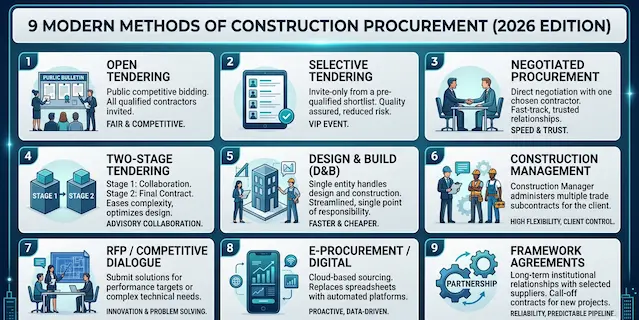
There is no magic bullet when it comes to sourcing for a build. Gone are the days when people could do with one outmoded strategy. Nowadays, project managers can choose between a number of ways of procurement that are specific to project sizes, risk levels and urgency.
You have to match the tool to the task. So, we will start with the first step in the best plans and dissect them to find out how they operate and when to fire them.
1. Open Tendering
Consider open tendering as the open door policy of the last resort. It is a very open competitive bidding system in which any qualified contractor is allowed to enter the race. The project is publicized through advertisement, the scope and requirements are outlined, and interested parties place their sealed bids.
Why it works
It promotes absolute fairness and drives down costs through sheer market competition. Because it’s an open field, contractors have to sharpen their pencils to win the job. It’s particularly common (and often legally required) in the public sector where strict transparency laws apply. For example, a recent public sector housing project in the UK successfully utilized open tendering to maintain rigid cost controls and satisfy stringent public spending audits.
The downside
It’s not a fast process. According to 2024 procurement data from the World Bank, while open tendering significantly reduces supplier bias and improves regulatory compliance, it notoriously extends project timelines. Sifting through hundreds of bids takes serious administrative muscle. You are also evaluating contractors strictly on paper, which can sometimes mask operational inefficiencies until they are on-site.
2. Selective Tendering
If open tendering is a casting call to the public, then selective tendering is an invite-only VIP event. You do not take bids in the general market, but rather maintain a shortlist of prequalified suppliers who have already demonstrated that they possess the technical ability and financial soundness to work on the task.
The Strategic Edge
This will be a huge quality assurance at the very start. You are not wasting the time of your procurement team to screen out totally unknown organizations or reject bids of unqualified organizations. Other organizations, such as the Chartered Institute of Procurement and Supply (CIPS) and the Royal Institute of Chartered Surveyors (RICS), often note the advantages of pre-qualification in the minimization of the overall project risk. You are pre-screening competence.
The Trade-Off
You are naturally restricting your competition by making the pool small. It is possible that you may lose a more cost-effective newcomer who may be hungrier and could have performed the job equally well. It involves the client maintaining a superb, current pulse on the contractor market in order to make the list of invited ones the best of the best.
3. Negotiated Procurement
You simply do not have the runway to engage in a bidding war that is going to last long, or the scope of the project is so specialized that there are few and far between contractors that can actually rip it off. Enter negotiated procurement! This is a one-on-one negotiation between the client and one contractor that is chosen.
The single-sourcing reality
This is the single-source procurement world. It is very much dependent on the already existing, trusted relationships and a strong trust in the past track record of the contractor. Is it risky as far as ensuring that you got the lowest market price possible? Yes. However, its pace and responsiveness are what can come to the rescue of a project that is going down the drain.
In fact, the Deloitte Global Construction Report (2024) highlighted a fascinating case study where a major hospital procurement phase was fast-tracked under single-source negotiation. The result? They ultimately saved an impressive 12% in sheer administrative time and avoided millions in inflation-driven material cost hikes by locking in the contract months earlier than a traditional tender would have allowed.
4. Two-Stage Tendering
Want the contractor’s operational expertise before you even finalize the architectural blueprints? Two-stage tendering is where early collaboration truly shines.
How the two stages work
In the first stage, a contractor is brought on board based on a preliminary schedule of rates, overheads, or an outline of the project. At this point, they act more in an advisory capacity. They sit together with the design team to assist in refining the constructability, probable bottlenecks in the supply chain, and locking down real cost estimates. After polishing the design and mapping the risks, the second stage is triggered to negotiate the final lump-sum contract.
This process is very dependent on careful procurement planning. It gives phenomenal cost certainty in the future since the builder has been closely involved in unravelling the complexity of the project since the beginning. Once the ground is broken, there are fewer ugly surprises since the individuals constructing it were also involved in designing it.
5. Design & Build (D&B)
The old-fashioned path of construction is notoriously discrete: contract a designer, complete the drawings, bid it, and contract a builder. Design Build (D&B) throws that disjointed model out of the window. In this case, the design process and the actual construction are done by a single entity, the D&B firm.
The strength of joint accountability: The major charm of D&B is the joint accountability. When a construction delay happens due to a design fault or a site conflict, you do not have to mediate a costly blame game between the architect and the contractor. The D&B company has the whole issue in its hands, and this gives them a reason to create and construct without errors.
The efficiency gains are undeniable. According to a comprehensive 2023 study by the Design-Build Institute of America (DBIA), Design-Build projects are completed a staggering 33% faster and 6% cheaper than traditional delivery methods. For developers looking to streamline complex, multi-phase builds, leveraging comprehensive Housing Development Procurement Solutions under a D&B contract is rapidly moving from an alternative method to the absolute industry standard.
6. Construction Management Procurement
Let’s talk about projects that are so large and complex that a single general contractor might struggle to shoulder the entire burden effectively. Construction Management procurement flips the traditional script. Instead of handing over the keys to one entity, the client hires a Construction Manager (CM) to act as their direct representative and site expert.
Management over manual labor
In this model, the CM doesn’t actually do the physical building. Their job is strictly management. They divide the giant project into smaller, manageable work packages and then get and administer single trade subcontractors (electricians, steelworkers, concrete pourers) on behalf of the client.
It is widely used in complicated, multi-phase commercial construction projects where flexibility is the priority. In case you have to begin groundworks and the interior finishes are not yet fully designed, a CM model can accommodate such an overlap. The Chartered Institute of Building (CIOB) often writes that although such an approach requires a very active client, the amount of granular control that it offers over the individual trade costs and schedules is virtually unmatched in the modern industry.
7. Request for Proposals (RFP) / Competitive Dialogue
It is not possible to simply stick a price tag on a very complex and undefined problem. This is precisely where a systematic request for proposals (RFP) or competitive dialogue comes in as your greatest asset. You do not just request contractors to give their lowest price because of the strict blueprints, but instead you offer them a performance target or a complicated technical specification and request them to submit a holistic solution.
You are more or less comparing their ability to solve problems and their price. It is very efficient in the specialized scopes, complex design integrations or technical service sourcing where innovation is needed.
An example is that in the case of engineering FFE and OSE Procurement for Large-scale Builds at Omni Build Pro, it is possible to assess the innovative sourcing solutions of a vendor, their global logistics infrastructure, and their responsiveness to disruptions in supply chains, not only their bottom-line estimate.
8. E-Procurement / Digital Procurement
The reality is this: attempting to operate a multi-million dollar 2026 construction project on a collection of spreadsheets and a disorganized chain of emails is an enormous operational burden. Contemporary structures demand contemporary infrastructure, and that implies a shift to cloud-based sourcing structures.
E-procurement / digital procurement digitalizes and centralizes the whole procurement process, including the first requisition to communication with vendors, bidding and final signing of the contract.
This has a direct financial effect that can be measured. The Deloitte 2024 Digital Procurement Report states that the switch to automated digital platforms decreases the sourcing lead time by 15% and cost of the project by 5%. It will turn your supplier management into a proactive and data-driven approach rather than a reactive, administrative headache. You have real-time tracking, automated compliance checks and perfect audit trail.
Traditional vs. Digital Procurement: The Operational Shift
| Feature/Metric | Traditional Procurement Methods | Modern E-Procurement Systems |
| Sourcing Speed | Slow; manual document drafting and physical distribution. | Fast; automated templates and instant vendor notifications. |
| Supplier Vetting | Siloed; relies on individual buyer knowledge and offline checks. | Centralized; integrated risk databases and automated compliance scoring. |
| Data Visibility | Fragmented; critical data is buried in emails or filing cabinets. | Transparent; real-time dashboards showing spend, lead times, and status. |
| Error Rate | High; manual data entry leads to frequent discrepancies. | Low; automated data transfer eliminates human keystroke errors. |
| Audit Readiness | Nightmarish; requires weeks of manual document gathering. | Instant; every action, bid, and communication is time-stamped and stored. |
9. Framework Agreements / Long-Term Partnership
Why re-invent the wheel every time you turn up a new site? Framework agreements are meant to form an institutionalized relationship with a small number of accepted suppliers or contractors in a long-term relationship. You bargain the general terms and conditions and prices structures over some time (typically three to five years). Each time you have a new, specific project to start, you just issue an existing structure a call-off contract.
The beauty of this method lies in the guaranteed operational rhythm. Gartner’s 2024 Supply Chain Trends report highlights a crucial metric: long-term procurement frameworks improve supplier reliability by a massive 22%. You secure guaranteed manufacturing capacity and priority shipping, while the supplier gets a reliable, predictable pipeline of work. It’s a reciprocal win that heavily relies on having a Trusted Procurement Partner for Construction Projects to oversee and nurture those ongoing multi-year relationships.
Not sure which procurement method fits?
Let our team choose the right strategy.
Choosing the Right Procurement Methods in Construction
Understanding the methods is only half the battle; the real skill lies in application. Selecting an incompatible strategy is the fastest way to bleed money. A fascinating study by Penn State University revealed a harsh truth for bargain hunters: “Low-bid projects average 12% higher cost growth than qualifications-based selection.” Chasing the cheapest initial number often results in catastrophic change orders and schedule delays later on.
To protect your margins, you must evaluate every new build against a strict set of criteria. Whether you are laying infrastructure for a housing tract or acting as Hotel Procurement Specialists fitting out a 500-room luxury resort, the decision requires a hard look at your risk appetite and operational capacity. The sheer variety of building procurement methods means you have the flexibility to tailor your approach.
Procurement Strategy Decision Matrix
| Procurement Method | Best For Project Size | Client Involvement Required | Budget Flexibility | Timeline Urgency | Primary Risk Allocation |
| Open Tendering | Medium to Large | Low to Medium | Low (Fixed Price focus) | Low (Takes time to bid) | Transferred to Contractor |
| Two-Stage Tendering | Large, Highly Complex | High | Medium | Medium | Shared early, then transferred |
| Design & Build (D&B) | All Sizes | Low | Low (Cost certainty early) | High (Fast-tracked) | Fully on D&B Contractor |
| Construction Mgmt. | Mega-Projects / Phased | Very High | High | Very High | Remains largely with Client |
| Framework Agreements | Portfolio / Repetitive | Medium upfront, Low later | Medium (Pre-agreed rates) | Very High (Call-offs are instant) | Shared over long term |
Cost Avoidance, Risk Mitigation, and Supplier Management
Amateurs focus solely on cost savings; professionals focus on cost avoidance. There is a massive difference. Savings might mean negotiating a cheaper price on steel. Cost avoidance means structuring your contracts and vetting your supply chain so thoroughly that you avoid a critical delay that would have cost you hundreds of thousands in liquidated damages.
Strategic procurement is fundamentally an exercise in risk mitigation. When you implement rigorous tracking and continuous performance evaluations, you identify supplier distress long before it impacts your critical path.
NetSuite’s 2024 supply chain analytics confirm this, noting that “structured procurement frameworks improve cost control and delivery times” by actively identifying bottlenecks before they escalate.
Consider a recent mini case study highlighted in SpendHQ’s 2024 procurement report: a mid-sized commercial developer conducted a routine, preventive supplier audit on their primary HVAC manufacturer. The audit revealed severe financial instability at the manufacturing plant.
By immediately pivoting to a secondary supplier using a pre-established framework agreement, the developer successfully avoided an estimated $100,000 in emergency replacement costs and a massive six-week schedule delay. That is the true power of a refined procurement methodology. For highly regulated sectors, utilizing specialized Procurement Services for Healthcare Projects or similar expert teams ensures these audits are aggressive and accurate.
Future Trends in Construction Procurement (2026 and Beyond)
The landscape is shifting rapidly, and the strategies that got you through 2020 will not sustain your business through the end of the decade. The integration of AI and machine learning into supply chain logistics is no longer a futuristic concept; it is an active requirement.
Predictive analytics now allow project managers to forecast material shortages months in advance, assessing global geopolitical risks, weather patterns, and shipping port congestions to dynamically adjust purchasing schedules.
Furthermore, sustainability and ESG (Environmental, Social, and Governance) compliance are completely rewriting the rulebook. Carbon tracking is becoming a mandated prerequisite for winning public sector bids and securing institutional funding. The evolution of procurement methods in construction industry frameworks now demands strict vetting of Tier 2 and Tier 3 suppliers to ensure ethical labor practices and low-carbon material sourcing.
“In 2026, your supply chain is your biggest vulnerability or your strongest competitive advantage,” notes the Lead Project Director at Omni Build Pro. “We are moving away from transactional buying. The future belongs to those who use data to build resilient, transparent, and hyper-integrated supplier ecosystems.”
Frequently Asked Questions
1. What is the Procurement Method in Construction?
It refers to the strategic framework and contractual process used by a client to select contractors, source materials, and manage the delivery of a building project. It defines how risk is shared, how costs are established, and the operational hierarchy between the client, designers, and builders.
2. How to Choose a Procurement Method in Construction?
Selection requires auditing your project’s specific constraints. You must analyze your firm timeline, budget rigidity, desired level of design control, and your internal capacity to manage risk. A fast-tracked hotel needs a different approach (like Design & Build) compared to a publicly funded municipal building that requires absolute cost transparency (Open Tendering).
3. What are the advantages and disadvantages of sealed bids versus single-source procurement?
Sealed bids drive down base costs through aggressive market competition and ensure a fair, transparent selection process, but they are incredibly slow and often prioritize cheapness over quality. Single-source procurement is incredibly fast, leverages trusted historical relationships, and drastically reduces administrative burden, but it limits market competition and can result in paying a premium.
4. How does digital/e-procurement change traditional procurement methods in construction?
It fundamentally shifts the process from manual, siloed administration to an integrated, data-driven ecosystem. Digital platforms automate compliance tracking, centralize bid evaluations, provide real-time inventory visibility, and drastically reduce the human error and extended lead times inherent in paper-based traditional methods.
5. How can you measure cost avoidance and risk mitigation when selecting a procurement method?
You measure cost avoidance by comparing the final project cost against the projected costs of alternative methods or historical benchmarks where delays or market inflation occurred. Risk mitigation is measured through KPIs like schedule adherence, the reduction in vendor default rates, and the minimization of safety or compliance breaches on site.
Your supply chain shouldn’t keep you awake at night. If you are struggling with unpredictable lead times, inflated material costs, or unreliable vendor networks, it is time to upgrade your sourcing strategy. Partner with a Trusted Procurement Partner for Construction Projects today, or explore our specialized solutions for FFE and OSE Procurement to secure your margins and guarantee your next delivery.