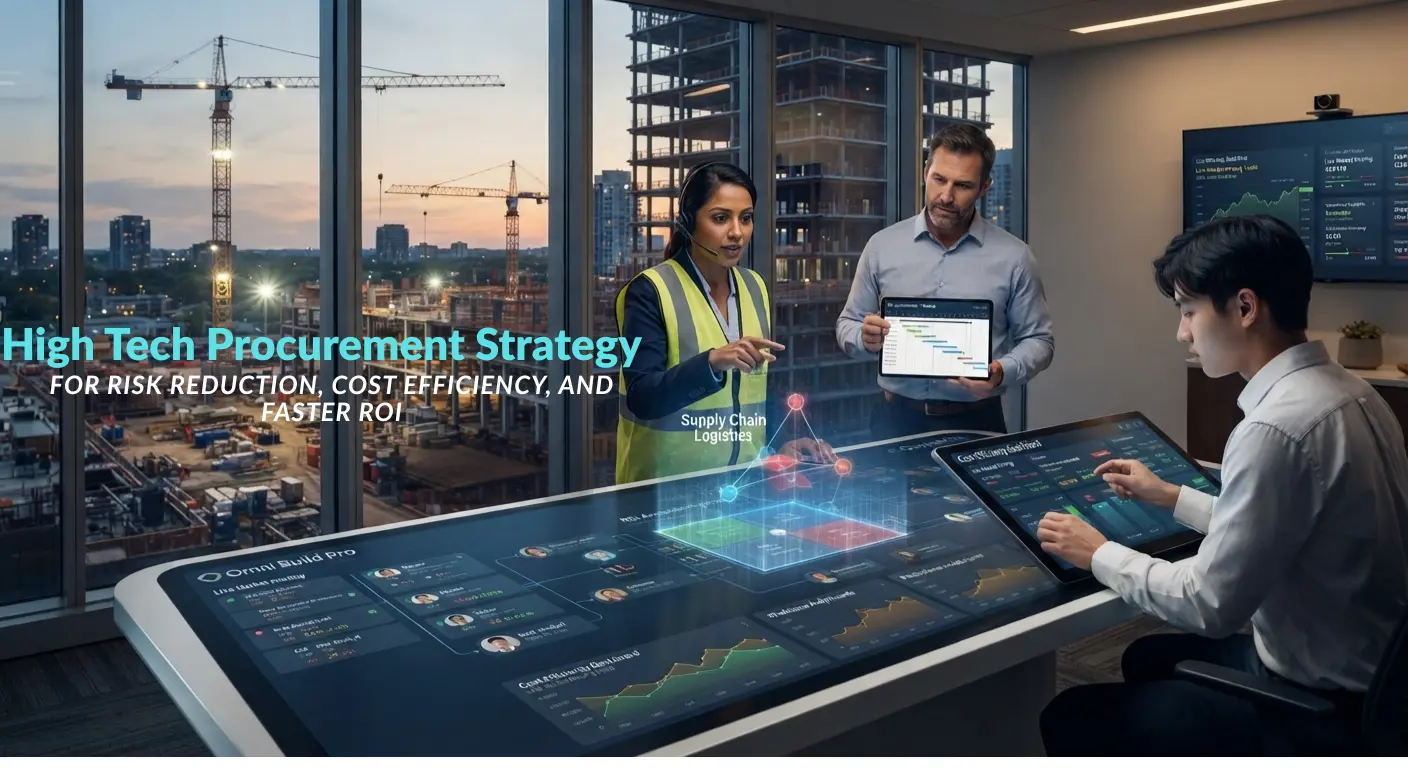

In construction, it is not only the workers of high skills or the sophisticated tools that are needed, but it starts way before the first brick is laid. Planning and procurement are the core of any good project. The two terms might be technical, but they determine whether a project completes within the deadline, works within the budget, and fulfills client expectations, or it turns into another headline of an expensive delay.
The McKinsey Global Institute report shows that 98 % of mega-projects experience overruns or delays in costs.
What is Planning and Procurement in Construction
Simply, construction planning entails laying out all the details, prior to the commencement of the work, in terms of timing and economy, as well as the determination of the materials, manpower, and equipment required. Procurement, on the contrary, is the act of obtaining those materials and services at the appropriate cost, quality, and time.
With these two functions coming together, they create a dynamic system that ensures the smooth running of a project.
Why Good Planning Saves Money and Time
All project managers aspire to complete a job within the project on time and within the budget, but only a few can do it without planning. Effective planning assists the construction firms in making accurate cost estimates, minimizing wastes and managing their resources. Procurement planning goes a notch higher by ensuring that all the purchases are made in line with the ultimate project timeline and objectives.
For example, long-lead supplies can be obtained in advance to avoid delay at the last moment.
The Global Construction Challenge
The world of construction is faced with the same challenges every day: increasing prices of materials, shortage of labor, fluctuating regulations, and unpredictable site circumstances. Then add to that global supply chain distractions, and even the well-planned projects may get into trouble. This is why Planning and Procurement are not back-office functions anymore; they are on the front-line strategies that characterize the project success.
Setting the Stage for Smarter Construction
At Omni Build Pro, we realize that the true strength of the project is not at the concrete base, but at the operational one. This is why our strategy to complete contracting services involves proper planning, open procurement, and overall coordination.
In the next sections, we will identify the specific steps, priority processes, and effective strategies.
Understanding the Procurement Planning Process
Before we talk about strategies and performance, it’s important to understand what the procurement planning process really involves. It is not only a process of purchasing materials in construction. It is a systematic method that determines how, when, and from whom a project will acquire the goods and services it requires.
Proper procurement planning is where smart budgeting and the perfect execution of the projects meet each other, and where successful construction project operations start.
What Procurement Planning Really Means
Procurement planning involves the process of determining what is required to be bought, when it is required and how to be acquired. Stated differently, it is the blueprint of sourcing materials, labor and equipment.
The primary objective of procurement planning is to make sure that all things will be delivered on time, at the appropriate cost, and of the appropriate quality level.
Why Procurement Must Align With Project Goals
Construction projects have tight deadlines and budgets. When procurement does not match the project schedule or cash flow, things easily collapse. This is the reason why it is necessary to synchronize procurement activities with project goals. The flow of resources is smooth when procurement schedules coincide with construction phases. Equally, alignment with the cost objectives keeps the project afloat.
A potent observation made by McKinsey & Co. is that procurement is 50-80 % of the total cost base of the company.
Ready to align planning and procurement?
Streamline your process with proven expert guidance.
Forecasting, Budgeting, and Scheduling: The Core Trio
All powerful procurement strategies are based on three pillars, namely forecasting, budgeting, and scheduling.
- Forecasting: The future material requirements on the basis of project design, scope, and timelines. This will prevent order crises or shortages of supplies.
- Budgeting: Establishing the cost boundaries of every procurement category with the help of spend analysis to make financial operations visible.
- Scheduling: Adapting delivery schedules to the requirements on the site. This ensures that the materials do not come too early (which leads to storage expenses) or too late (which leads to a work stoppage).
How Pre-planning Saves Rework and Wastes
Some causes of many construction delays do not relate to poor workmanship; they just occurred because something was not planned on time. Delays, incorrect material, or lack of approvals are normally subject to rework, and that translates to money and time wastage. Through early procurement planning, teams are able to recognize risks, seek back-ups, and have vendors ready when the project requires them. It is a proactive measure that makes the site fruitful and lucrative.
At Omni Build Pro, we guide clients to develop planned strategies of relating procurement decisions to project success. Our professional procurement solutions oversee forecasting, coordinating with suppliers, and also have an analysis of spending, so that no purchase is made that fails to advance the overall picture of the project.
The Key Stages of Planning and Procurement
Any successful construction project is guided by a systematic roadmap of planning the project from start to closing the contract. And among the most important steps at the very beginning of this roadmap is Strategic Sourcing & Market Research. At this point, the keyword Planning and Procurement comes alive.
Stage 1: Strategic Sourcing & Market Research
Strategic sourcing is not about identifying vendors: it is about identifying the right ones that can provide quality, competitive prices, and predictable deliveries. The supplier selection is a direct factor affecting the project in the construction industry, where every day of delay means thousands of dollars.
Supplier Analysis and Prequalification
Supplier analysis and prequalification are the initial parts of strategic sourcing. This will include verification of supplier credentials, certifications, and previous performance. An experienced supplier does not merely sell materials, but becomes a reliable partner in the success of your project.
As an illustration, here we consider a large hotel project that has several suppliers of FF&E (furniture, fixtures, and equipment). The project team does not pick a single large vendor; instead, it separates the orders among the prequalified suppliers according to quality and speed. This strategy identifies a reduction in the lead time of about 15 years, and therefore, rooms are prepared within the time frame, and budgets remain intact.
The Power of Supplier Selection and Evaluation
The selection of a supplier is not a box and tick decision, but rather a decision of risk management. The process includes:
- Assessment of the financial stability of suppliers.
- Checking the records of deliveries and quality certifications.
- Comparison of pricing and terms of contract.
- Evaluation of responsiveness and reliability of communication.
Omni Build Pro’s role in Strategic Procurement
We make supplier selection a science at Omni Build Pro. Our strategic procurement services for construction projects assist clients in identifying, screening, and collaborating with the best-performing vendors, besides enhancing efficiency, predictability, and cost improvement.

Stage 2: Supplier Selection, Evaluation & Risk Management
After the identification of potential suppliers through the strategic sourcing, the next process in the Planning and Procurement process is supplier selection and risk evaluation. This phase determines the actual provider of goods, materials, or services and whether he/she can deliver them without derailing the project schedule or budget.
The World Bank Infrastructure Procurement Report revealed that, in recognition of contract execution inefficiencies, 46 % of contracts experience delays in execution because of insufficient evaluation of suppliers.
How to Evaluate Suppliers, Smartly
It is not simply a matter of the lowest bidder when it comes to a supplier. The analysis should consider price, capability, quality, and reliability as a combination. Let’s break that down:
- Price: Is the supplier providing competitive pricing that conforms to the cost targets of the project, and can they continue with the same during the project?
- Capability: Are they equipped in terms of machinery, manpower, and systems to deliver on time?
- Quality: Do they have the needed standards and certifications in their materials and workmanship?
- Reliability: Are they able to perform consistently even when they are on a tight schedule or when the demand suddenly changes?
Supplier Risk Management Tools and KPIs.
Good risk management of a supplier is based on visibility, the capacity to anticipate, quantify, and take action before problems arise. The procurement teams in the modern world utilize online dashboards and analytics to monitor the performance of suppliers and identify early warning signals.
Some of the frequently used supplier monitoring KPIs are as follows:
- On-time delivery rate: percentage of deliveries that meet schedule requirements.
- Defect or rejection rate: quality problems/problems per batch or shipment.
- Financial stability score: credit and performance-based score.
- Response time: the speed at which a supplier responds to changes in orders or emergencies.
- Risk exposure index: a composite score of the possible effect on the progress of a project.
Such measures will ensure supplier management is proactive rather than reactive and will save more money and time in the end.
Mitigating Risk Before It Hits the Site
The most effective supplier may encounter the problems of a logistics delay, absence of raw material, and sudden labour strikes. This is the reason why mitigation of risks should begin during the selection level. A strong risk plan includes:
- Having alternative suppliers.
- Creating flexibility in contracts.
- By use of performance bonds or guarantees.
- Carrying out occasional audits and feedback.
The Proven Approach at Omni Build Pro
We do not just evaluate the vendors at Omni Build Pro; we develop long-term reliability. Our reliable procurement support for energy projects incorporates risk management that is data-driven, supplier scorecards, and continuous review of performance.

Stage 3: Contract Negotiation and Award
After proper evaluation and approval of the right suppliers, the second important step in Planning and Procurement is to negotiate contracts and award. It is at this stage that the strategy becomes an agreement, and all the clauses, terms, and price points begin to influence the financial performance of the project.
The McKinsey Construction Benchmark Report says the best-practice procurement can achieve direct savings of up to 12%.
Balancing Cost and Value
A powerful contract does not necessarily entail the lowest price. More important is Total Cost of Ownership (TCO), the total cost of a purchase in its life cycle.
That is not only the purchase price, but also transportation, maintenance, replacement, and warranty.
As an illustration, a supplier who could be slightly expensive in terms of the price of materials may still be a better option because they are faster, has higher quality of goods, or minimize future maintenance costs.
It is this type of value-based negotiation that applies sustainability and long-term savings. At Omni Build Pro, we balance around that aspect, making sure that all our agreements are just, open, and advantageous to both supplier and client.
The Role of Negotiation in Construction Procurement
Construction negotiation is not a single meeting, but it is a process.
It involves several stages:
- Scope alignment: Defining project expectations, project deliverables, and technical specifications.
- Price benchmarking: The comparison of the price with market data so that it is competitive.
- Risk-sharing: Risk-sharing is an assignment of tasks in the event of unexpected delays or quality problems.
- Performance guarantees: Establishing punishments or rewards, according to delivery and quality measures.
- Timeline agreement: Completing delivery schedules in line with construction milestones.
The Approach of Omni Build Pro to Smarter Contracting
We are convinced of open and informed negotiations at Omni Build Pro.
We use industry benchmarks, supplier analytics, and life cycle costing models to design contracts based on the actual market conditions and project requirements.
This guarantees that all projects enjoy the benefits of strategic contract negotiation and award practices that transcend price, providing value, accountability, and quantifiable savings.

Stage 4: Goods/Services Delivery and Inspection
Goods/services delivery and inspection is the actual step after the signing of the contracts, and the suppliers are on board. This phase transforms all the planning, negotiations, and sourcing activities into tangible on-site development.
But it is also here that even little coordination problems can cause large delays when not handled with accuracy.
Delivery Coordination: Timing is Everything
Timing is a very important factor in construction as well as cost. Deliver materials too soon, and the expense of storage increases. Deliver them late, and workers stand idle.
This is why it is necessary to match the delivery dates with the construction phases. At Omni Build Pro, we also ensure that each shipment is smoothed into the project plan. Our logistics teams liaise well with the managers of the sites and suppliers such that materials are received when required, not earlier, not later.
Scheduling of delivery assists in the management of inventory, material damage prevention, and stabilization of the project cash flow.
Inspection Procedures: The Quality Checkpoint
Inspection is the last safety gate to be passed through before the use of materials in the field. The inspection procedures would ensure that the goods and services are within the specifications, certifications, and quality standards agreed upon.
The organized inspection typically comprises:
- Checking amounts against purchase orders.
- Assessing quality and the state of materials on receipt.
- Authenticating supplier documentation (test certificates, warranties, compliance forms).
- Immediate reporting of defects or non-conformance.
Importance of Aligning Delivery Schedules with Construction Phase
The importance of inspections can be illustrated by the following real-life situation: One project of a commercial tower had all the deliveries of fixtures completed within the time frame, but the checking of the fixtures took a few days longer.
That minor failure meant a two-week delay in the schedule, since the inspected fixtures could not be installed until approval was received. This delay alone impacted several trades, electricians, carpenters, and finishing crews, indicating that each minute matters in the large construction projects.
Omni Build Pro’s Delivery and Inspection Expertise
We control each process of delivery and inspection at Omni Build Pro. Our FF&E and OS&E sourcing for construction projects to deliver materials on the ground, inspect, and approve without stopping.

Stage 5: Performance Evaluation and Spend Analysis
The final step in the Planning and Procurement journey is where the full circle is completed: performance evaluation and spend analysis.
Post-Procurement Review: Learning from Each Project
As soon as the delivery and installation of the project are over, you should consider the level of success of the procurement plan.
A post-procurement review is normally comprised of:
- Supplier performance: Have the vendors performed as they had agreed, within the right time and specifications?
- Budget performance: Did we accomplish cost targets, or was there an overrun?
- Efficiency of process: Did it have any approval bottlenecks, delays, or missed communications?
At Omni Build Pro, we provide systematic assessment of the evaluation of each significant procurement cycle.
Continuous Feedback and Vendor Scoring
Supplier evaluation is not only a way to detect errors, but also to create a better partnership.
And that is where vendor scoring comes in. The suppliers are rated based on the main performance factors, including accuracy of delivery, quality of materials, communication, responsiveness, and compliance.
These findings are saved in a database of suppliers, which generates long-term visibility and responsibility. A performance history enables Omni Build Pro to clearly realize high-performing vendors and engage them in new projects with ease, and clearly detect possible risks early.
The Power of Spend Analysis and Visibility
The second stage is the analysis of spending on the money that was used during the procurement lifecycle. It shows the precise location of funds, the areas that have taken the largest percentage of the budget, and the places in which the budget could be saved.
Spend visibility provides the project managers with a clear prognosis of procurement efficiency.
It identifies the tendencies, including the change orders regularity, purchases being duplicated, or suppliers unused and used sparingly, so as to be able to plan more smartly next time, and when the sustainability objectives are bound, spend analysis also monitors the compliance of suppliers against green procurement requirements or the usage of green materials.
This match between cost tracking and sustainability is not only a good practice in the current market, but also a good business.
Procurement Strategy and Planning in Construction
After understanding the process, it is time to consider how the procurement strategy and planning can take the construction performance to a higher level.
This step is solely about transforming process efficiency into strategic vision, where procurement is aligned not only to what has to be purchased, but also to what the project objective is.
Aligning Procurement with Project Objectives
The first step towards every successful construction project is alignment, in which the procurement objectives are aligned with the budget, sustainability, and schedule of the project.
The costs get out of control, materials are not brought on time, and sustainability goals are disregarded when procurement planning is done separately. However, when procurement is incorporated into the project strategy, all flows in a more efficient way.
An example is that early communication with the design and project teams can enable Omni Build Pro to identify in advance the type of materials that will influence the schedule and expenses.
In case a high-rise project involves complicated requirements in the form of a glass facade, it is possible to make those orders six months before, and save time and capital. This alignment will make sure that the project not only achieves its goals but also does so in an orderly fashion.ion
Smart Procurement Technology Integration
The construction procurement is no longer limited to the use of spreadsheets and phone calls. E-procurement and data dashboards have taken the game to a new level. They have concentrated databases of suppliers, automated bid comparisons, and provided real-time delivery and cost variation.
We apply technology in Omni Build Pro to make all the processes, including the evaluation of suppliers as well as monitoring performance, faster and easier.
Dashboards give immediate information on the purchase orders, logistics, and supplier reliaSuch transparency will minimize miscommunication, accelerate the decision-making process, and minimize procurement errors before they can affect the site.he site.
Reducing Risk By Strategic Planning
A good procurement strategy is actually put to the test in risk management.
The KPMG Construction Outlook 2023 says that 66 % of the contractors stated that their projects had been delayed because of disruptions in the supply chain.
The appropriate planning prevents such pitfalls through diversifying sources of suppliers, forming backup contracts, and predictive analytics to avoid disruptions.
We provides the ability to keep projects on track by creating visibility of the supply, and flexibility of sourcing, even when outside forces change. The uncertainty is transformed into resilience through strategic planning.
Omni Build Pro’s Strategic Edge
Omni Build Pro does not merely operate procurement, but designs it to support the vision of the project. To hospitality and commercial developers, our end-to-end FF&E and OS&E solutions for hotel projects make this strategy come true, integrating design with the precision of procurement.
Simply put, strategy is not a luxury in construction procurement; it is the sole method of building with certainty.

Procurement Plan Example
To get an idea of how a well-organized procurement strategy can be applied to real life, we will consider a Procurement Plan Example of a business hotel, mid-size construction project, 250 rooms plus with built-in retail and workspace units.
Such a project implies having a number of vendors, complicated FF&E coordination, and strict schedule deadlines, the ideal environment to practice smart procurement planning.
Cost Control and Budget Allocation
The initial phase is that of clarity, and it entails knowing what actually must be bought and how it should be priced.
In the case of our hotel, the overall procurement budget will be divided into such categories as structural materials, MEP (mechanical, electrical, plumbing) systems, FF&E, and OS&E.
The project team can control costs on a real-time basis by locking supplier rates early and through a digital spend tracker. This visibility will ensure that there is no overspending, and each department remains accountable. We regularly apply cost dashboards at Omni Build Pro, which automatically update when purchase orders are issued, making procurement a controlled and predictable process.
Vendor Evaluation and Selection Sheet
This is followed by supplier qualification.
Every vendor is considered in terms of capability, quality record, lead time, and project performance.
A supplier evaluation sheet lists the suppliers by a scoring system, which assists the decision-makers in not only selecting the lowest supplier, but also the one that is trustworthy. As an example, the suppliers of FF&E can have a high rating on quality and a medium rating regarding delivery speed. These are balanced by the procurement team before awarding a contract to make sure that the workflow is not disrupted by a contract.
Delivery Milestones and Scheduling
The timeline of procurement should be synchronized with the construction program to be successful.
In caIn case the materials are received earlier than expected, they will occupy the storage space; if they are received late, then the construction will be stalled. This is why every material package has a delivery milestone that is associated with the corresponding site phase.
The coordination of procurement and construction timelines reduced idle expenses by 8 % and enhanced the total speed of delivery.
RiskCheckList and Performance Metrics
Any procurement strategy should have a risk checklist that covers potential problems such as delay in shipments, insolvency of suppliers, or fluctuations in prices.
We go the extra mile by applying performance measures on every vendor contract, tracking KPIs, including delivery accuracy, defect rate, and responsiveness. This makes the suppliers accountable and in line with the projects.
This is why the office and workspace procurement management solutions are developed with the same discipline. That ensures that any project, be it large or small, assists in planning the projects, sourcing is reliable, and the project runs smoothly.
Conclusion:
Even the best of plans in building may fail without appropriate planning and procurement of the plans. An effective plan will ensure that budgets are maintained, that schedules are adhered to, and materials flow smoothly through suppliers to the site. It is the disparity of disorder and order, and that is where experience counts.
Omni Build Pro has perfected the procurement of complex and high-value projects in the commercial, hospitality, and infrastructure industries. Our teams have a strategic vision with practical coordination to provide cost-efficiency, quality assurance, and reliable schedules each and every time.
From concept to completion, our entire contracting services guarantee that each project is constructed on a platform of accuracy, performance, and trust, precisely what is required by modern construction.
Frequently Asked Question:
What is procurement planning in construction?
Procurement planning defines how materials, equipment, and services are sourced and delivered on time and within budget. It ensures all procurement aligns with project objectives.
How does strategic sourcing reduce construction costs?
Strategic sourcing consolidates purchases, leverages supplier competition, and improves material quality, reducing total project costs by 5–10%.
What should a procurement plan example include?
A complete procurement plan includes supplier lists, contract types, delivery schedules, risk analysis, and cost breakdowns.
How do you manage supplier risk for construction projects?
Through supplier vetting, performance scoring, contract clauses, and diversification of sources.
Why use Total Cost of Ownership (TCO) in construction procurement?
Because TCO considers not just purchase price but long-term maintenance and lifecycle costs, ensuring sustainable value.