
When constructing, even a small approval delay may become a huge leak in costs. Teams wait for sign-offs. Materials get ordered late. Invoices pile up. The project gets behind schedule and takes the budget along before anyone realizes it. The majority of these overruns occur due to a lack of clear visibility of the money flow, that is, the request for payment. That is where a structured procure-to-pay workflow is involved. It links all the spending stages, and thus, teams will be aware of what is approved, what is purchased, and what is paid in real-time.
The Real Problem: Manual Chaos and Hidden Costs
Some of the construction companies still rely on paper trails or distributed spreadsheets.
Manual approvals hamper progress. A missing signature implies that a supplier does not receive payment, or even worse, the wrong supplier receives payment.
These loopholes not only waste time, but they also distort the true cost image. In the absence of data that is held together, project managers are not able to determine what portion of the budget is committed, waiting or has already been overspent. This is how cost mismanagement creeps in silently.
Enter the Modern P2P Process
The P2P of construction projects is the entire process that involves raising a purchase requisition till the final payments of the supplier. In layman’s terms, it entails the steps of the procurement cycle (requisition – PO – receipt – invoice – payment).
This process will come to the forefront of financial control by 2025. Major construction companies are now digitizing their procurement process from requisition to payment, and this has made the process of approval much quicker and spending more accountable.
Why the Shift Matters Now
Grand View Research shows that the worldwide Procure-to-Pay (P2P) solutions market is set to reach USD 14.07 billion in 2033 with a 6.8% CAGR. This demonstrates the rapid pace with which the industry is adopting automation and smarter control.
When your company considers going digital with procurement on construction, the P2P cycle is the initial point that will make your budgets cleaner and build easier.
Understanding the Workflow Procure-to-Pay Process in Construction
In construction, hundreds of purchases are made daily, whether it is steel bars or safety gloves. In the absence of a systematic process, even a single delayed approval or invoice will destroy schedules and budgets. This is why the majority of the modern companies are now adopting a Workflow Procure to Pay Process that links all the spending steps into one traceable chain.
This is not paperwork on the run. It is a rigorous cycle which determines how requests are raised, approved, fulfilled and eventually paid fully with full view at each stage.
Struggling with a slow procure-to-pay process?
Let us streamline your purchasing and payments.
The 5 Key Procurement Cycle Steps
The procedure of the procurement cycle in the construction projects follows a clear pattern:
1. Purchase Requisition in Construction
Each project begins with the need, cement, fixtures, tiles or technical services.
A site engineer or project manager submits a purchase requisition at this step in construction. It is a formal request that states what is required, the quantity, and at what time.
This form can be pre-filled and automatically sent to the department that is supposed to approve the digital systems. This removes confusion and prevents unnecessary purchases prior to their commencement.
Example:
One of the site supervisors realizes that the rebar is running low. They enter the P2P portal and place a requisition. The project manager goes over it, verifies the budget line, and presses the approve button. The system automatically shifts to the next step.
2. Purchase Order (PO) Process Contractor
After approval, the system creates a purchase order (PO), which is an official document that determines the price, quantity, and delivery conditions.
The contractor purchase order (PO) process is a method of ensuring that both buyer and supplier are in agreement with the item being purchased.
Digital POs avoid errors in version and are easier to track. They are even able to extract data directly from the requisition to decrease manual data input. Contractors are able to inquire about the PO number at any time to determine whether it has been approved or shipped.
3. Goods Receipt / Service delivery
Goods receipt/service delivery in construction procurement follows after the delivery of materials on-site or the delivery of services.
This proves that what is ordered has been received in good condition. In manual systems, this tends to involve the pursuit of paper slips. With a digital procure-to-pay, the goods receipt is recorded in real time, usually with photo evidence or QR code reading. This provides an immediate inventory and financial account record.
Example:
One hundred bags of cement are delivered by a truck. The team on site confirms the quantity and quality, and also uploads a confirmation photo, and the PO is declared as received. The information is automatically updated on the central dashboard.
4. Invoice Processing and Accounts Payable
The invoice is sent by the supplier after the receipt of the goods. The system matches it against the PO and goods receipt, a “three-way match.”
Construction autopilot invoice processing and accounts payable help to eliminate paying twice and decrease disputes.
Without going through spreadsheets, finance teams can review the pending invoices, compare them to deliveries, and pay them off.
5. Payment & Record Keeping
Upon verification, the last payment is made according to the terms of a contract. With every step, there is a digital footprint with a timestamp, evidence that spending is policy-compliant.
The modern platforms also connect the payments and pay roll and project cost codes to enhance traceability. This will make sure that none of the payments slips out of the budget approval process.
Why a Structured P2P Workflow is important
The greatest advantage of the digital Workflow Procure to Pay Process is accountability.
All approvals are time-stamped, all receipts are recorded, and all invoices are triangulated so that there is no chance of having guesswork budgets.
In a building, where the cost might run out of control when a single approval is not done, digital solutions can be used to standardize and allow the teams to control the amount of money spent. They also enable the management to monitor the performance of suppliers, prevent delays, and make future budgets more precise.
Once the workflow is visible, all people, including the site engineer and the finance controller, will see the same information. This is the clarity that ensures the construction projects run on time and on budget.
Why a Procure-to-Pay Workflow Matters for Construction Projects in 2026
This is a different form of challenge in construction projects in 2025, not only in supply chain delays or the escalated costs of materials, but there are latent inefficiencies within the old procurement systems.
Manual spreadsheets, invoices that are not paid on time and missing supplier records have become budget black holes. One late approval may postpone a whole delivery, which will guide the project to run beyond schedule and exceed the budget.
This is why progressive constructors are embracing an automated procure-to-pay workflow, not as a tech enhancement, but as a source of cost management, precision, and responsibility.
The Cost of Staying Manual
Whenever a paper requisition is lost or an invoice is misplaced, the project budget loses some money.
The manual system makes it difficult to trace the flow of funds until it is too late. Project managers usually use guesswork, whereby reports are received at the end of the month rather than having real-time information.
P2P is different in construction projects through automation. All purchases, approvals and payments are made on a single digital channel.
This means fewer email chains, faster approvals, and fewer “where’s that PO?” phone calls from site teams.
4 Key Benefits of P2P Automation in Construction

1. Real-Time Spend Visibility
Transparency is the greatest game changer. In the construction projects with the spend visibility and budget control, the managers can immediately see what is committed, pending or spent.
Clients of Omni Build Pro frequently note that after they digitize approvals, they are able to identify budget risks prior to them appearing on the ledger, not weeks later.

2. Centralised Vendor and Supplier Data
Days of having to manage ten spreadsheets of supplier information are long gone. All the vendor profiles, contracts and performance data are all in one location with the automated vendor/supplier management for builders.
A study by the 2024 Corex Corp revealed that 87% of companies are currently utilizing e-procurement tools to handle sourcing and vendor information. The message is obvious: the construction industry is rapidly falling behind.

3. Fewer Delays in Invoice Processing
A delay in payment is the surest way to bring a project to a standstill. The builders can minimise the number of bottlenecks by automating invoice matching and approvals.
Digitized invoice matching will guarantee that all payments are in correspondence with an approved PO and receipt of goods, no confusion, no duplicate invoices.
This productivity also enhances confidence among the suppliers, which minimizes conflicts and fines.

4. Payroll and Inventory Integration
The contemporary P2P construction project systems do not merely deal with purchases. They are also combined with inventory and payroll modules to maintain financial information throughout departments.
This implies that in case a project requisition is authorized, it will automatically maintain material inventory and cost allocations in real time.
Such integration eradicates the problem of double entry and enhances the accuracy of data in all respects.
A Growing Market for Digital Procurement
Fortune Business Insights also states that the world construction software market will hit USD 21.04 billion in 2032, indicating the pace with which the industry is going digital.
If you are considering modernizing procurement, you can find our guide on digital procurement solutions in construction, which is a handy step ahead of the builders who need to streamline their budgets and increase accountability on-site.
Common Challenges in Construction Procurement (and How P2P Solves Them)
Construction procurement can be chaotic even with experienced project managers and strict budgets. On-site teams make approvals in a hurry. Vendors wait for payments. Finance departments juggle scattered invoices. In the middle of it all, precious time and money go down the drain.
Corex Corp (2024) estimates that on a daily basis, procurement professionals waste 2 hours and 45 minutes on sourcing activities, the majority of which is spent navigating manual systems and fragmented approvals.
That is almost a third of the working time wasted in inefficiency.
This is where a digital procure-to-pay process comes in to fill the gap. We will outline the most common challenges and illustrate how each of them is addressed in the quietest way by means of P2P technology.
Manual Data Entry Errors
Spreadsheets are good until they are not. A single-digit mistake in construction that keeps a management of hundreds of items per day can bring down a whole purchase order.
Manual entry wastes time and also leads to duplicate invoices, inconsistency in pricing and wrong budget calculations.
Automated P2P in construction projects eradicates all these risks by aligning requisitions, POs and invoices into a single digital record. When the systems are fed with/controlled by repetitive entries, the error margin reduces significantly.
Teams do not need to type decisions; they can make decisions. Our clients at Omni Build Pro have reported that almost half of the administrative hours were reduced after going digital in procurement processes, which is evidence that accuracy is more important than time; it is more important than trust.
Delayed Approvals
A late approval may seem like a domino effect on the ground. The crew is unable to work, since there were no materials to work with, and materials can not be delivered, because the requisition has not come to three desks and two emails.
With the automation of the construction site procurement approvals, real-time workflows are experienced. Every request is automatically redirected to the correct manager, instant notifications are sent, and whoever is next in line is tracked.
It does not matter whether it is a project engineer who approves something using a mobile device or a finance manager who is watching projects remotely; the process will become smooth and transparent.
In fast-paced projects, this comes as a game-changer. Approvals, which used to take days, are now just hours old.
Fragmented Invoice Systems
Still, at several companies, invoice management takes place in various folders, emails, and PDFs. The result? Cancellation, wasted payments, and the frustration of suppliers.
Current invoice processing and accounts payable in construction make all invoices centralized.
It automatically compares them to POs and goods receipts, a three-way match to confirm accuracy and then payment is made.
This not only accelerates the processing but also gives complete visibility on the pending liabilities and due dates. Finance teams no longer waste hours tracking down missing paperwork. Everything is linked, visible, and auditable in seconds.
Poor Contract Tracking
Construction projects are based on dozens of supplier agreements and service contracts. Forgetting one of the clauses or the expiration date may result in expensive fines or non-adherence.
Automated contract compliance in construction procurement ensures that all the contracts exist within the P2P system and are accessible as time-stamped and searchable by the teams authorized to access them. There are alerts that remind managers about deadlines or renewals, which ensures compliance is stringent and accountability is high.
This centralization also helps in making audits a quick and simple process, as all the records are digitally checked.
From Chaos to Coordination
All these pain points, data entry, approvals, invoices, and compliance are united by one factor: fragmentation.
A procure-to-pay workflow brings them all to a single roof, and the tasks that were previously disconnected are now joined together to form a seamless and automated process. Automation is no longer a choice, but the sole means of survival for firms in the construction sector that are attempting to strike a balance between time, cost and quality.
To understand how these process optimizations are applied within the larger scope of the project planning, consider our insights on modern construction management, where accountability, visibility, and automation come together to keep every project on track.
How the Procure-to-Pay Workflow Keeps Projects on Budget
Any construction manager is well acquainted with that feeling, the figures seem okay on paper until a month-end report tells otherwise. Margins are silently eroded by hidden expenses, time-consuming approvals, or lost invoices.
It is not about having more spreadsheets; it is a procure-to-pay workflow that links project spending with real-time control.
Automation does not simply make things easier; it provides a definite connection between all the approvals, all the deliveries, and all the rupees utilized. This is how construction companies avoid overruns of their budgets prior to setting them.
Automation: The silent budget
With automated procurement, there is no request that can be processed outside the chain of approval.
This implies no unauthorized expenditure, no bogus invoices and no lost receipts in someone’s inbox.
Under a digital P2P construction project system, every purchase requisition, PO, goods receipt and invoice is subjected to pre-established checks. The approvers are able to view precisely what is pending, what is committed and what has been paid in real time.
Such visibility assists project managers in moving in time before costs start increasing. Budgets that operate in synchronization with procurement information have no surprises in the latter half of the accounting year.
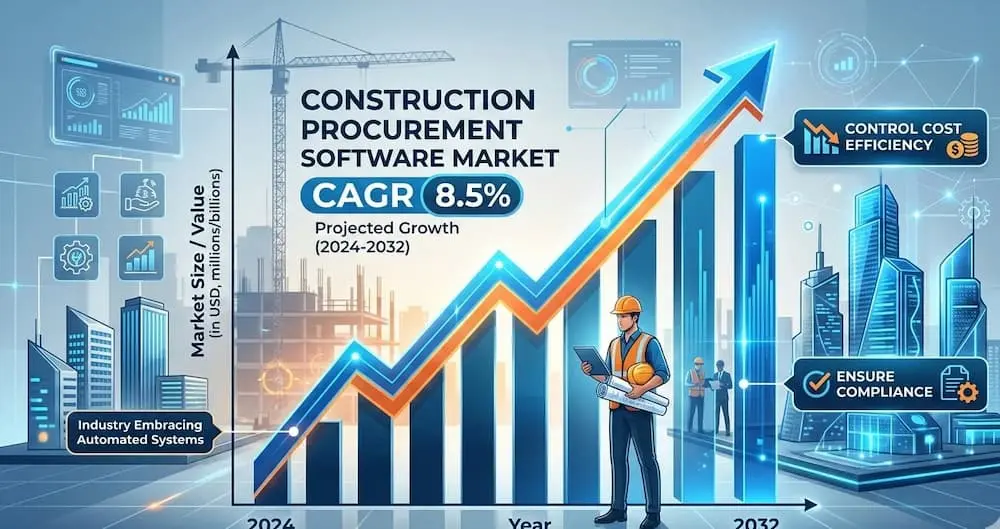
A recent Global Market Insights report revealed how fast the industry is embracing automated systems to control cost efficiency and compliance by indicating that the Construction Procurement Software Market is expected to increase at a rate of 8.5% CAGR between 2024 and 2032.
Connecting Procurement, Payroll and Inventory
Budget control is not only about following up on the cost, but also about incorporating systems.
When selecting platforms that combine P2P and payroll/inventory, construction companies equate their financial base with on-site work.
The following is how this is done practically:
- When a requisition gets approved, it instantly updates the inventory.
- Payroll and accounts payable reflect expenses in real-time.
- Forecasting tools revise cash flow projections on the basis of material and labor consumption taking place.
This removes the old divide between what is captured in procurement and what is reported in finance. The result? Real-time view of the budget throughout the project life.
KPIs That Keep Projects Financially Grounded
Smart constructors do not simply automate; they measure.
Monitoring the key performance indicators (KPIs) has the benefit of enabling teams to measure the value of automation and data-driven decision-making.
The following are some of the key KPIs of a procure-to-pay workflow:
- Average Approval Time: How long does it take from requisition to PO approval?
- Invoice Cycle Time: How quickly are invoices processed and paid?
- Supplier Lead Time: How efficiently are vendors fulfilling orders?
- Budget Variance: How closely does actual spending align with the approved budget?
- Compliance Rate: Percentage of purchases made through approved suppliers and contracts.
Omni Build Pro frequently applies these measures to assist customers in detecting the bottlenecks in processes, tightening its spending, and ensuring predictable cash flows at the sites of various construction projects.
Avoiding Cost Overruns: The P2P Best Practices
Cost creep, even with well-managed projects, may occur when the procurement data is dispersed or old-fashioned.
The necessity to follow budget overruns and P2P best practices will also make sure that all information on cost flows through a single system.
This involves standard approval lanes, scoring of vendors and audit-ready documentation.
With in-built dashboards, project teams would be able to immediately identify suspicious spending or slow invoices. And that is why, automated procurement cycle steps (requisition – PO – receipt – invoice – payment) can be directly converted into budget efficiency.
At the same time, Corex Corp claims that 40 per cent of firms report increased sourcing expenses in the absence of digitalization, which is a proper sign that manual operations come with a quantifiable cost.
From Oversight to Insight
A properly-organized P2P process not only saves money, but it also changes the way construction businesses plan, spend and scale.
When decisions are made based on data, project managers will be able to predict the needs, avoid shortages and maintain compliance without being overwhelmed by paperwork.
To budget a large-scale site, particularly in public works or any other complex infrastructure construction, consider our expertise in procurement for energy and infrastructure projects, where automation satisfies accountability to drive cost-sensitive construction.
Real-World Example: Site-Level P2P in Action
Any construction project has its daily beat, orders being made, requests being made, and invoices being pursued. However, where there are two or more sites running simultaneously, mayhem can creep in.
A single late authorization or lost invoice at Site A will mess up the deliveries at Site B. Times that by 5 sites, and you have a bad budgeting headache that no one will want to get.
This is precisely what happened to one medium-sized construction company that decided to go to a digital cloud-based P2P solution that is powered by Omni Build Pro.
The Challenge: Too Many Sites, Too Little Control
The firm was operating four live housing projects in two cities. The purchase requisitions and vendor payments were done manually in each of the sites.
Forms were sent by email, WhatsApp messages, and office messengers. It could take days, at times weeks, and the finance department would get invoices for materials they had not even approved.
The result?
- Lost requisitions and duplicated orders.
- Dubious purchases that had bloated project budgets.
- Slow payment of suppliers is leading to poor relations with the vendors.
The Solution: Connecting Every Site Through a Single Workflow
Omni Build Pro launched a single and digital construction procurement platform, which is geared towards multi-site coordination.
The purchase requisitions were raised online by each site team, tagged to particular project codes and budget lines.
After being submitted, the requests were forwarded immediately to central procurement to be looked at. Status updates could be monitored by site managers in real time without the need to call or send email messages.
The P2P solution is a cloud-based solution that automatically:
- Matched requisitions to approved purchase orders.
- Synced delivery confirmations from site teams
- Flagged any order exceeding pre-set budget limits
- Sent alerts for pending approvals and due payments
This implied that the head office would never be left guessing the actual level of commitment, receipts, and payments per site without having to wait until the reconciliation of the monthly claims.
The Results: Real-Time Control and Proven Savings
In half a year, the company recorded:
- The approval time is 35% quicker, reducing the time spent on delivering materials.
- 28% lessening in unapproved purchases, which was the result of automated approval routing.
- Complete accessibility of vendor transactions and project budgets.
- Better audit trails whereby digital records are used instead of paper logs.
Inbuilt digital bookkeeping tools allowed the finance teams to make reports at any time, and every rupee could be traced between the time it was requisitioned and when it was paid.
It was best put by one of the project managers:
“Prior to automation, we would lose the information about who authorized what. And now, all that happens at a much faster speed and our budgets are actually matched to what is taking place on-site.”
Scaling Up the Smart Way
After the pilot’s success, the company increased its workflow to include new construction procurement involving residential and housing developments, making sure that all future locations were subject to the same transparent work.
Combining the system with payroll and inventory, they created a procurement backbone strong enough to serve a number of projects and flexible enough to expand.
Conclusion Building Budget Confidence with P2P Automation
Construction projects do not wander off budget overnight; they slide. One approval slips through, one invoice is misplaced, and then in a short time, the whole forecast is already slipping. However, when teams adopt automation by providing a Systematic Procure to Pay Workflow, such gaps are finally bridged.
With the digitalization of all processes, including purchase requisition in construction and final payment firms, not only can they see their spending in real-time, but they can also assume complete responsibility. All material orders, receipt of services, and invoices are processed via a single path through which audit can be done transparently.
Why Automation Builds Trust and Control
In today’s fast-moving construction landscape, cost control isn’t just about saving money; it’s about building predictability.
A P2P for construction projects empowers teams to;
- Monitor budgets in real-time, and not prospectively.
- Eliminate manual data errors and approval bottlenecks.
- Strengthening customer ties with vendors through quality and punctual payments.
- Make sure that all contracts and cost codes are complied with.
With centralized and automated spend data, project managers are able to anticipate costs, finance departments can plan, and leadership will have a full picture before overruns occur, not after.
Omni Build Pro’s Expertise in Digital Procurement Transformation
We have assisted contractors, developers and builders at Omni Build Pro to simplify procurement using precision that is driven by cloud technologies.
Our systems are structured in such a way that they make workflow user-friendly, combine with payroll and inventory applications, and deliver paperless efficiency towards even the busiest construction sites.
We realize visibility is not an indulgence, but it is the basis of financial success. That is why our online procurement of construction solutions is based on quantifiable savings, expedited approvals, and unparalleled precision.
Your Next Move: Build with Confidence
A Procure to Pay Workflow is not a matter of automation; it is a matter of making sure that every dollar outlay of the company brings tangible benefits. Omni Build Pro will provide all your projects with smarter control, cleaner audit and trusted vendor responsibility at the very beginning.
Ready to take control of your project spending? Discover our expert FFE and OSE procurement processes, which are optimal for some of the detailed project types, such as restaurants, commercial kitchens, and other complicated construction projects that require precision and effectiveness.
With an established Procure to Pay Workflow, one will not struggle to remain on budget; it will be a given.
Frequently Asked Questions
What is a procure-to-pay (P2P) workflow, and how does it differ from traditional procurement?
A procure-to-pay (P2P) workflow is a managed system that links all the steps of buying – purchase requisition through purchase order (PO) through goods receipt through invoice to payment. The steps in traditional procurement can be quite slow, involve errors in data and misinterpretation of the budget, as such processes can be performed manually via emails or paper-based records.
How does a P2P workflow help keep construction projects on budget?
A P2P in construction projects provides teams with control, on a real-time basis, over all expenses. It follows through on approved requisitions, payments to vendors and invoices within a single system, hence no secret or duplicate costs. Automation offers construction projects visibility of spending and budget control that helps managers to realize when their businesses are spending over their budget.
What are the common mistakes when implementing a P2P workflow in construction, and how can they be avoided?
Mistakes that are most frequent are:
- Incomplete records of site-level data.
- The dependency on manual workflow over automated workflow.
- Separate invoicing, vendor and budgeting systems.
Is cloud-based P2P suitable for construction companies, and how secure is it?
Absolutely. A cloud P2P solution provides central visibility in different locations, which is ideal when a contractor has to deal with a large project or one that is distributed. On their part, security-wise, these platforms are encrypted to transfer data, implement access controls, and maintain audit logs to protect sensitive financial data.
What should construction firms look for when choosing a P2P solution?
Look for a system that is both automated and industry-specific. The best solutions include:
- Vendor/supplier management by builders is being centralized.
- Introduction of intelligence in KPI monitoring (approval times, supplier lead time, compliance rates)
- Payroll and inventory integration.
- Forecasting and spending dashboards in real-time.