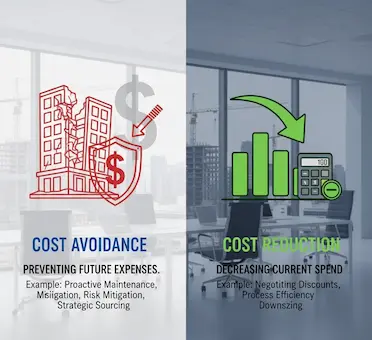
When it comes to construction projects, making smart financial decisions determines whether you save money or lose it silently over time.That is the point at which the Cost Avoidance vs Cost Reduction argument commences.These two terms are almost synonymous, yet they operate in entirely different ways in terms of budget management and profit margin enhancement.
Cost Avoidance involves avoiding costs in the future, before they are incurred, and Cost Reduction involves reducing costs.This difference is a key issue to be understood by any individual dealing with construction procurement or project management. It aids in better planning, smarter negotiating, and ensuring long-term project value by teams.
Be it the upgrading of materials, renegotiation of supplier terms, or the efficiency of workflow, the most important thing is to know when to use Cost Reduction or Cost Avoidance because that may be the only way to remain competitive in a cost-driven industry.
What is Cost Avoidance in Procurement?
The most intelligent method of saving money in procurement is to prevent unnecessary expenditure before it happens. That is precisely what cost avoidance consists of: the avoidance of future expenditures by taking proactive decisions, sourcing carefully, and planning. It is a long-term strategy that aims at maintaining the financial well-being of the projects instead of addressing the issues when they occur.
Prevent Future Costs Before They Arise
Cost avoidance, as it is essentially understood, involves making a decision today to prevent future costs that may hurt budgets in the future. In construction, this may imply selecting quality materials that have a longer lifespan, employing qualified contractors, or even ensuring that inspections are conducted at the right time to prevent equipment breakdowns. Every proactive decision ensures that the hidden costs in the form of repairs, replacement, or penalties do not creep into your project.
As an example, consider the use of less expensive concrete that cracks in a year. The expenses of repair, labor, and delays would be way more than the original savings. Cost avoidance eradicates such a cycle by making smarter decisions in the first place.
Proactive Cost Management in Action
Proactive cost management is the foundation of cost avoidance. It is the process of recognizing possible risks at an early stage and taking small, preventive measures that will equip one with the long-term benefits. This may include a better maintenance schedule, fixing supplier rates before the market inflation kicks in, or reengineering processes to minimise wastage.
A real-life example of this is great work by SpendHQ, where preventive maintenance controls enabled a company to save almost US $100,000 in equipment replacement costs, a classic example of cost avoidance through intelligent foresight.
Anticipate cost increases Do Not React to Them.
Markets change, fuel prices increase, and supply chains become stricter. Cost avoidance is already being practiced by the teams that anticipate cost increases by negotiating long-term contracts or sourcing locally. They do not respond to the increase in costs of firefighting but plan ahead.
Ready to cut costs the smart way?
Find out which strategy saves your project money.
What is Cost Reduction in Procurement?
Cost reduction refers to the evaluation of the current monetary expenditures and identification of plausible methods of spending less without compromising quality or performance. It might be as basic as renegotiation of supplier contracts to provide more favorable prices or better optimization of order quantities to prevent overstocking.
To take an example, the freight costs and time-delayed delivery are not only immediate savings but will quickly increase. Switching to locally sourced materials can result in a decrease in freight costs and delivery delays. These are reactive cost cuts that are brought about in reaction to perceived inefficiencies or financial limitations.
Reducing Existing Costs.
Although cost avoidance is aimed at eliminating future costs, cost reduction is entirely about taking actions today to cut current expenses. It is a practical, quantifiable strategy that focuses on the expenses already hitting your bottom line. This frequently occurs in procurement by means of renegotiating with vendors, efficient operations, and intelligent value engineering during design and material selection.
Finding measurable savings through process improvements
As compared to cost avoidance, where we are dealing with risks that are unseen or in the future, cost reduction provides measurable savings that are reflected in your present financial statements. It can be more easily measured, monitored, and accounted to the stakeholders.
According to Concord suggests, 8-15% savings can be achieved within the first year and 3-5% in the future through the introduction of the procurement cost reduction strategies, as continuous process improvements can yield impressive results, evidence that even a small change in the operations can produce significant outcomes.
Optimizing Procurement via Design and Strategy.
Design value engineering also flourishes in reducing costs by looking at materials, layout, and processes, and ensuring that performance is maintained at a reduced cost. In some cases, minor design modifications can reduce the cost of projects and do not affect the strength or safety. Firms that master procurement strategy in construction projects usually combine an element of cost avoidance and cost reduction to achieve maximization of ROI. Their combination is one that maintains lean budgets and projects that are robust as they balance both short-term savings and long-term stability.
Cost Avoidance vs Cost Reduction in Construction Procurement
There is only one truth about all construction projects: budgets never remain still. Amidst price fluctuations of materials, labor resources, and delivery deadlines, project managers always have to balance between short-term cost reduction and long-term strategy. That is where the Cost Avoidance vs Cost Reduction Procurement balance enters the picture.
At Omni Build Pro, we have witnessed how the knowledge of when and how these two approaches can be used to determine the budgets of projects and also the long-term performance and reliability. We can deconstruct the functionality of both strategies in contemporary construction procurement.
The Core Difference Understanding
Cost reduction helps to address the costs which are present nowadays, whereas cost avoidance helps to avoid the costs which may appear tomorrow. One is aimed at short-term salvation; the other at eventual sustainability. The best performing procurement teams understand when to apply each of them and, more so, how to mix them in a strategic manner.
The Strategic Value of Each Approach
Timing and intent are everything in high-value construction procurement.
Cost avoidance is a long-term approach as it places emphasis on proactive investments. Imagine that it is strengthening the foundation before the cracks show up. The selection of materials with long durability, improving energy-efficient systems, or predictive maintenance are all under this umbrella. These precautions not only prevent repair costs but also prevent replacement costs.
As a matter of fact, Gordian discovered that 81 percent of contractors who apply the JOC (Job Order Contracting) programs save time, and 68 percent spend less time to control projects, clear evidence that planned, long-term cost-avoiding initiatives cause both savings and efficiency.
Instead, cost reduction is concerned with cost impact and short-term savings. It’s reactive but essential. Immediate relief of financial burden and cash flow can be achieved by renegotiating the terms with the vendors, redesigning the material specifications, or consolidating the suppliers. Both are essential as one protects the future and the other nurtures the present.
The Way Omni Build Pro Strikes the Balance
At Omni Build Pro, we take a strategic cost control approach that integrates the two approaches into the procurement procedures. It is not only about spending less, but it is also about spending smartly to strike the balance between short-term savings and long-term wisdom.
In sourcing FFE and OSE materials, e.g., our smart sourcing process is based on the same logic of cost-avoidance: it is necessary to select suppliers and materials that reduce maintenance requirements and replacement periods with time. It is win-win, it has fewer surprises, clearer budgets, and greater project ROI.
The 1:5:200 Rule – Why Avoidance Tends to Win in the Long-term
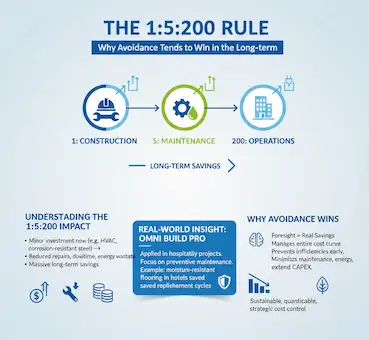
The savings in construction procurement are not always immediately apparent. The 1:5:200 rule is a very potent reminder of that fact. It claims that one dollar invested in the construction of a building will be invested in its maintenance about five times, and a mind-boggling 200 times in operations throughout the life of the building.
The first ratio to be introduced in industry research, which is cited on Wikipedia, quantifies the impact of early design and procurement choices over decades of operation. It emphasizes the situation of why cost avoidance, which avoids future costs as opposed to responding to them, tends to be the best ROI in the long term.
Understanding the 1:5:200 Impact
Consider it like this: a minor investment in a decision now, e.g., choosing a better HVAC system or a corrosion-resistant steel, can slightly increase the initial budget. However, in the long term of a building, such a choice can cut down on repair rates, downtime, and energy wastage. All these prevented expenses compounded into massive savings in operation.
That is where cost management in construction procurement extends beyond price negotiation and is more of a strategic lifecycle thinking. The prevention of inefficiencies in the sourcing stage will avoid huge costs in the future in terms of maintenance and normal everyday operations.
Real-World Insight: The Approach of Omni Build Pro
This rule has been realized at Omni Build Pro in a variety of industries, particularly with the hospitality projects, where wear and tear of the facilities is constant. Our sourcing groups have focused on preventive maintenance and thereby enabled our clients to save high lifecycle costs in the future, which perfectly fits the principle of 1:5:200.
During the renovation of a single hotel, for example, a relatively small expenditure on moisture-resistant flooring at the time of purchase saved several cycles of replenishment and renovation. That is making ROI smarter with long-term cost tracking and cost monitoring, not only reducing the numbers on a spreadsheet but also making sure that every spend has its purpose over the entire lifecycle of the building.
Why Avoidance Wins
The 1:5:200 rule leaves one thing clear: real savings are a result of foresight. Cost avoidance assists in managing the entire cost curve of a project, including construction and operations. It does not fight the issues as they come, but rather entraps efficiency on the very first day.
Monitoring the Impact of small procurement choices on the overall building performance allows the teams to minimize the maintenance budget, decrease the energy consumption, and extend every dollar of capital expenditure. Ultimately, preventing expenses before they happen not only makes sense but is also sustainable, quantifiable, and a testament to real strategic cost control.
Building a Balanced Procurement Strategy
In procurement, the most intelligent solution does not lie in Cost Avoidance vs Reduction, but rather in understanding when and how to use both. In construction works, all decisions, including the choice of suppliers and lifecycle planning, have an impact on the bottom line. This is why an effective procurement strategy relies on the combination of active planning and savings.
Omni Build Pro’s Cost Avoidance Measures
At Omni Build Pro, preventive maintenance, risk planning, and early involvement of the vendor are part of the cost avoidance procedures. Cost-cutting enters the scene via contract negotiation with vendors, minimization of waste, and streamlining of processes, all aimed at reducing existing costs without compromising quality.
Dual Strategy for Smarter Resource Allocation
Such a dual strategy enables smarter resource allocation in construction projects. Our supplier consolidation and business process optimization develop procurement systems that are cost-saving and maintain value over time. Consequently, our clients experience a stable increase in ROI and greater financial management of large-scale constructions.
The Importance of Proactive Procurement
Recent statistics by Constrafor indicate that ineffective procurement is a leading source of project delays and budget overruns, proving that proactive cost avoidance can stop cost escalation before it begins. That is precisely what our model does best: striking a balance between short-term successes and long-term strength.
Omni Build Pro has used this philosophy in various fields. As an illustration, our hospitality clients’ preventive maintenance planning projects saved 20% on unplanned repair, and our vendor negotiation projects on energy projects saved material costs by 12%.
If you’re managing complex builds or high-volume supply chains, now’s the time to choose smarter procurement. We specialize in procurement solutions for hotels that balance immediate cost reduction with long-term cost avoidance. Our end-to-end procurement solutions for offices focus on lifecycle value, not just upfront savings.
FAQs:
What is the difference between cost avoidance and cost reduction in construction procurement?
Cost avoidance concerns the avoidance of future costs prior to their occurrence, e.g., investing in preventive maintenance or selecting long-life cycle materials that minimise the replacement requirements.
Reduction of costs, on the other hand, seeks to reduce existing costs by means of vendor repurchase, bulk purchasing, or streamlining of processes. In brief, avoidance serves as a proactive measure, whereas reduction is a reactive action also imperative in a balanced procurement policy.
How can cost avoidance be measured in a construction project?
The cost avoidance may be quantified by monitoring the prevented cost of maintenance or replacement due to proactive decisions. As an illustration, SpendHQ cited an example where preventive maintenance had saved more than US $100,000 in costs of equipment replacement, a very tangible effect of cost avoidance in practice. Costs to avoid maintenance, energy efficiency, supplier quality, etc., assist in measuring the long-term effect of preventive measures.
When should a project manager choose cost reduction over cost avoidance?
Certainly, cost reduction is usually emphasized by project managers when the project is in its short term or is within the limits of a low budget, and urgent financial support or relief is required, such as renewing vendor contracts or maximizing labor utilization.
However, cost avoidance should be given priority in lifecycle-based construction, such as hotels, offices, or infrastructure. The precautions taken in the sourcing, design, and maintenance planning will result in reduced total ownership cost and only a few operational setbacks in the long run.
What are common procurement strategies for cost avoidance in FFE & OSE sourcing?
Cost avoidance of FFE and OSE sourcing is usually characterized by an active approach to the supplier, quality selection of the vendors, and prolonged performance assessment. These measures will eliminate expensive replacements and repairs, and design integrity will be preserved.
In Omni Build Pro, our smart sourcing FFE and OSE materials model employs the same preventive reasoning that focuses on durability, supplier dependability, and lifecycle worth as opposed to short-term cost reductions.
Can cost reduction efforts ever backfire and lead to higher long-term costs in construction projects?
Yes, when the reduction of costs is based on price rather than quality, it may cause costly issues in the future. This is best demonstrated by the 1:5:200 rule; every dollar invested in building may result in 5 dollars in fixing and 200 dollars in operation expenses throughout the building’s life.
The short-cutting of materials or preventative planning can save money in the present day, but will replicate costs later. Smart procurement refers to striking a balance between making sure that the current performance is not jeopardized by the current savings.